


























Views
Downloads

The Olympic Games History: Printable Grade 5-7 ELA Worksheet
Paste this activity's link or code into your existing LMS (Google Classroom, Canvas, Teams, Schoology, Moodle, etc.).
Students can open and work on the activity right away, with no student login required.
You'll still be able to track student progress and results from your teacher account.
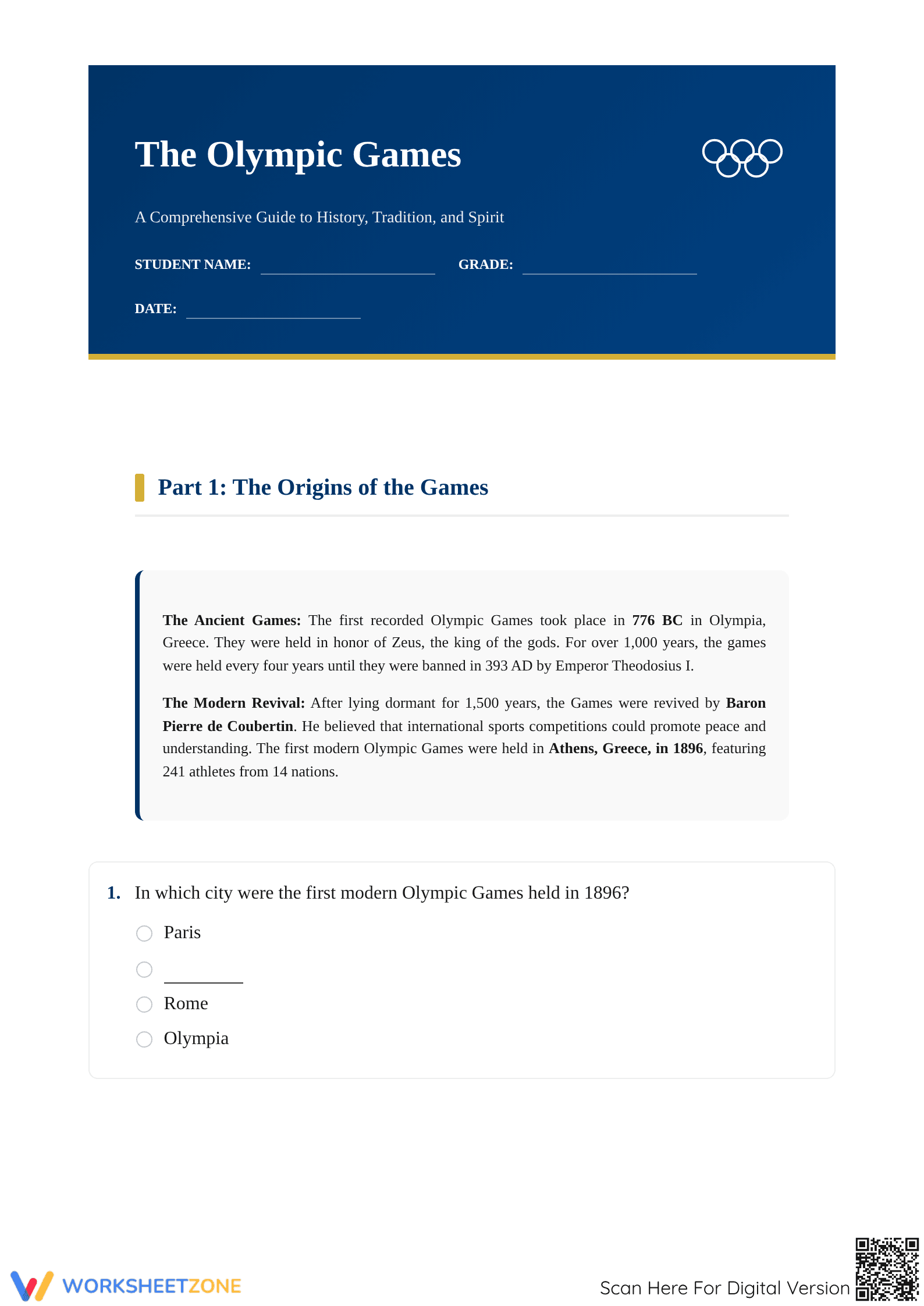
Students explore the rich history and enduring spirit of the Olympic Games with this comprehensive reading comprehension worksheet. Designed for grades 5-7, this resource guides learners through ancient origins, modern revivals, and the expansion of the games into the Winter and Paralympic movements. It ensures students can cite textual evidence while building cultural literacy.
At a Glance
- Grade: 5–7 · Subject: ELA / Social Studies
- Standard:
CCSS.ELA-LITERACY.RI.5.1— Quote accurately from a text when explaining what the text says explicitly- Skill Focus: Informational Text Analysis
- Format: 4 pages · 12 problems · Answer key included · PDF
- Best For: Independent reading or Social Studies units
- Time: 30–45 minutes
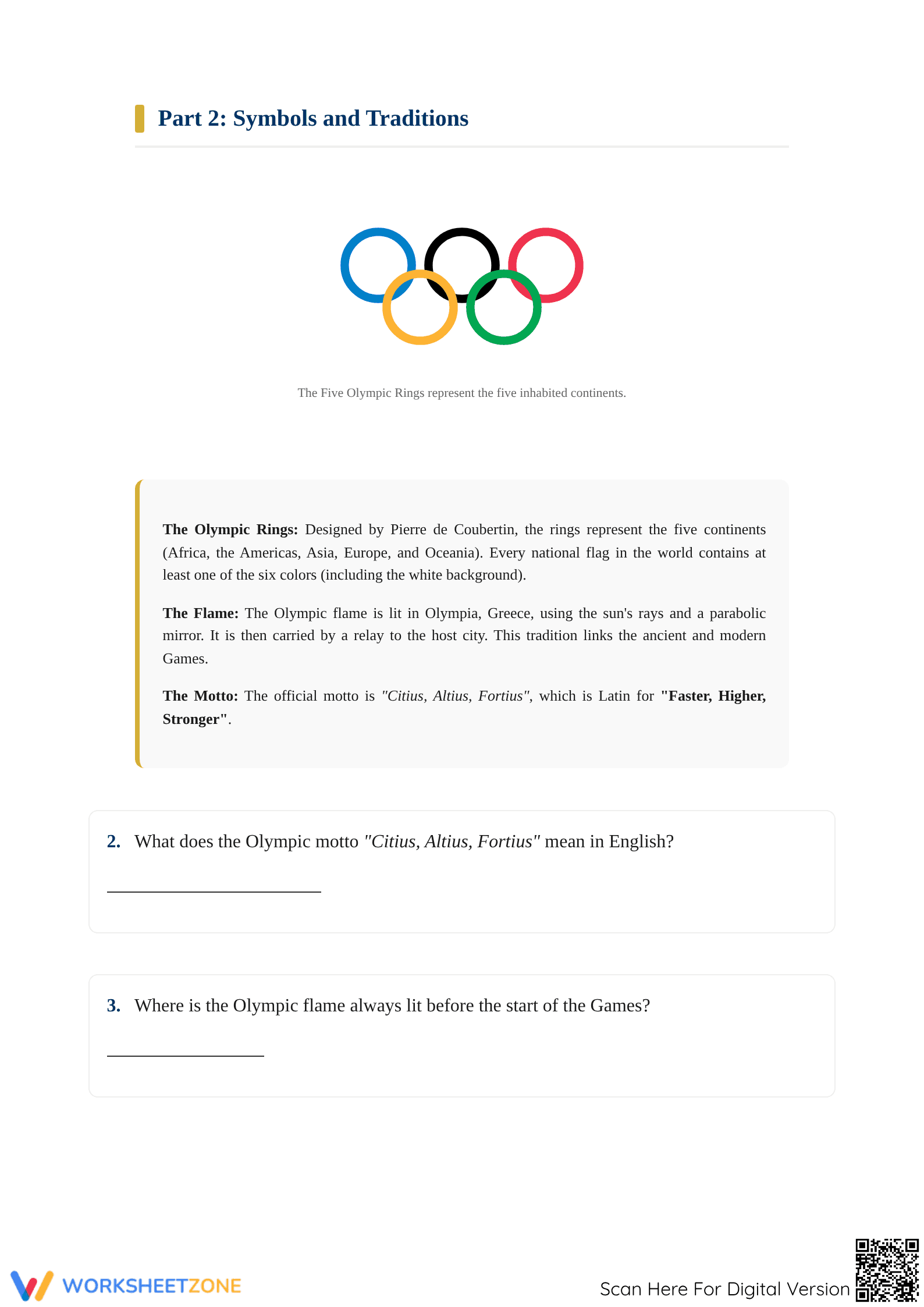
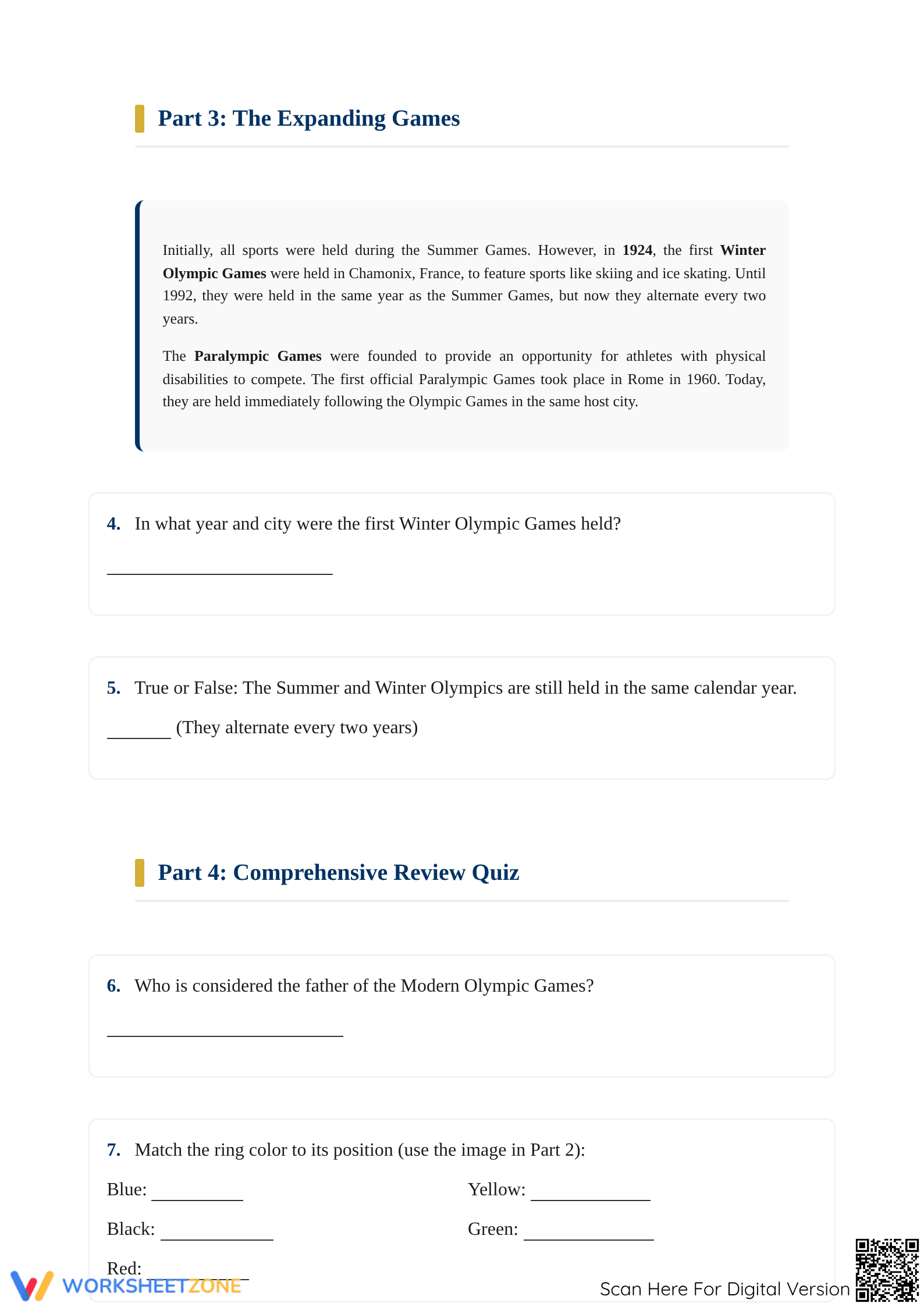
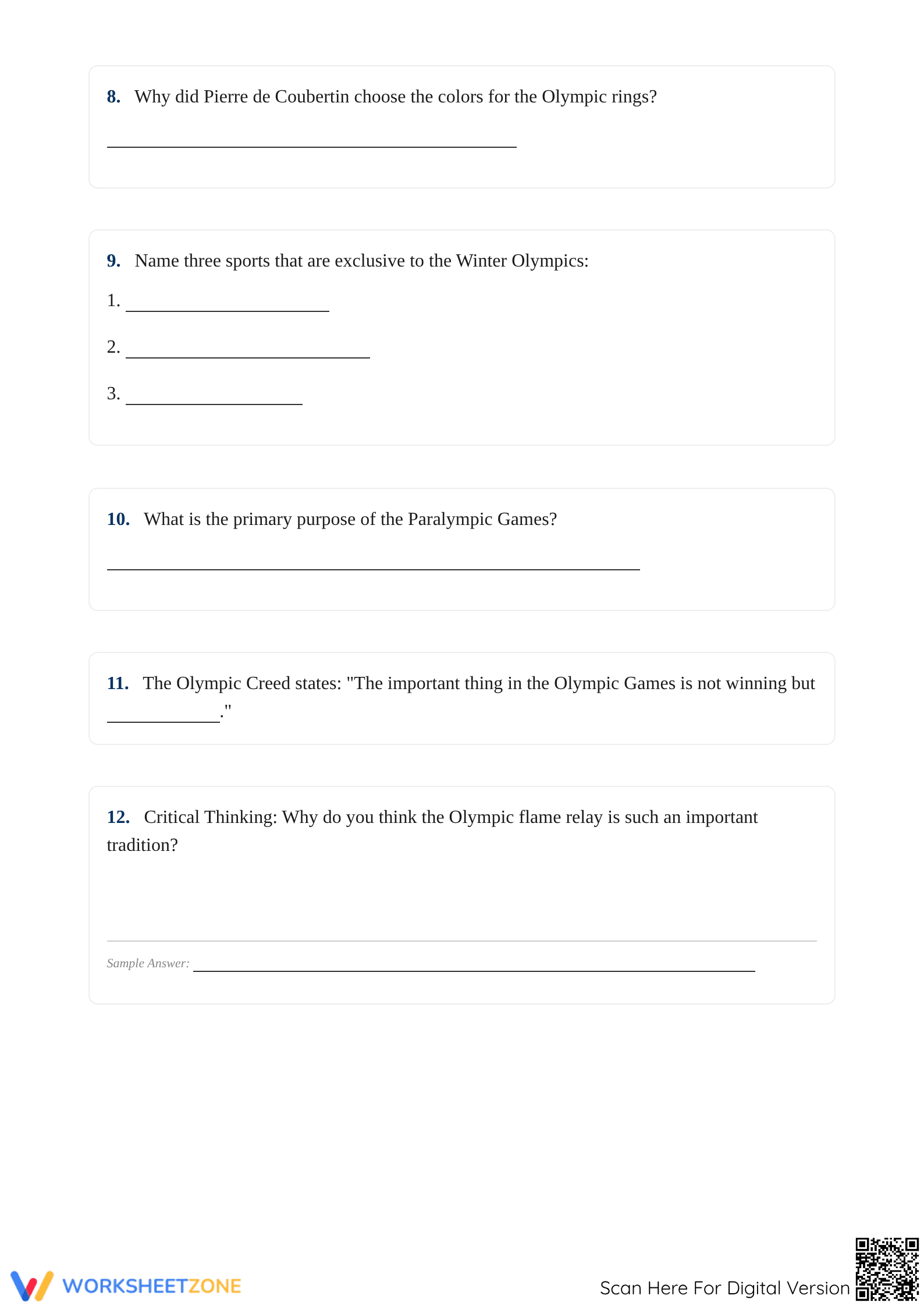
This four-page instructional packet features four distinct parts: The Origins of the Games, Symbols and Traditions, The Expanding Games, and a Comprehensive Review Quiz. Students engage with multiple-choice questions, short-answer responses, matching tasks for the Olympic rings, and a final critical thinking prompt. A full answer key is provided to facilitate quick grading and immediate feedback.
Skill Progression
- Guided Practice: Part 1 introduces the ancient and modern history with a supported multiple-choice task to build initial confidence.
- Supported Practice: Part 2 and 3 require students to locate specific symbols, mottos, and historical dates within the text to answer open-ended questions.
- Independent Practice: Part 4 challenges learners with a 7-question review quiz including a critical thinking reflection to demonstrate mastery.
This structured approach follows a gradual-release model, moving from literal recall to inferential analysis of complex informational texts.
Standards Alignment
This resource is primarily aligned to CCSS.ELA-LITERACY.RI.5.1, which requires students to quote accurately from a text when explaining what the text says explicitly and when drawing inferences from the text. It also supports RI.6.1 and RI.7.1 standards across the middle school bands. Both standard codes can be copied directly into lesson plans, IEP goals, or district curriculum mapping tools.
How to Use It
Use this worksheet as a central component of a Social Studies unit on global traditions or as a targeted ELA informational text lesson. It is ideal for "During" instruction practice after a mini-lesson on scanning for dates and proper nouns. Teachers should observe students during the matching portion of the review quiz to ensure they are referring back to the "Symbols and Traditions" section for accuracy. Completion typically takes 30 to 45 minutes.
Who It's For
This resource is tailored for upper elementary and middle school students in general education, though the clear headings and segmented text make it accessible for English Language Learners and students with IEPs requiring chunked information. It pairs naturally with an Olympic Games introductory video or a map-tracking activity for host cities like Athens and Rome.
The integration of historical narrative with multi-modal assessment tasks, such as the Olympic ring matching and motto translation, directly supports the development of rigorous informational text literacy. By requiring students to navigate a 4-page technical guide to extract specific dates (776 BC, 1896, 1924, 1960) and cultural symbols, the worksheet reinforces the close reading strategies advocated by Fisher & Frey (2014) in their research on scaffolding complex texts. This approach ensures that learners do not merely skim for answers but instead synthesize information across multiple sub-topics, including the Paralympic movement and the evolution of the Winter Games. The inclusion of a critical thinking prompt at the end of the 12-task sequence provides a formative assessment opportunity to measure deeper conceptual understanding beyond simple recall. This resource aligns with NAEP frameworks for measuring student ability to explain and analyze informative texts effectively.


