


























Views
Downloads

Community Helpers Worksheet | Grade 1 Essential Guide
Paste this activity's link or code into your existing LMS (Google Classroom, Canvas, Teams, Schoology, Moodle, etc.).
Students can open and work on the activity right away, with no student login required.
You'll still be able to track student progress and results from your teacher account.
This Community Helpers worksheet provides a comprehensive introduction to various occupations, helping students identify and describe different roles within their neighborhood. By engaging with visual matching and descriptive clues, learners build essential vocabulary and reading comprehension skills. It transforms abstract social studies concepts into concrete, relatable learning moments for early elementary students.
At a Glance
- Grade: Kindergarten · Subject: English Language Arts
- Standard:
CCSS.ELA-LITERACY.L.K.1— Use frequently occurring nouns and verbs to describe people and places- Skill Focus: Occupation Vocabulary & Reading Clues
- Format: 4 pages · 26 tasks · Answer key included · PDF
- Best For: Social studies units or ELA centers
- Time: 30–45 minutes
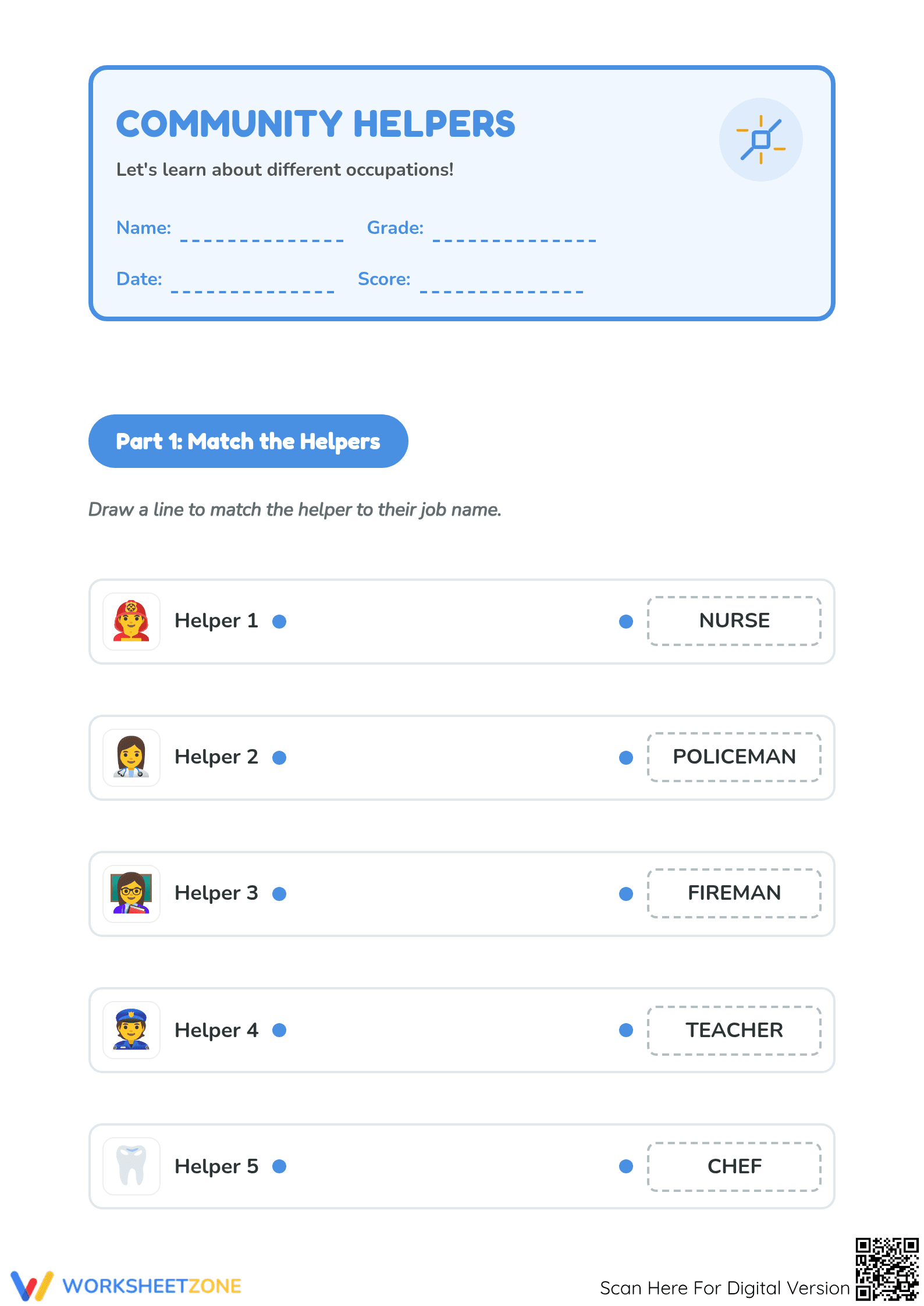
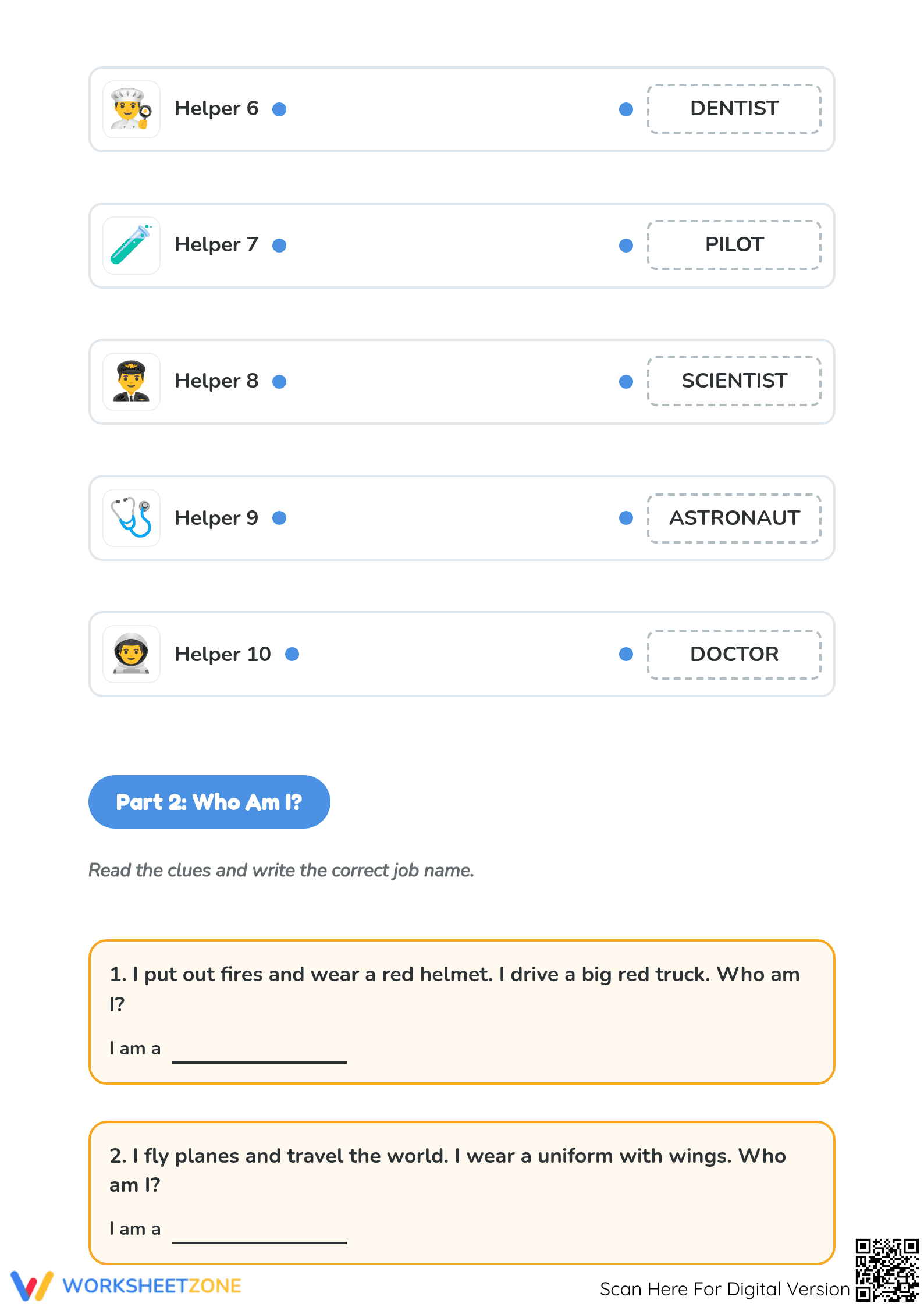
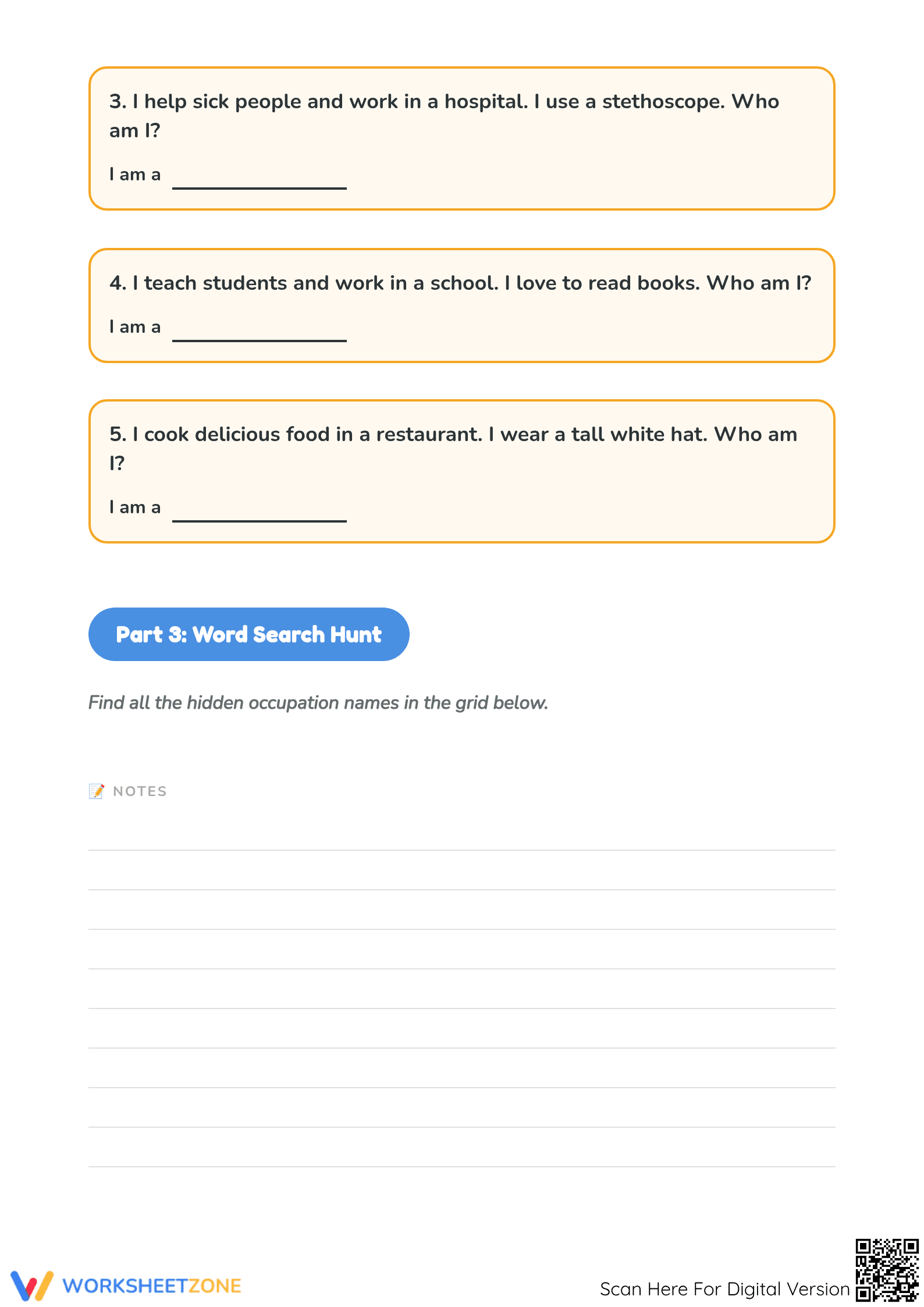
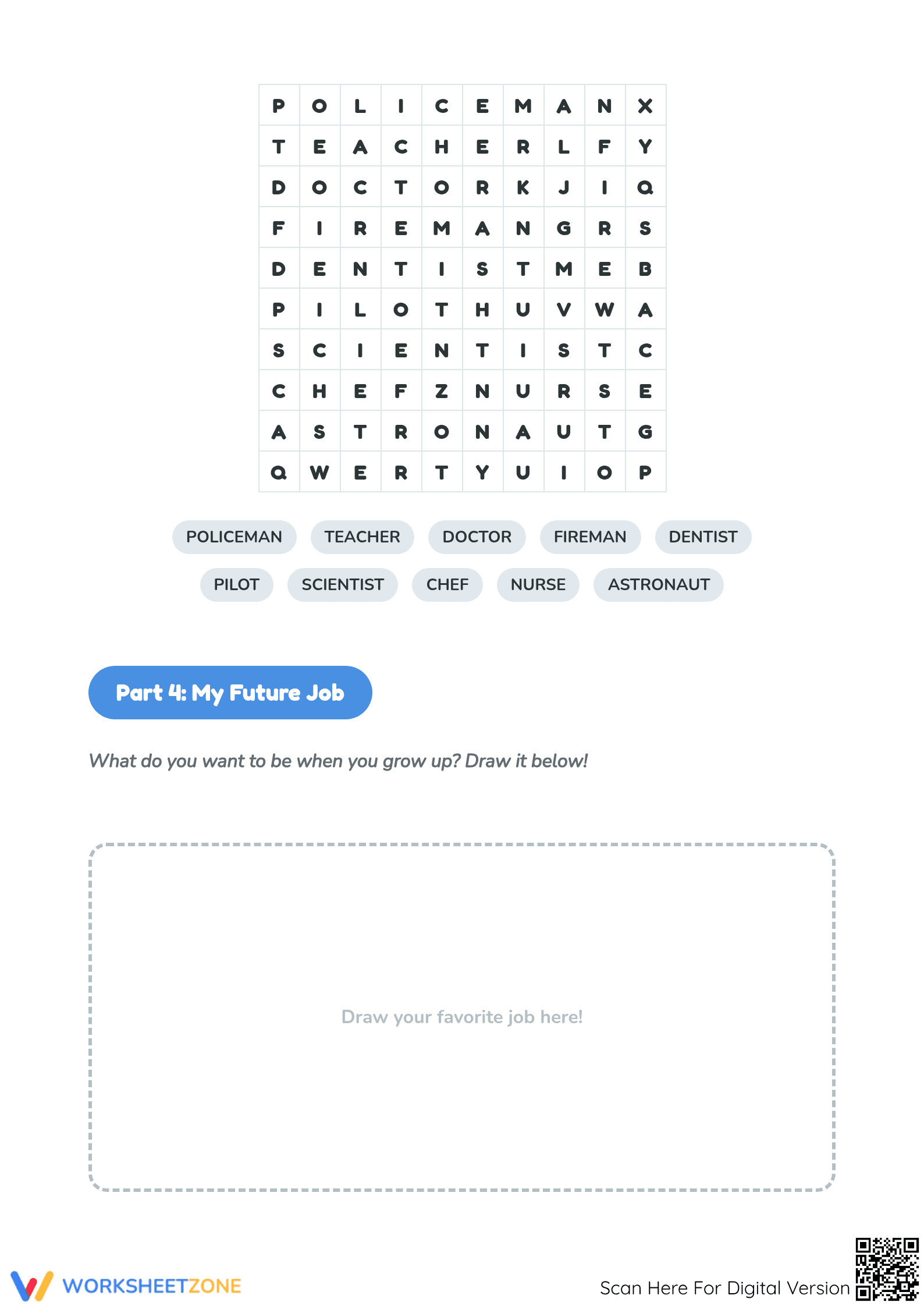
The packet contains four distinct sections across four pages. Part 1 features 10 visual matching tasks connecting helper icons to job titles. Part 2 challenges students with 5 "Who Am I?" reading comprehension riddles. Part 3 offers a 10-word hidden occupation search to reinforce spelling, and Part 4 provides a creative drawing space for personal reflection on future careers. A full answer key is provided for all objective tasks.
This resource follows a zero-prep workflow designed for busy educators. First, print the four-page PDF (30 seconds). Second, distribute the packets to students for independent or small-group work (1 minute). Third, review the "Who Am I?" clues and word search using the included answer key (5 minutes). Total teacher preparation time is under two minutes, making it an ideal emergency sub plan or Friday afternoon activity.
This worksheet aligns with `CCSS.ELA-LITERACY.L.K.1`, focusing on the acquisition and use of frequently occurring nouns related to community roles. It also supports CCSS.ELA-LITERACY.RI.K.1 by requiring students to identify key details in short descriptive texts. Both standard codes can be copied directly into lesson plans, IEP goals, or district curriculum mapping tools.
Use this as a summative assessment after a unit on community helpers or as a literacy center rotation. During the "Who Am I?" section, observe if students can identify key tools (like a stethoscope or red truck) to infer the occupation. This provides a quick formative check on their inferencing skills. Expected completion time ranges from 30 to 45 minutes depending on reading level.
This resource is designed for Kindergarten and Grade 1 students, including English Language Learners who benefit from the visual icons paired with text. It pairs naturally with a "People in My Neighborhood" picture book or an anchor chart displaying community tools. The varied task types ensure that both visual and logical learners remain engaged throughout the lesson.
Research from Fisher & Frey (2014) emphasizes the importance of scaffolding vocabulary through multiple exposures and varied task types, such as the matching and word search activities found in this packet. By connecting visual icons to written labels and descriptive riddles, the worksheet supports the gradual release of responsibility model, moving students from simple recognition to higher-order inferencing. The inclusion of 26 specific tasks ensures high engagement and sufficient practice for mastery of the CCSS.ELA-LITERACY.L.K.1 standard. According to the NAEP framework, early exposure to domain-specific vocabulary in social studies contexts significantly improves long-term reading comprehension outcomes. This printable resource provides the structured environment necessary for students to internalize these concepts while building the fine motor skills required for writing and drawing. It serves as a reliable tool for documenting student progress toward foundational literacy goals.


