


























Views
Downloads
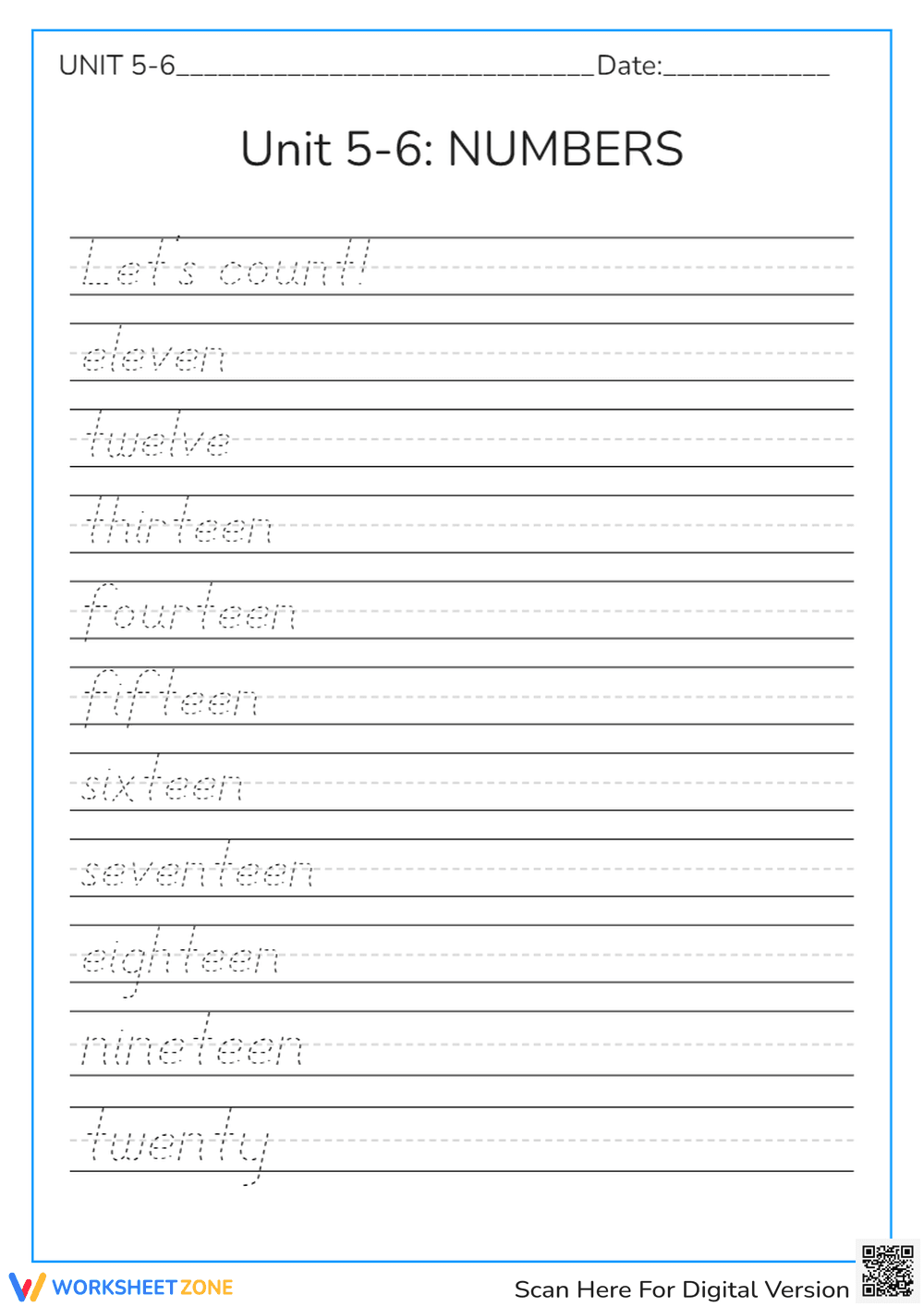

Cursive Numbers 11-20 Worksheet | Essential Grade 1
Paste this activity's link or code into your existing LMS (Google Classroom, Canvas, Teams, Schoology, Moodle, etc.).
Students can open and work on the activity right away, with no student login required.
You'll still be able to track student progress and results from your teacher account.
This Grade 1 cursive handwriting worksheet provides structured tracing practice for number words eleven through twenty. By focusing on fluid letter connections, learners develop the fine motor control necessary for cursive mastery. It serves as a bridge between numeracy and literacy, reinforcing number recognition while building essential penmanship skills.
At a Glance
- Grade: 1 · Subject: Handwriting
- Standard:
CCSS.ELA-LITERACY.L.1.1.A— Print or write all upper- and lowercase letters legibly- Skill Focus: Cursive number word tracing
- Format: 1 page · 10 problems · Answer key not required · PDF
- Best For: Morning work or handwriting centers
- Time: 10–15 minutes
What's Inside
This single-page PDF features 10 tracing lines, each dedicated to a number word from eleven to twenty. The worksheet utilizes a clear, dotted-line font on primary ruling to guide student hand movements. The layout includes a "Let's count!" header and space for name and date, ensuring an organized practice session.
Zero-Prep Workflow
- Print: Generate copies for your entire class in under 30 seconds.
- Distribute: Hand out during morning arrival or as a transition activity.
- Review: Perform a quick visual scan of student work to check for proper letter formation.
Total teacher preparation time is less than 2 minutes, making this an ideal resource for sub plans or busy classroom mornings.
Standards Alignment
The primary focus is `CCSS.ELA-LITERACY.L.1.1.A`, requiring students to demonstrate command of standard English conventions when writing. While cursive is not explicitly mandated in all CCSS versions, it supports the goal of legible production. Both standard codes can be copied directly into lesson plans, IEP goals, or district curriculum mapping tools.
How to Use It
Use this worksheet during independent practice after demonstrating letter joins for "v" and "e." It also works as a formative assessment tool; observe stroke direction to identify students needing support. Completion typically takes 10 to 15 minutes.
Who It's For
This resource is designed for Grade 1 students, though it is suitable for Kindergarteners with advanced motor skills. It supports English Language Learners (ELLs) by pairing numerical concepts with written English. Pair this with a cursive alphabet anchor chart for maximum student independence.
According to Fisher & Frey (2014), the gradual release of responsibility begins with clear modeling followed by guided practice, such as the tracing tasks provided in this resource. This worksheet aligns with research suggesting that kinesthetic activities like handwriting improve letter-sound recognition and overall literacy retention. By focusing on the specific range of numbers 11-20, the tool addresses a common developmental hurdle where students transition from single-digit to double-digit concepts. The inclusion of CCSS.ELA-LITERACY.L.1.1.A ensures that the activity remains grounded in foundational literacy standards. Educators can utilize this 1-page PDF to provide consistent, low-stakes practice that builds the muscle memory required for fluent writing. This approach is supported by the NAEP findings which highlight the correlation between writing fluency and overall academic achievement in early elementary grades.


