


























Views
Downloads
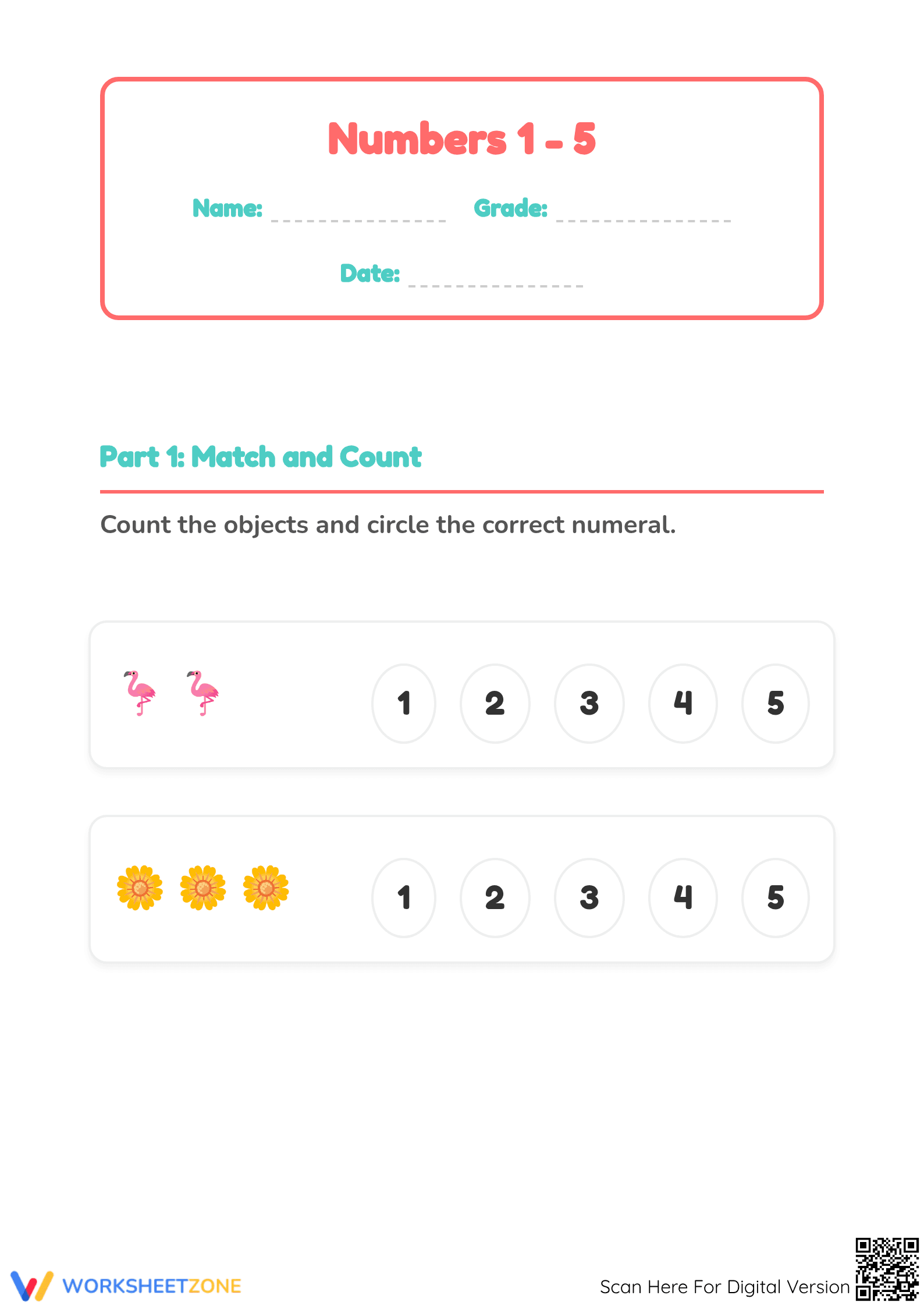
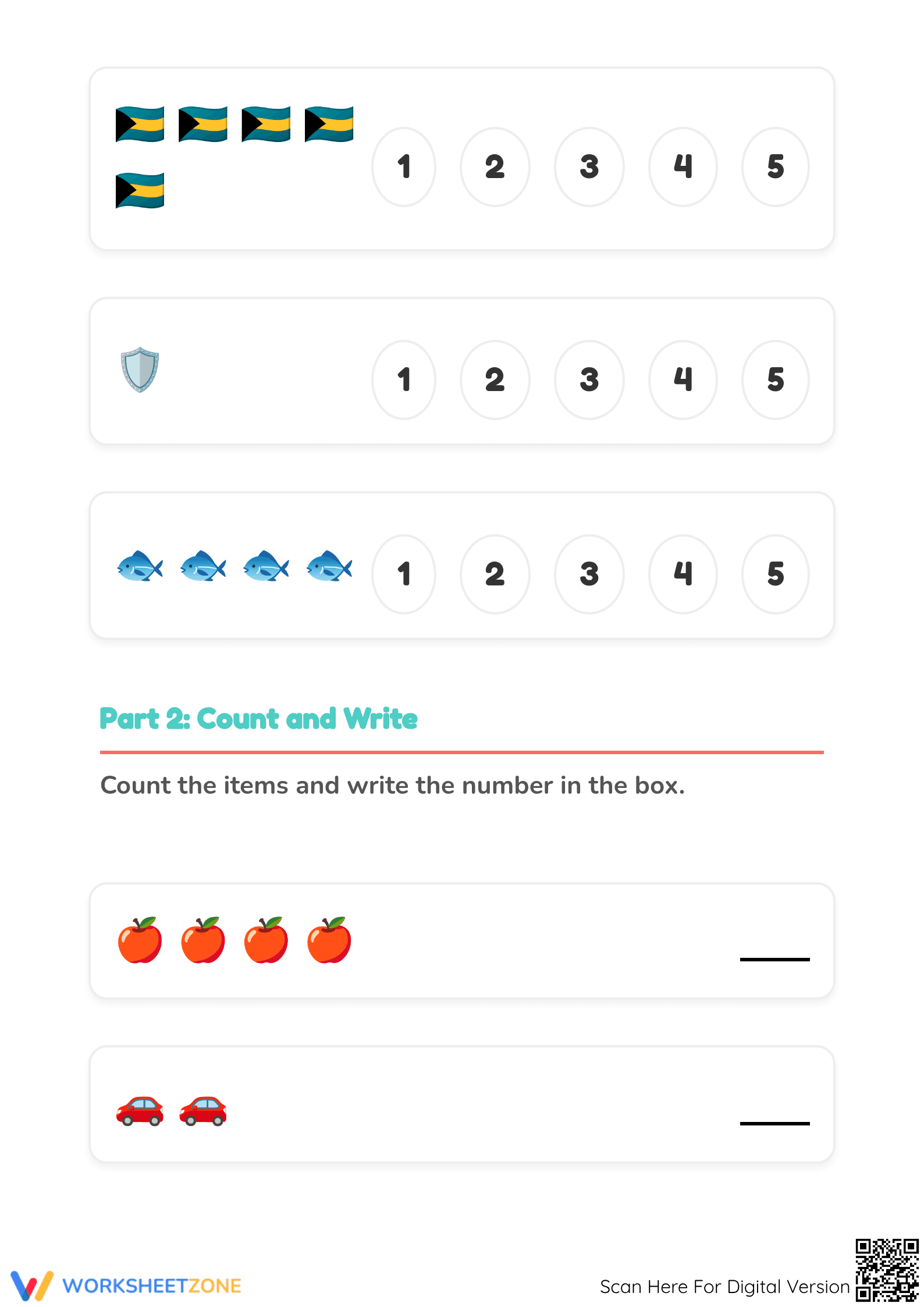
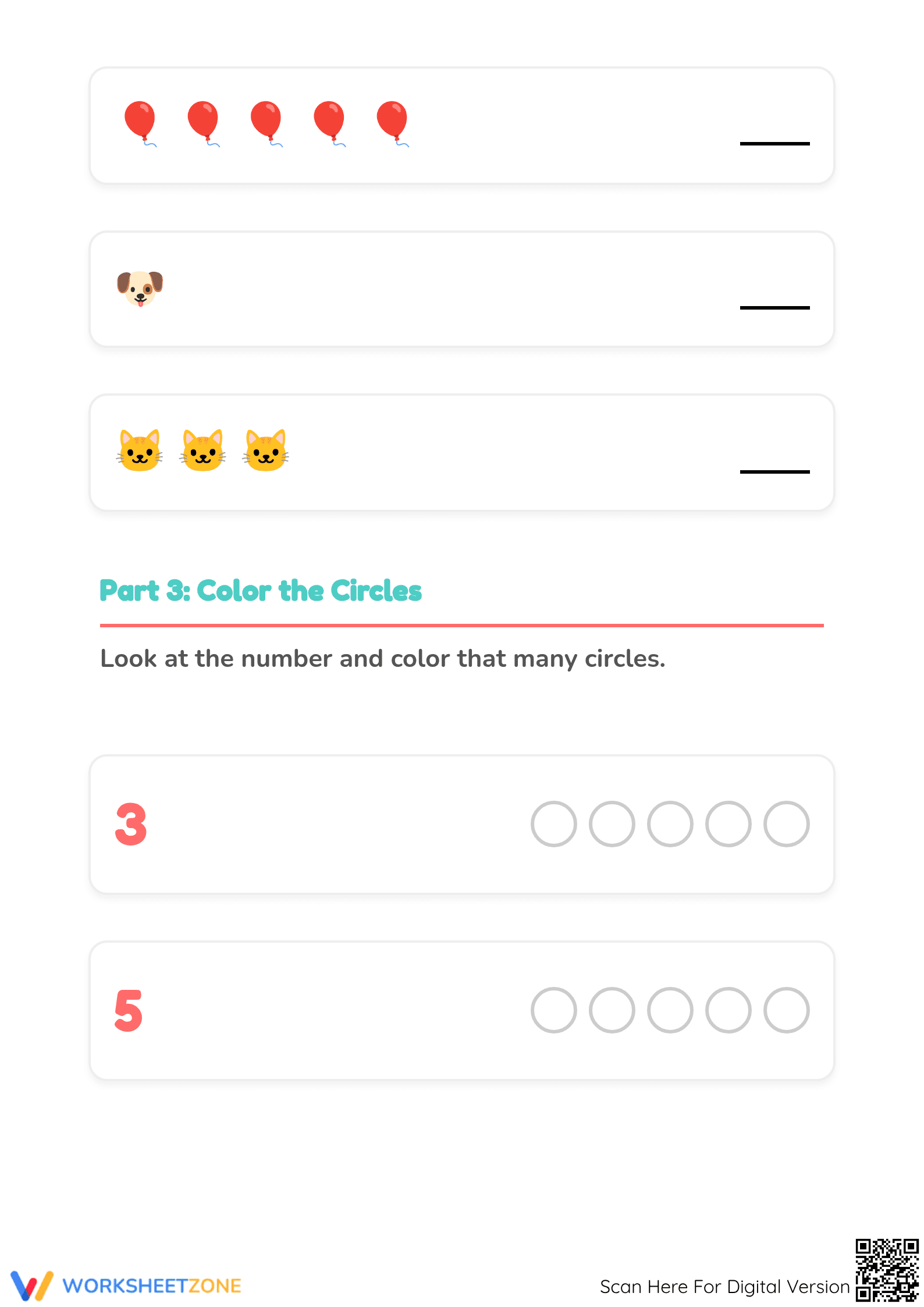


Essential Numbers 1 to 5 Counting Worksheet | Grade K
Paste this activity's link or code into your existing LMS (Google Classroom, Canvas, Teams, Schoology, Moodle, etc.).
Students can open and work on the activity right away, with no student login required.
You'll still be able to track student progress and results from your teacher account.
Helping early learners master the fundamentals of number recognition and cardinality is the primary goal of this comprehensive Numbers 1 to 5 resource. Students engage with interactive counting tasks, tracing exercises, and visual matching to solidify their understanding of small quantities. This 4-page packet provides the structured repetition necessary for Kindergarten students to bridge the gap between abstract numerals and concrete amounts.
At a Glance
- Grade: K · Subject: Math
- Standard:
CCSS.MATH.CONTENT.K.CC.B.4— Understand the relationship between numbers and quantities; connect counting to cardinality.- Skill Focus: Numbers 1–5 Recognition and Counting
- Format: 4 pages · 20 problems · Answer key included · PDF
- Best For: Daily morning work or math centers
- Time: 15–20 minutes
This resource is organized into four distinct pages designed to provide a multi-sensory approach to early numeracy. The packet includes a matching page where students connect illustrations to numerals, a "how many" page for circling quantities, a dedicated tracing guide for proper number formation, and a creative "count and color" assessment. With 20 total problems, it ensures students stay focused on the mathematical task at hand.
First, print the four-page PDF in less than 30 seconds, utilizing the high-contrast black-and-white design for cost-effective copying. Second, distribute the materials to students as a complete packet or individual daily sheets; no extra manipulatives or scissors are required. Finally, review student work using the included 4-page answer key, which allows for grading in under 2 minutes per student set.
The primary focus of this worksheet is `CCSS.MATH.CONTENT.K.CC.B.4`, which requires students to understand that the last number name said tells the number of objects counted. By matching, circling, and coloring specific sets, students demonstrate mastery of the 1-to-1 correspondence principle. This alignment supports broader Kindergarten math goals regarding number names and the count sequence. Both standard codes can be copied directly into lesson plans, IEP goals, or district curriculum mapping tools.
Deploy this packet during the "I Do" or "We Do" phase of a math lesson to introduce the concept of sets. It works exceptionally well as a formative assessment after direct instruction on numbers 1-5; observe students as they count to identify those who may still struggle with skip-counting or re-counting objects. Expect most Kindergarten students to complete the entire 4-page sequence in approximately 20 minutes of independent work time.
This resource is tailored for Preschool and Kindergarten students who are developing foundational number sense, but it is also appropriate for Grade 1 students requiring Tier 2 intervention. It pairs naturally with a number line anchor chart or a "Counting to Five" read-aloud to reinforce auditory and visual learning styles. The large print and clear icons make it accessible for diverse student needs.
Research conducted by Fisher & Frey (2014) highlights that the gradual release of responsibility, supported by structured visual practice, is essential for early mathematical development. This worksheet implements those findings by transitioning students from simple recognition tasks to independent application through counting and coloring. By focusing specifically on the numbers 1 to 5, the material aligns with developmental milestones recognized by the NAEP for early childhood numeracy. The repetitive nature of the tasks builds cognitive fluency, ensuring that the connection between a numeral and its quantitative value becomes second nature for the learner. Providing varied task types—such as matching, tracing, and identifying—accommodates different processing speeds and ensures that foundational math concepts are accessible to all students regardless of their initial skill level. This structured approach ensures foundational math concepts are bridged for all learners.


