


























Views
Downloads
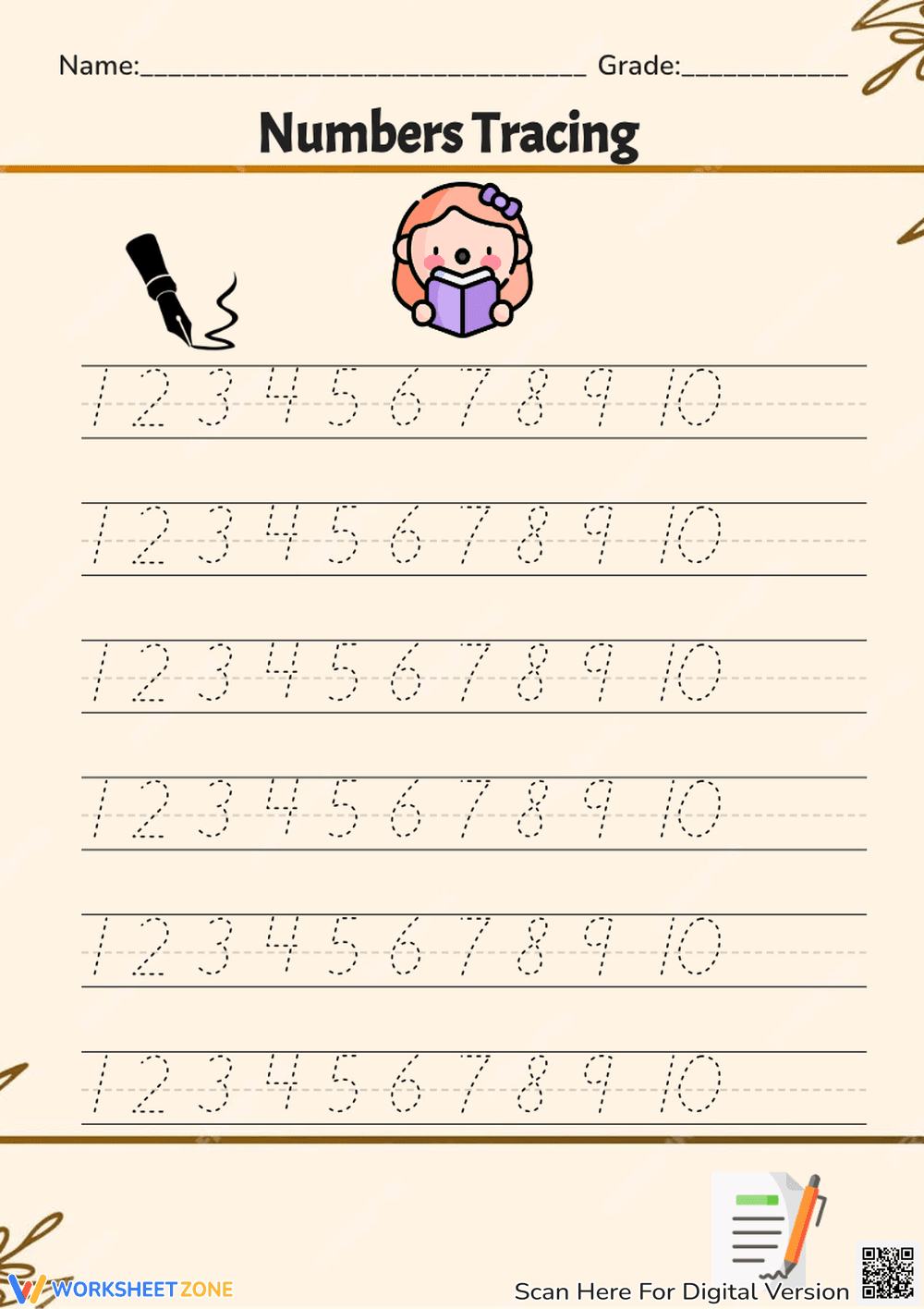

Numbers 1-10 Tracing Worksheet | Essential Grade K-1
Paste this activity's link or code into your existing LMS (Google Classroom, Canvas, Teams, Schoology, Moodle, etc.).
Students can open and work on the activity right away, with no student login required.
You'll still be able to track student progress and results from your teacher account.
This Kindergarten and Grade 1 number tracing worksheet provides a structured environment for students to master the formation of digits 1 through 10. By focusing on repetitive, guided practice, learners develop the fine motor control and numerical recognition necessary for early mathematical success. It transforms abstract symbols into concrete writing skills.
At a Glance
At a Glance
- Grade: Kindergarten · Subject: Handwriting
- Standard:
CCSS.MATH.CONTENT.K.CC.A.3— Write numbers from 0 to 20 with correct formation- Skill Focus: Number tracing 1-10
- Format: 1 page · 60 tasks · No-prep · PDF
- Best For: Morning work or fine motor practice
- Time: 10–15 minutes
What's Inside
This single-page PDF features six identical rows of numbers 1 through 10, rendered in a clear, dashed font for tracing. The layout includes a name and grade header for easy classroom organization. With 60 individual tracing opportunities, the worksheet ensures high-repetition practice without overwhelming young learners with complex instructions or distracting visuals.
Zero-Prep Workflow
- Print: Select the single-page PDF and print enough copies for your group in under 30 seconds.
- Distribute: Hand out the sheets during morning arrival or math centers to provide immediate engagement.
- Review: Circulate to check for proper pencil grip and stroke order as students complete the rows.
Total teacher preparation time is under 2 minutes, making this an ideal resource for substitute folders or unexpected schedule gaps.
Standards Alignment
The primary focus is `CCSS.MATH.CONTENT.K.CC.A.3`, which requires students to "Write numbers from 0 to 20. Represent a number of objects with a written numeral 0-20." This worksheet specifically targets the motor-skill component of this standard. This standard code can be copied directly into lesson plans, IEP goals, or district curriculum mapping tools.
How to Use It
Use this worksheet as a warm-up activity at the start of a math block to transition students into a focused mindset. It also serves as an effective formative assessment tool; observe which numbers students struggle with to identify specific digits requiring more direct instruction. Expected completion typically takes 10 to 15 minutes.
Who It's For
This resource is designed for Kindergarten students beginning their writing journey and Grade 1 students needing remedial fine motor support. It pairs naturally with a number line anchor chart or a counting-to-ten read-aloud to reinforce the connection between symbols and quantities.
According to the RAND AIRS 2024 report, high-frequency repetition in early childhood writing tasks is a critical predictor of later academic fluency. This worksheet aligns with those findings by providing 60 specific tracing tasks for numbers 1-10, ensuring students move past simple recognition toward automaticity. By targeting CCSS.MATH.CONTENT.K.CC.A.3, the resource addresses the foundational requirement of writing numerals to represent quantities. Research from Fisher & Frey (2014) emphasizes that guided practice, such as tracing dashed lines, serves as a necessary scaffold before students can transition to independent production. This structured approach reduces cognitive load, allowing young learners to focus entirely on the physical mechanics of handwriting. Educators can utilize this data-backed method to ensure that every student in a diverse Kindergarten or Grade 1 classroom achieves the motor milestones required for more complex mathematical operations and data recording in later grades.


