


























Views
Downloads




Printable Number Order Worksheet | Kindergarten Math
Paste this activity's link or code into your existing LMS (Google Classroom, Canvas, Teams, Schoology, Moodle, etc.).
Students can open and work on the activity right away, with no student login required.
You'll still be able to track student progress and results from your teacher account.
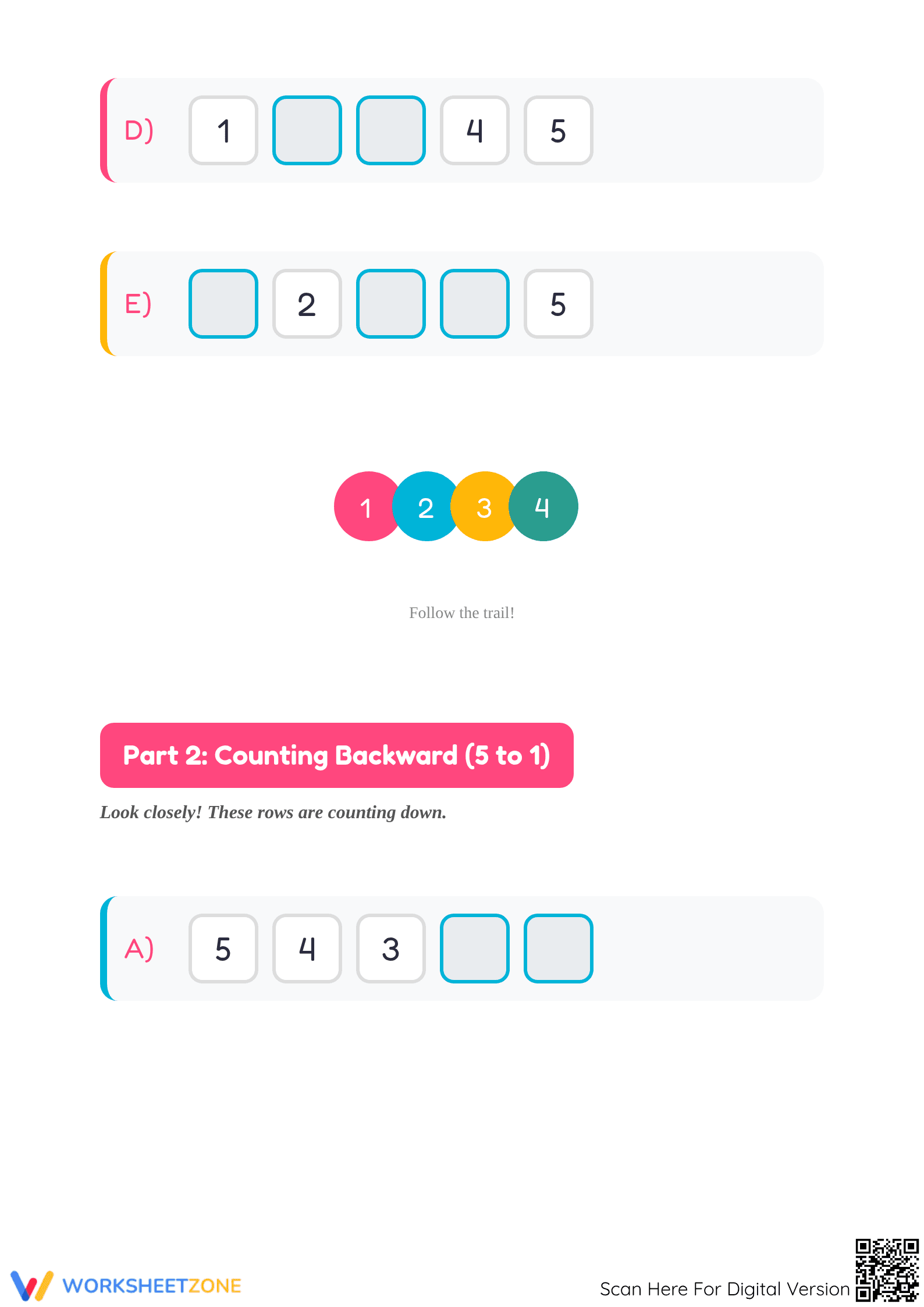
This Kindergarten Number Order worksheet provides young learners with essential practice in identifying and completing number sequences from 1 to 5. Students fill in missing numbers to master both ascending and descending patterns, building a strong foundation for early counting and numerical fluency before moving to larger sets.
At a Glance
- Grade: Kindergarten · Subject: Math
- Standard:
CCSS.MATH.CONTENT.K.CC.A.2— Count forward beginning from a given number within the known sequence- Skill Focus: Number sequencing (1-5)
- Format: 5 pages · 15 problems · Answer key included · PDF
- Best For: Early morning work and centers
- Time: 10–15 minutes
This comprehensive 5-page packet features a variety of missing-number sequences designed specifically for preschoolers and kindergarteners. Each page provides clean, clear layouts with ample space for writing, including a full answer key for rapid grading. The repetitive structure ensures students gain confidence through sustained, focused practice on the first five digits of the number line.
Zero-Prep Workflow
The zero-prep workflow for this resource is designed for maximum efficiency in the busy classroom. Teachers can print the entire set in under 1 minute, distribute the sheets in seconds, and utilize the provided answer key for a 30-second review. This makes it an ideal choice for unexpected sub plans or transition periods between main lessons.
Standards Alignment
Primary alignment is to `CCSS.MATH.CONTENT.K.CC.A.2`, which requires students to count forward beginning from a given number within the known sequence (instead of having to begin at 1). This worksheet also supports `K.CC.A.3` by providing opportunities to write numbers 1-5 in context. Both standard codes can be copied directly into lesson plans, IEP goals, or district curriculum mapping tools.
How to Use It
Use this as an exit ticket after an initial lesson on counting to check for individual student mastery of number patterns. It also functions well as a quiet "bell-ringer" activity to settle the class during morning arrival. Observe whether students use their fingers or a number line to find the missing digits to identify those needing more concrete support.
Who It's For
This resource is perfect for early childhood learners, including preschool and kindergarten students, as well as Grade 1 students requiring intervention. It pairs naturally with a classroom number line or "hundreds chart" for students who benefit from visual references while completing the independent work pages.
According to the RAND AIRS 2024 analysis of foundational numeracy, frequent, low-stakes practice with small number sets (1-5) is critical for developing the mental "number line" necessary for later arithmetic success. This worksheet targets the `CCSS.MATH.CONTENT.K.CC.A.2` standard by requiring students to recognize number neighbors and fill gaps in both directions. Research from NAEP suggests that early mastery of counting sequences correlates strongly with mathematical proficiency in later primary grades. By isolating the digits 1 through 5, the cognitive load is reduced, allowing students to focus purely on the logic of "one more" and "one less" within the sequence. Educators can trust this structured approach to provide the scaffolding needed for emergent mathematicians to move from rote counting to true numerical understanding.


