


























Views
Downloads


Essential Number of the Day Mastery Sheet | Grade 5
Paste this activity's link or code into your existing LMS (Google Classroom, Canvas, Teams, Schoology, Moodle, etc.).
Students can open and work on the activity right away, with no student login required.
You'll still be able to track student progress and results from your teacher account.
This Number of the Day worksheet provides a comprehensive daily routine for Grade 4 and 5 students to master place value, rounding, and number properties. By engaging with a single number across seven analytical parts, learners develop a deep conceptual understanding of the base-ten system. This resource ensures students can fluently transition between standard, expanded, and word forms while applying higher-order thinking to mathematical comparisons.
At a Glance
- Grade: 5 · Subject: Math
- Standard:
CCSS.MATH.CONTENT.5.NBT.A.1— Recognize that a digit in one place represents 10 times as much as the right- Skill Focus: Multi-digit number sense and place value
- Format: 3 pages · 17 problems · Answer key included · PDF
- Best For: Daily morning work or bell-ringers
- Time: 15–20 minutes
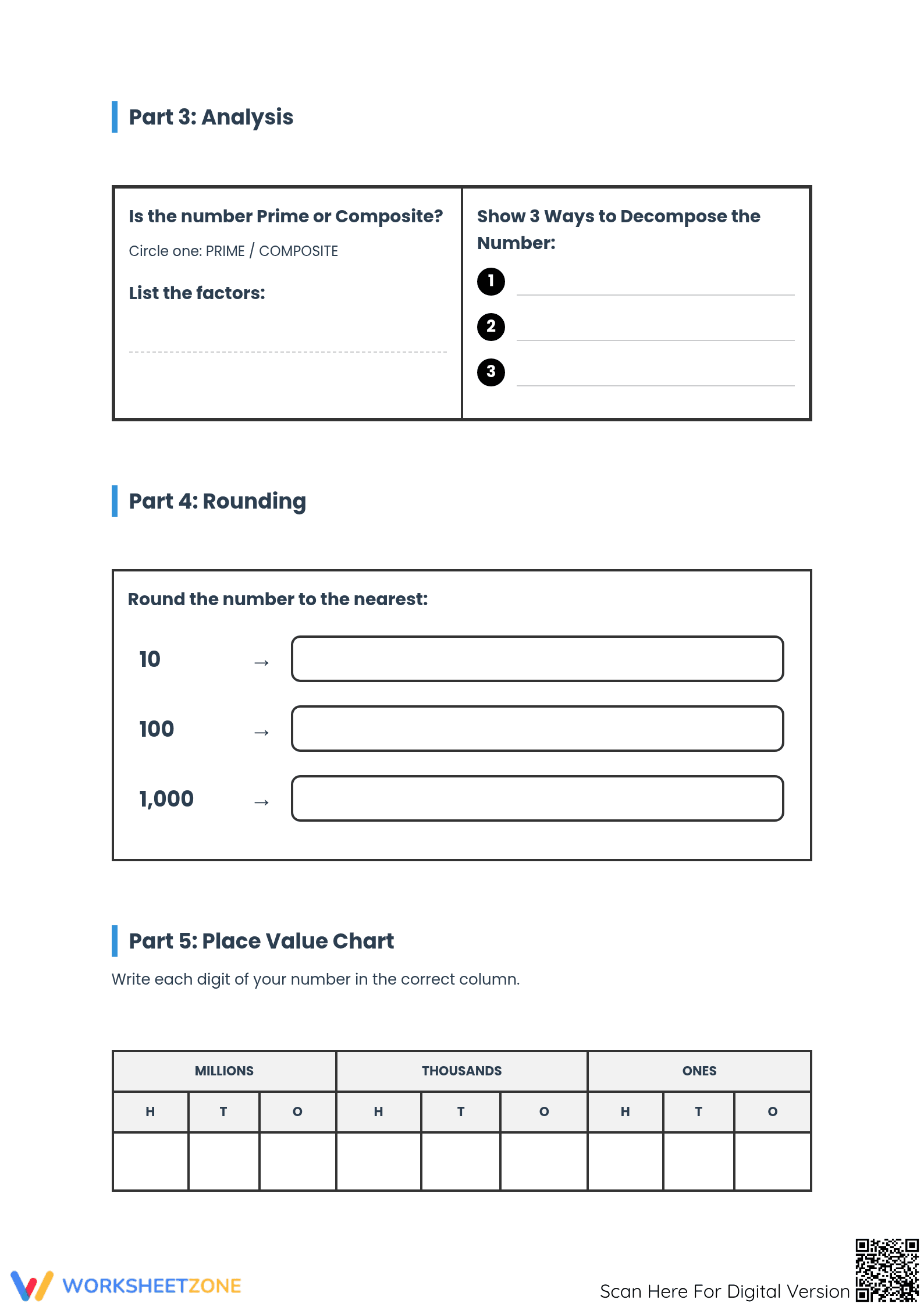
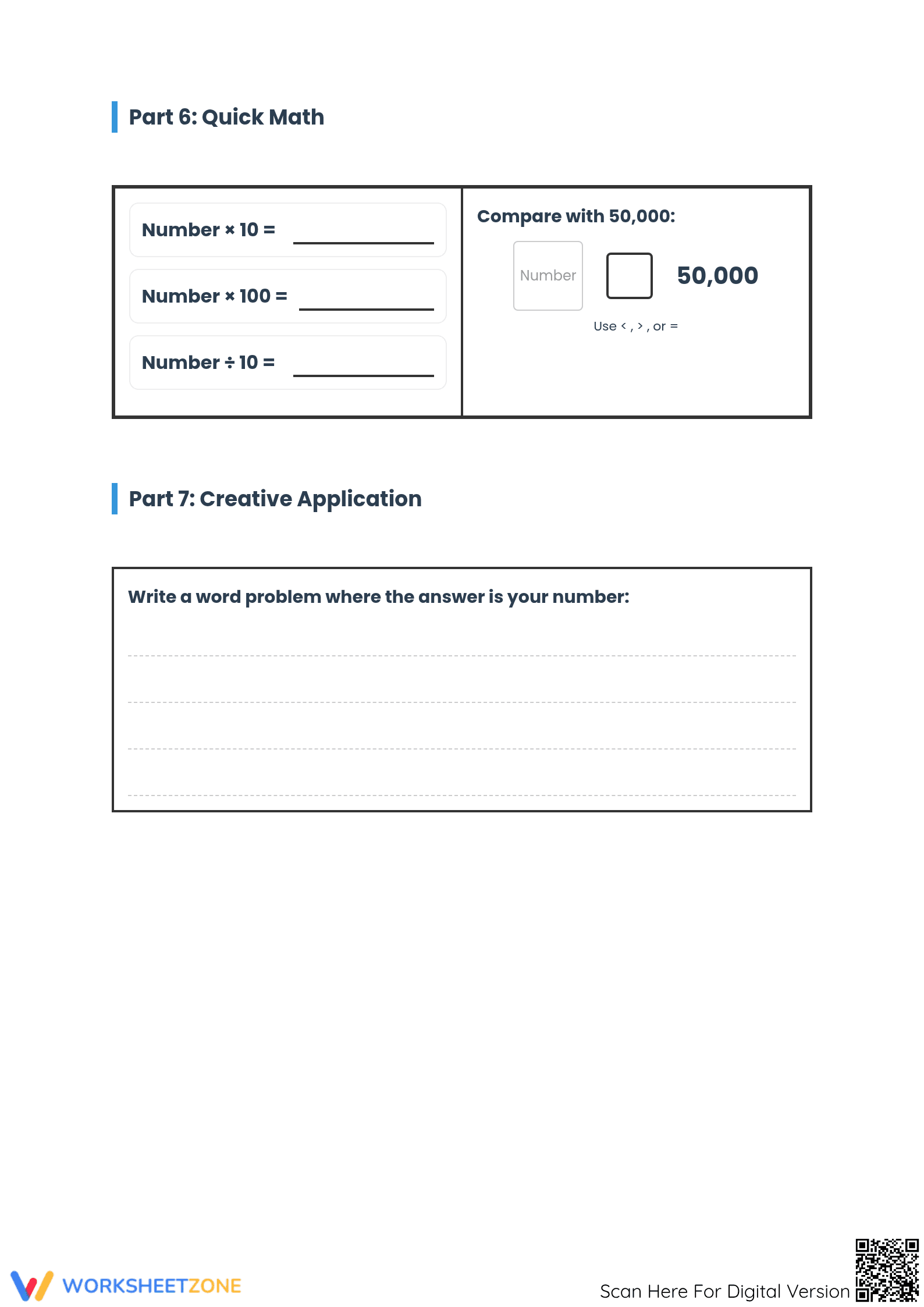
The three-page printable includes seven sections covering identity, forms, comparisons, and analysis. Students work with expanded form, rounding to the nearest 10, 100, and 1,000, and a place value chart extending to millions. The final pages challenge students with "Quick Math" operations—multiplying and dividing by powers of ten—and a section to construct an original word problem. A full answer key is provided for rapid grading.
Zero-Prep Workflow
The zero-prep workflow is designed for efficiency. Teachers simply print the three-page PDF, taking seconds for a full class set. Distribution is immediate as the tasks are self-explanatory. Reviewing work is streamlined by the structured layout, allowing teachers to check for misconceptions in under two minutes using the provided answer key. This makes the resource an ideal choice for emergency sub plans or consistent morning routines.
Standards Alignment
The primary focus is `CCSS.MATH.CONTENT.5.NBT.A.1`, which requires students to recognize the ten-fold relationships between adjacent place values. It also supports `CCSS.MATH.CONTENT.4.NBT.A.2` by requiring the reading and writing of multi-digit whole numbers using base-ten numerals and expanded form. Both standard codes can be copied directly into lesson plans, IEP goals, or district curriculum mapping tools to track student progress throughout the unit.
How to Use It
Incorporate this as a morning routine during the first 15 minutes of class to build mathematical fluency. Alternatively, use it as a formative assessment after place value instruction to identify students struggling with rounding or prime numbers. Teachers should observe students during the "Quick Math" section to ensure they understand digit shifts rather than just memorizing rules. Expected completion is 20 minutes for most Grade 5 learners.
Who It's For
This resource is tailored for upper elementary students in Grades 4 and 5 who are working toward mastery of multi-digit numbers. It provides necessary scaffolds like the place value chart for students requiring support, while the creative word problem section offers an extension for advanced learners. It pairs naturally with a base-ten block anchor chart or a daily number talk session during math centers.
Effective math instruction relies on consistent retrieval practice to move concepts into long-term memory. According to Fisher & Frey (2014), routines like "Number of the Day" provide the necessary repetition for students to internalize base-ten relationships. This Grade 5 worksheet aligns with `CCSS.MATH.CONTENT.5.NBT.A.1` by requiring students to manipulate numbers through multiplication and division by ten. Research from ScienceDirect TpT Analysis indicates that high-utility, low-prep resources significantly reduce teacher burnout while maintaining rigorous academic standards. By integrating multi-modal tasks—such as place value charting and word problem construction—this worksheet addresses diverse learning styles. The inclusion of prime and composite analysis ensures students are not merely performing rote calculations but are actively analyzing mathematical properties. This approach supports the development of robust number sense, a critical prerequisite for success in middle school algebraic thinking and complex problem solving.


