




























Views
Downloads


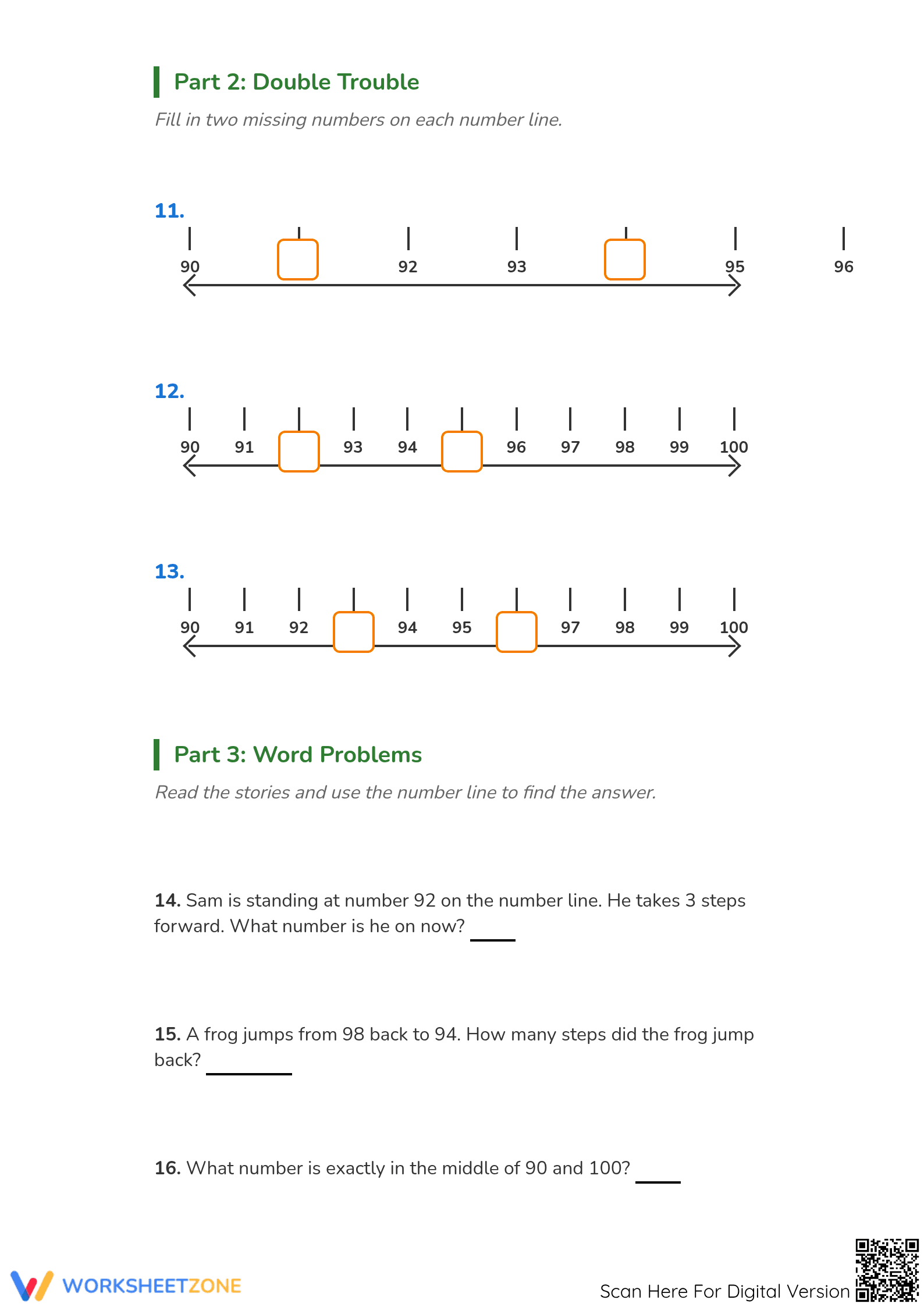


Printable Number Line 90-100 Worksheet | Grade 2 Math

Paste this activity's link or code into your existing LMS (Google Classroom, Canvas, Teams, Schoology, Moodle, etc.).
Students can open and work on the activity right away, with no student login required.
You'll still be able to track student progress and results from your teacher account.
Mastering Numbers 90-100 on the Number Line
This worksheet provides targeted practice for second-grade students on using number lines to identify and place numbers from 90 to 100. Through a series of focused exercises, learners will strengthen their understanding of number sequence and magnitude within a specific range, building a crucial foundation for more complex mathematical concepts.
At a Glance
- Grade: 2 · Subject: Math
- Standard:
CCSS.MATH.CONTENT.2.MD.B.6— Represent whole numbers on a number line diagram within 100.- Skill Focus: Identifying missing numbers on a number line (90-100)
- Format: 5 pages · 50 problems · Answer key included · PDF
- Best For: Independent practice, math centers, or homework
- Time: 15–20 minutes
What's Inside
This resource includes a five-page PDF worksheet packet designed for easy printing and use. Each page features multiple distinct number line problems where students must fill in the missing values between 90 and 100. A complete, corresponding five-page answer key is provided for quick and efficient grading or student self-checking.
A Progression to Independence
The worksheet packet follows a consistent structure to build student confidence and skill mastery.
- Guided Practice: Initial pages can be used with teacher support, modeling how to use existing numbers as anchors.
- Supported Practice: Students can work in pairs or small groups, discussing reasoning and reinforcing counting by ones.
- Independent Practice: Final pages are excellent for independent work, allowing students to apply knowledge on their own. This gradual-release model ensures all learners can access the material.
Standards Alignment
This worksheet is directly aligned with Common Core standard CCSS.MATH.CONTENT.2.MD.B.6, which requires students to "Represent whole numbers as lengths from 0 on a number line diagram with equally spaced points corresponding to the numbers 0, 1, 2, ..., and represent whole-number sums and differences within 100 on a number line diagram." It also supports foundational counting and cardinality skills from previous grades. Both standard codes can be copied directly into lesson plans, IEP goals, or district curriculum mapping tools.
How to Use It
This versatile worksheet is effective as independent practice after a direct instruction lesson on number lines. It allows students to apply what they've learned in a structured format. Alternatively, use it in a math center rotation where students can work at their own pace. For quick formative assessment, observe which students can immediately fill in the blanks versus those who need to count up from the nearest marked number. Most students will complete the five pages in approximately 15 to 20 minutes.
Who It's For
This resource is designed for second-grade students who are developing their number sense up to 100. It is particularly helpful for learners who benefit from visual representations of number sequences. For students needing extra support, pair this worksheet with a physical hundred chart or base-ten blocks. It serves as a great follow-up to a lesson on counting patterns beyond the number 50.
Foundational skills in number sense, such as understanding sequence and magnitude on a number line, are critical for future mathematical success. This worksheet targets CCSS.MATH.CONTENT.2.MD.B.6, which focuses on representing whole numbers on a number line. Research consistently highlights the importance of visual models in developing number sense. According to Fisher & Frey (2014), effective instruction often moves from concrete representations to visual and then abstract ones, a process this worksheet supports by providing a clear visual model. The 50 problems offer repeated, structured practice necessary to solidify the concept of number order and placement within the 90-100 range. This practice is essential for building fluency and preparing students for operations involving larger numbers, a key finding echoed in analyses from RAND AIRS 2024 on effective mathematics interventions.


