


























Views
Downloads
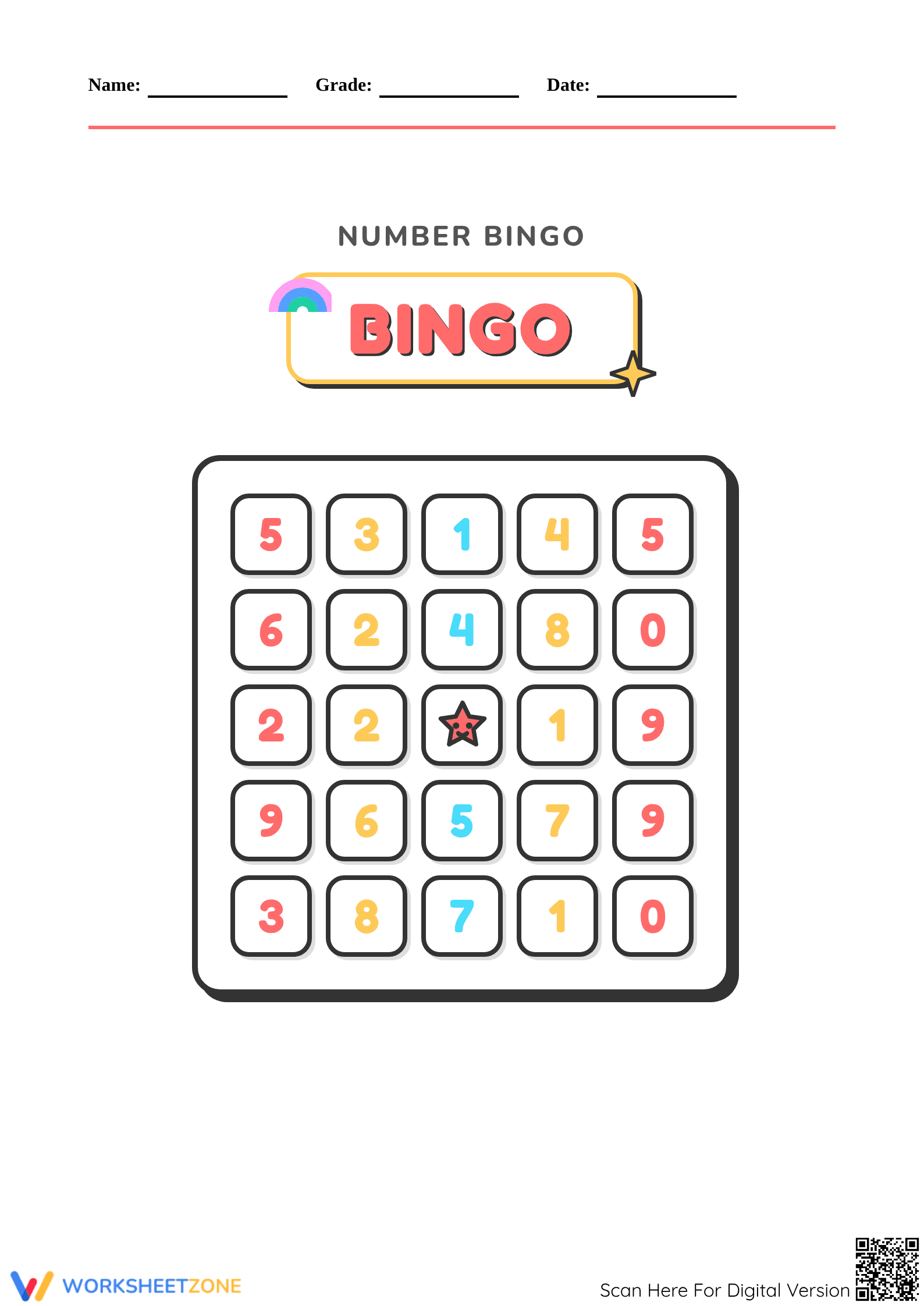

Number Bingo Worksheet | Grade 1 Printable
Paste this activity's link or code into your existing LMS (Google Classroom, Canvas, Teams, Schoology, Moodle, etc.).
Students can open and work on the activity right away, with no student login required.
You'll still be able to track student progress and results from your teacher account.
This Grade 1 number recognition worksheet provides students with an engaging bingo board to practice identifying numerals from zero to nine. By turning foundational math practice into an interactive activity, young learners build fluency and confidence in reading single-digit numbers.
At a Glance
- Grade: 1 · Subject: Math
- Standard:
CCSS.MATH.CONTENT.1.NBT.A.1— Read and write numerals to represent quantities- Skill Focus: Number recognition 0-10
- Format: 1 page · 1 bingo board · No answer key needed · PDF
- Best For: Whole class math games
- Time: 15–20 minutes
This single-page resource features a colorful five-by-five bingo grid filled with numbers ranging from zero to nine. The center square includes a traditional free space marked with a star. Because this is a game board, no answer key is required, making it an incredibly straightforward tool for immediate classroom application.
Implementing this activity requires virtually zero teacher setup.
- Print (1 min): Generate copies directly from the PDF.
- Distribute (1 min): Hand out boards and manipulatives to cover numbers.
- Review (15 min): Call out numbers randomly while students cover the corresponding digits.
Total teacher prep time is under two minutes. This makes it an excellent option for emergency sub plans or a quick transition activity.
This activity aligns with CCSS.MATH.CONTENT.1.NBT.A.1, which requires students to read and write numerals. While the standard extends to 120, mastering the foundational digits 0-9 is a critical prerequisite step. Both standard codes can be copied directly into lesson plans, IEP goals, or district curriculum mapping tools.
This bingo board serves as an excellent warm-up activity before direct instruction on place value. Teachers can use it as a formative assessment tool by observing which students quickly locate the called numbers and which hesitate. Alternatively, place the boards in a math center where a student leader rolls a ten-sided die and calls out the numbers. Expected completion time ranges from fifteen to twenty minutes.
This resource is designed for first-grade students who are solidifying their basic number recognition skills. It also works well for kindergarten students needing an extra challenge or second graders requiring targeted intervention. To differentiate, teachers can call out simple addition or subtraction problems instead of the direct number, forcing students to solve the equation before marking the space on their board. Pair this game with a large classroom number line or anchor chart for added visual support.
Developing rapid number recognition is a fundamental component of early mathematical literacy. When students practice with CCSS.MATH.CONTENT.1.NBT.A.1 to read and write numerals to represent quantities, they reduce the cognitive load required for more complex arithmetic tasks later on. According to a recent EdReports 2024 analysis of foundational math curricula, incorporating game-based learning structures like bingo significantly increases student engagement and retention of basic numeral identification compared to traditional rote memorization drills. By utilizing interactive formats, educators provide a low-stakes environment where young learners can repeatedly encounter target numbers without the pressure of formal testing. This repeated exposure builds the automaticity necessary for subsequent place value understanding and operational fluency, ensuring a stronger mathematical foundation as students progress through the primary grades and encounter multi-digit operations.


