


























Views
Downloads

Grade 1 Pronouns Worksheet — Printable No-Prep Practice
Paste this activity's link or code into your existing LMS (Google Classroom, Canvas, Teams, Schoology, Moodle, etc.).
Students can open and work on the activity right away, with no student login required.
You'll still be able to track student progress and results from your teacher account.
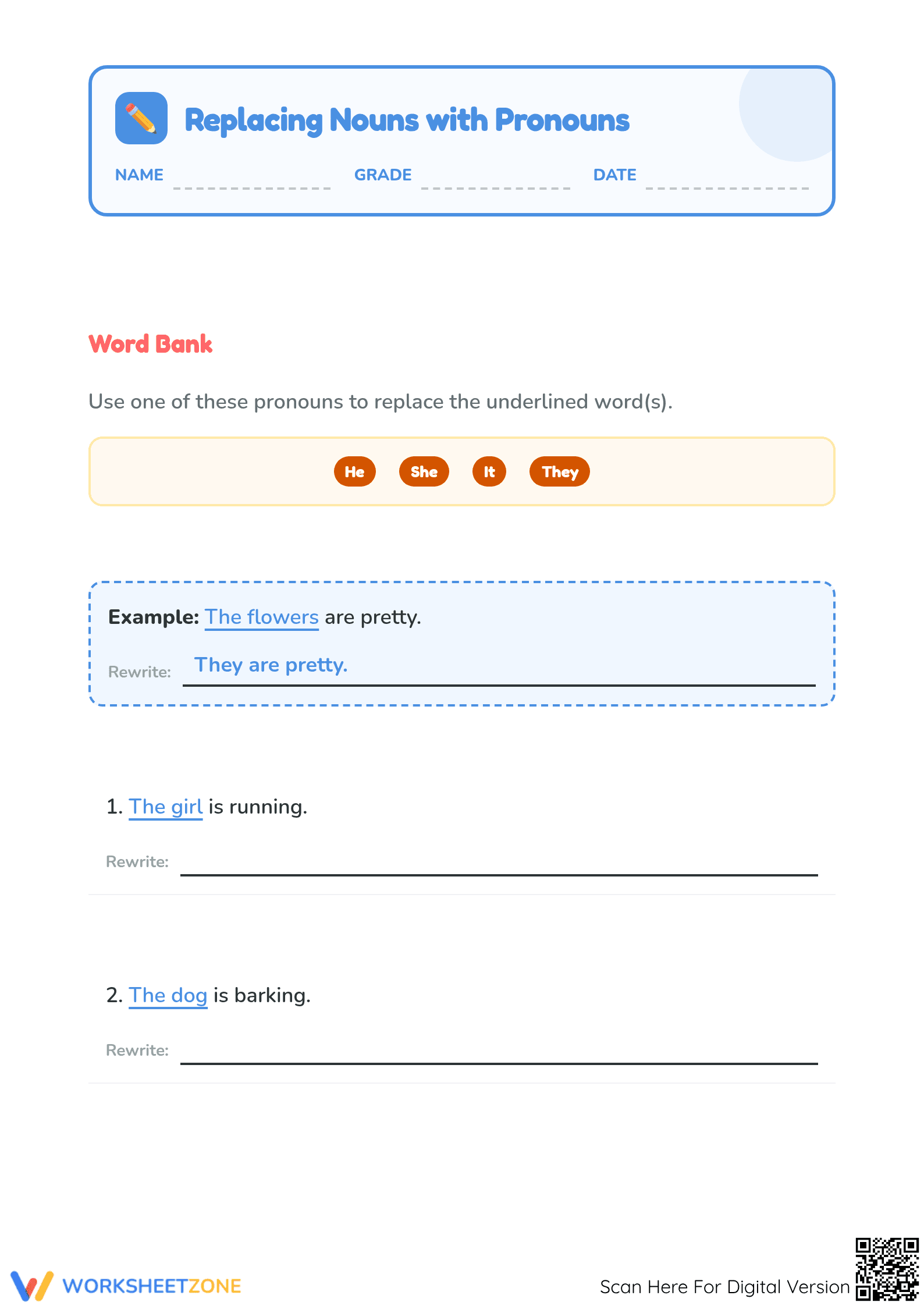
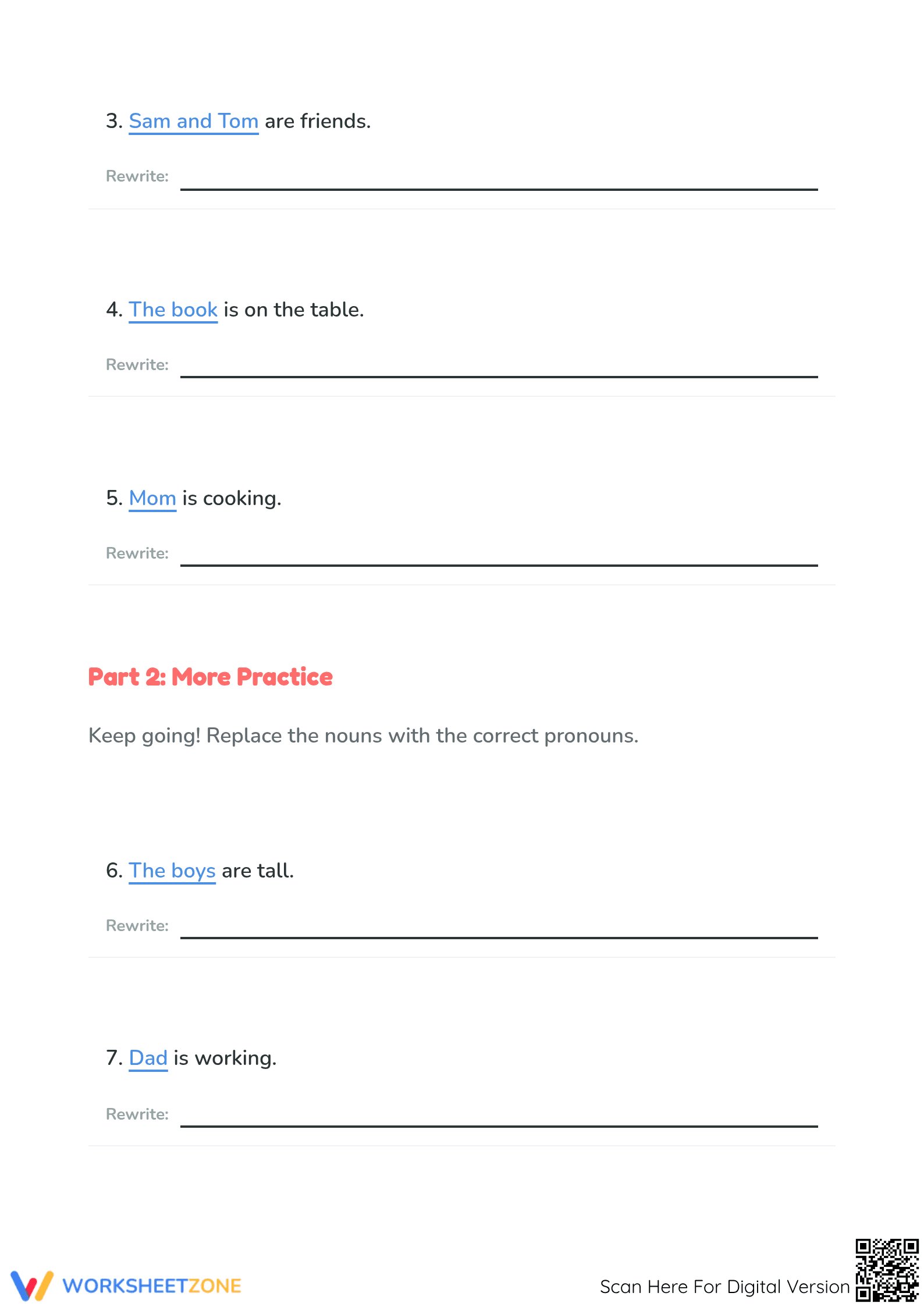
This Grade 1 ELA worksheet helps students master pronoun substitution by replacing underlined nouns with appropriate personal pronouns. By completing these 11 exercises, learners develop a foundational understanding of how pronouns function within sentences to improve writing flow and clarity. It provides immediate practice with gendered and neutral singular and plural pronouns.
At a Glance
- Grade: 1 · Subject: ELA
- Standard:
CCSS.ELA-LITERACY.L.1.1.D— Use personal, possessive, and indefinite pronouns in sentences- Skill Focus: Pronoun substitution (He, She, It, They)
- Format: 3 pages · 11 problems · Answer key included · PDF
- Best For: Independent practice or quick formative assessment
- Time: 15–20 minutes
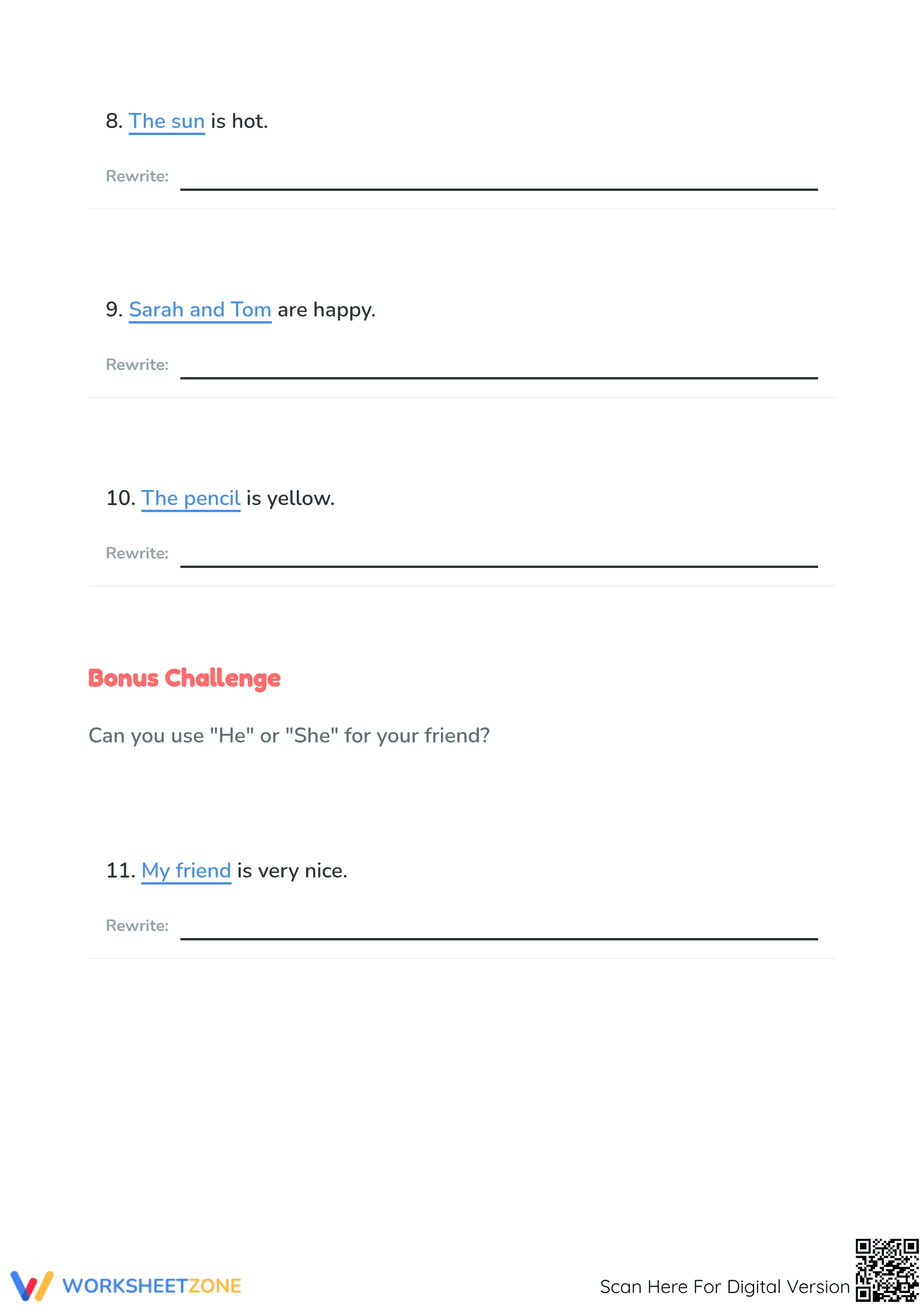
What's Inside: This comprehensive 3-page PDF includes a clear word bank featuring "He," "She," "It," and "They." Students are presented with 11 distinct sentences where specific nouns are underlined. Below each sentence, a dedicated "Rewrite" line encourages students to transcribe the entire sentence using the correct pronoun. A full answer key is provided to facilitate rapid grading or student self-correction.
The zero-prep workflow is designed for busy educators. First, print the three-page set (30 seconds). Second, distribute the worksheets to students during your grammar block; the included word bank and worked example ensure students can begin immediately without additional verbal instructions (1 minute). Finally, use the provided answer key to review student work or project it for a whole-class check (1 minute). Total teacher prep time is under two minutes, making this an ideal resource for sub plans or morning work.
Standards Alignment: This resource aligns directly with `CCSS.ELA-LITERACY.L.1.1.D`, which requires students to use personal, possessive, and indefinite pronouns. Specifically, it targets the identification and application of personal pronouns in the nominative case. Both standard codes can be copied directly into lesson plans, IEP goals, or district curriculum mapping tools.
How to Use It: Use this worksheet as a "You Do" activity following a direct instruction lesson on word classes. It serves as an excellent formative assessment to check if students can distinguish between singular and plural subjects. Observe students as they work on the "Bonus Challenge" on page 3 to see if they can apply the skill to a less structured prompt. Completion typically takes 15 to 20 minutes depending on writing speed.
Who It's For: This resource is ideal for first-grade students, English Language Learners (ELL) requiring scaffolded grammar practice, and second-grade students needing a quick review. It pairs naturally with a classroom anchor chart displaying pronoun categories or a shared reading passage where students hunt for pronouns in the text.
Research from Fisher & Frey (2014) emphasizes the importance of the gradual release of responsibility, particularly when introducing abstract grammatical concepts like pronoun substitution. This worksheet facilitates that transition by providing a clear word bank and a worked example before requiring independent sentence production. By focusing on CCSS.ELA-LITERACY.L.1.1.D, the resource ensures that Grade 1 students build the linguistic precision necessary for more complex writing tasks in later grades. The 11-task structure provides sufficient repetition to move the skill from short-term memory to functional application without overwhelming young learners. Using personal pronouns correctly is a critical milestone in early literacy development, as it allows students to avoid repetitive noun usage and begin constructing more sophisticated narrative and informational texts. This printable resource offers a structured, evidence-based approach to mastering these essential word classes in a classroom setting.


