


























Views
Downloads
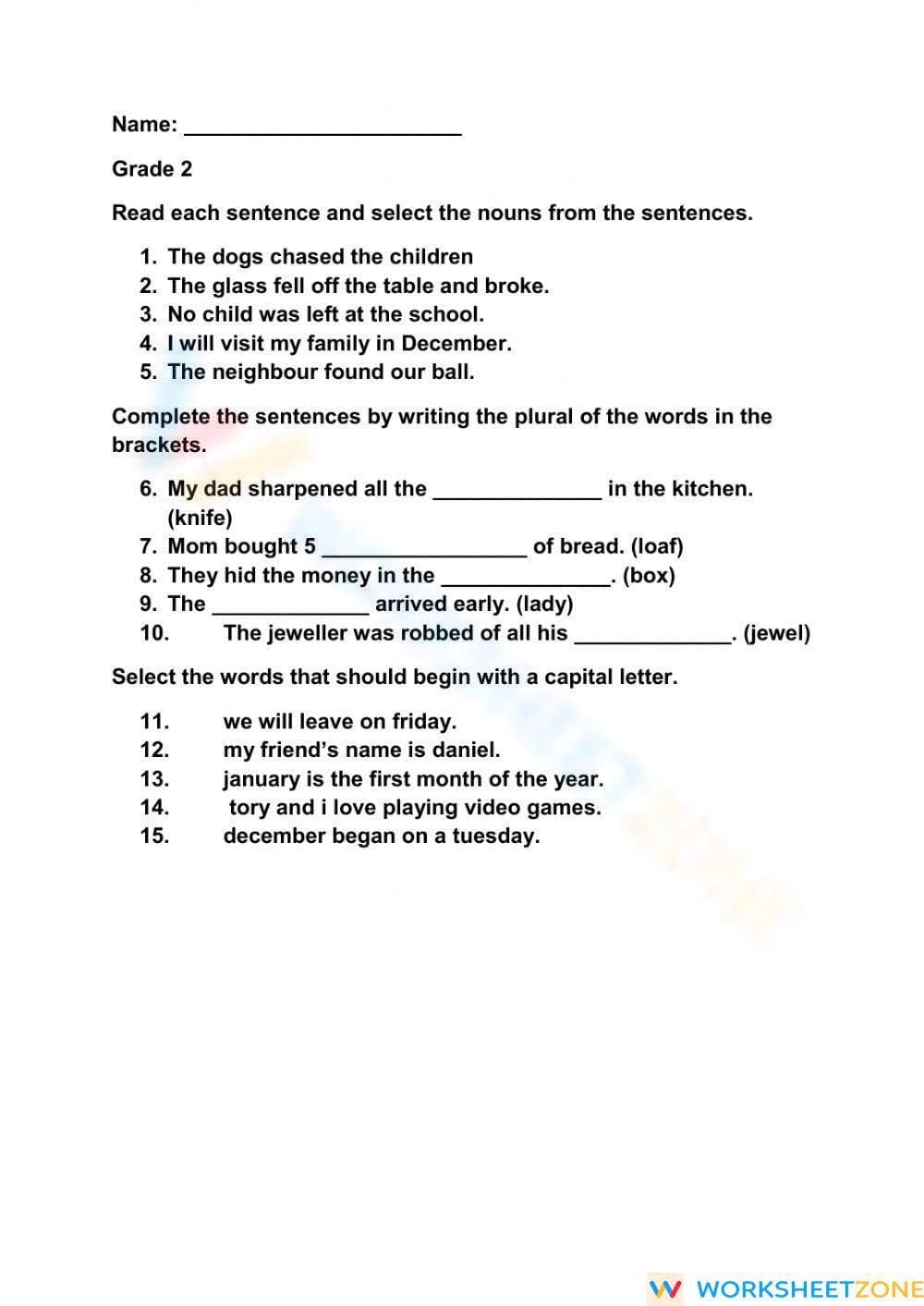

Essential Nouns and Capitalization Worksheet | Grade 2
Paste this activity's link or code into your existing LMS (Google Classroom, Canvas, Teams, Schoology, Moodle, etc.).
Students can open and work on the activity right away, with no student login required.
You'll still be able to track student progress and results from your teacher account.
This printable Grade 2 English Language Arts worksheet provides a comprehensive review of nouns, pluralization, and capitalization. Students will strengthen their lexical skills by identifying common nouns, transforming singular words into plurals, and correcting capitalization errors. It is an ideal resource for reinforcing foundational grammar through structured, independent practice that builds confidence and accuracy.
At a Glance
- Grade: 2 · Subject: English Language Arts
- Standard:
CCSS.ELA-LITERACY.L.2.1.B— Use frequently occurring nouns and pluralize words ending in y, f, and x- Skill Focus: Noun Identification, Plurals, and Capitalization
- Format: 1 page · 15 problems · Answer key included · PDF
- Best For: Grammar review and morning work
- Time: 15–20 minutes
Inside this one-page PDF, you will find 15 targeted practice problems. The first five tasks require students to identify nouns in sentences. The next five focus on pluralizing words with tricky endings like "knife" and "lady." The final five exercises challenge students to correct capitalization errors involving days, months, and names. A full answer key is included for efficient grading and immediate feedback.
The "print-and-go" design ensures this worksheet is classroom-ready in seconds. Step 1: Print the single-page document (30 seconds). Step 2: Distribute to students for independent practice or as a quick formative assessment (1 minute). Step 3: Review answers using the provided key (5 minutes). Total teacher preparation time is under two minutes, making it a perfect solution for sub plans, morning work, or unexpected schedule shifts.
This resource is primarily aligned with CCSS.ELA-LITERACY.L.2.1.B, which requires students to form and use frequently occurring irregular plural nouns. It also supports CCSS.ELA-LITERACY.L.2.2.A by asking students to capitalize holidays, geographic names, days of the week, and months. Both standard codes can be copied directly into lesson plans, IEP goals, or district curriculum mapping tools to ensure instructional alignment and rigorous practice.
This worksheet is best used during the "Independent Practice" phase of a grammar lesson. It serves as an excellent formative assessment tool; teachers should observe if students correctly apply spelling rules when pluralizing "knife" or "box," providing immediate insight into their mastery. Expect students to complete the 15 tasks in approximately 15 to 20 minutes. It works well as a post-instruction check or a remediation activity for students needing extra support.
This resource is designed for second-grade students building their lexical foundations. It is also suitable for third-grade students needing a refresher or English Language Learners (ELL) working on pluralization and capitalization. Pair this worksheet with a noun-sorting anchor chart or a short reading passage to provide a well-rounded instructional experience that transitions students from guided instruction to independent mastery of English conventions.
Research from Fisher & Frey (2014) emphasizes the importance of the gradual release of responsibility model, where students move from teacher-led modeling to independent application of grammar rules. This worksheet facilitates that transition by providing isolated practice on nouns, plurals, and capitalization aligned to CCSS.ELA-LITERACY.L.2.1.B. By engaging with 15 distinct tasks, learners solidify their understanding of standard English conventions. The inclusion of pluralization rules for words ending in "y" and "f" aligns with high-leverage spelling instructions recommended for early elementary grades. Educators can use the results to identify specific gaps in capitalization logic, ensuring subsequent direct instruction is data-driven. This focused practice leads to long-term retention of grammatical structures and improved writing clarity across the curriculum. The clear layout supports cognitive load management for young learners.


