


























0
Views
0
Downloads

Save
0 Likes
Share
Non-Verbal Messages Worksheet: Understanding Communication
0 Views
0 Downloads
Paste this activity's link or code into your existing LMS (Google Classroom, Canvas, Teams, Schoology, Moodle, etc.).
Students can open and work on the activity right away, with no student login required.
You'll still be able to track student progress and results from your teacher account.
Information
Description
What It Is:
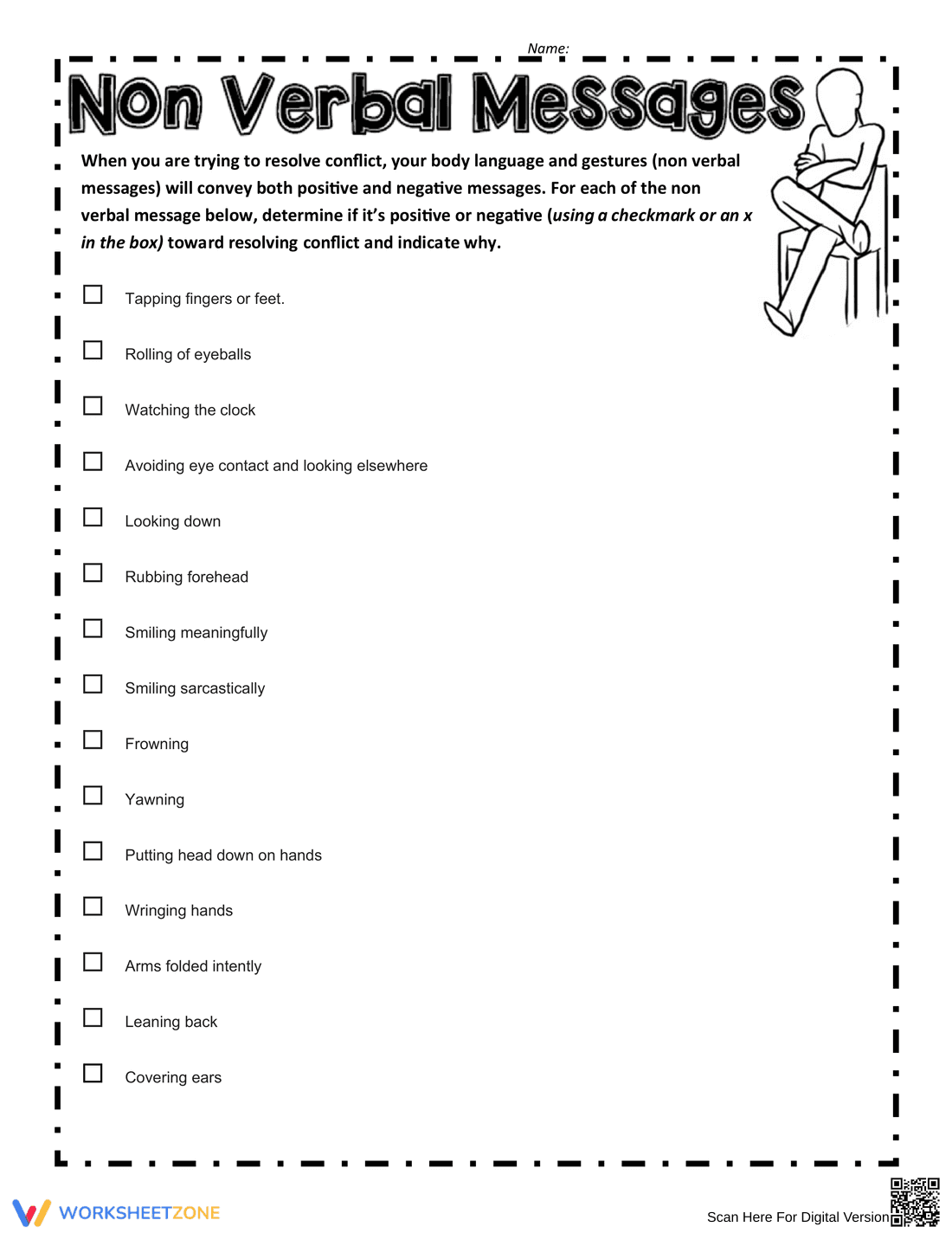
This is a worksheet titled 'Non Verbal Messages' designed to help students identify and interpret non-verbal cues in conflict resolution. The worksheet lists various body language examples such as 'Tapping fingers or feet,' 'Rolling of eyeballs,' 'Avoiding eye contact,' 'Frowning,' and 'Covering ears.' Students are instructed to determine if each non-verbal message is positive or negative and indicate why, using a checkmark or an 'x' in the provided boxes.
Grade Level Suitability:
This worksheet is suitable for grades 4-8. The concepts are accessible to upper elementary and middle school students, and the activity promotes critical thinking and social-emotional learning, which are important skills for this age group.
Why Use It:
This worksheet helps students develop their understanding of non-verbal communication and its impact on conflict resolution. It encourages them to think critically about how body language and gestures can convey different messages and how these messages can affect interactions. It also promotes empathy and awareness of social cues.
How to Use It:
Students should read each non-verbal message listed on the worksheet. They then need to decide whether the message is generally positive or negative in a conflict situation. They should mark the corresponding box with a checkmark or an 'x' and provide a brief explanation of their reasoning.
Target Users:
This worksheet is ideal for teachers, counselors, and parents who want to teach children about non-verbal communication, conflict resolution, and social skills. It can be used in classroom settings, small group activities, or as an individual assignment.
This is a worksheet titled 'Non Verbal Messages' designed to help students identify and interpret non-verbal cues in conflict resolution. The worksheet lists various body language examples such as 'Tapping fingers or feet,' 'Rolling of eyeballs,' 'Avoiding eye contact,' 'Frowning,' and 'Covering ears.' Students are instructed to determine if each non-verbal message is positive or negative and indicate why, using a checkmark or an 'x' in the provided boxes.
Grade Level Suitability:
This worksheet is suitable for grades 4-8. The concepts are accessible to upper elementary and middle school students, and the activity promotes critical thinking and social-emotional learning, which are important skills for this age group.
Why Use It:
This worksheet helps students develop their understanding of non-verbal communication and its impact on conflict resolution. It encourages them to think critically about how body language and gestures can convey different messages and how these messages can affect interactions. It also promotes empathy and awareness of social cues.
How to Use It:
Students should read each non-verbal message listed on the worksheet. They then need to decide whether the message is generally positive or negative in a conflict situation. They should mark the corresponding box with a checkmark or an 'x' and provide a brief explanation of their reasoning.
Target Users:
This worksheet is ideal for teachers, counselors, and parents who want to teach children about non-verbal communication, conflict resolution, and social skills. It can be used in classroom settings, small group activities, or as an individual assignment.


