


























Views
Plays


Grade 12 Insurance Literacy — Essential Printable Quiz
Paste this activity's link or code into your existing LMS (Google Classroom, Canvas, Teams, Schoology, Moodle, etc.).
Students can open and work on the activity right away, with no student login required.
You'll still be able to track student progress and results from your teacher account.
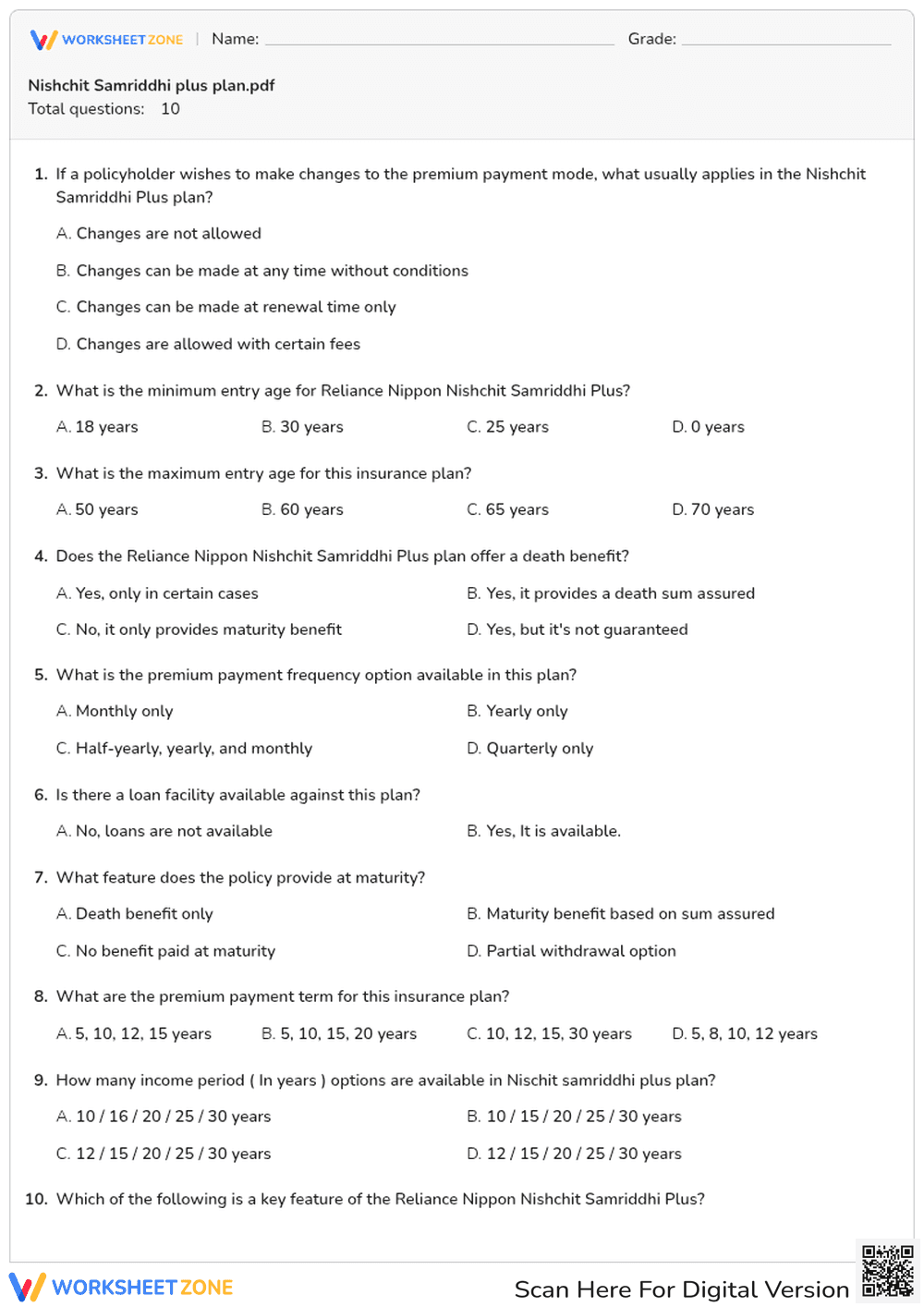
This Grade 12 financial literacy worksheet provides a structured assessment of insurance policy comprehension. Students analyze specific plan details to identify key features like entry age, premium frequencies, and maturity benefits. By engaging with technical informational text, learners build the critical reading skills necessary for real-world financial independence and informed decision-making.
At a Glance
- Grade: 12 · Subject: Financial Literacy
- Standard:
CCSS.ELA-LITERACY.RI.11-12.1— Cite strong and thorough textual evidence to support analysis of technical informational texts- Skill Focus: Insurance Policy Comprehension
- Format: 2 pages · 10 problems · Answer key included · PDF
- Best For: Quick formative assessment or sub plans
- Time: 15–20 minutes
The worksheet contains 10 multiple-choice questions spread across 2 pages. Each question targets a specific technical detail of a life insurance plan, requiring students to distinguish between similar numerical values and policy conditions. The layout is clean and professional, featuring a dedicated space for student names and grades, making it ready for immediate classroom distribution.
This resource is designed for a zero-prep classroom environment. Teachers can print the 2-page PDF in less than 60 seconds. Distribution takes approximately 1 minute, and because the questions are structured as clear multiple-choice items, grading or peer-reviewing the 10 responses can be completed in under 5 minutes. Total teacher preparation time is less than 2 minutes, making it an ideal choice for busy instructional days or unexpected substitute teacher needs.
This assessment aligns with CCSS.ELA-LITERACY.RI.11-12.1. This standard requires students to cite strong and thorough textual evidence to support analysis of what the text says explicitly as well as inferences drawn from the text. By identifying specific policy terms, students demonstrate mastery of literal comprehension within complex informational documents. Both standard codes can be copied directly into lesson plans, IEP goals, or district curriculum mapping tools.
Use this worksheet as a formative assessment after a lesson on personal finance or risk management. It serves as an excellent check for understanding to see if students can navigate the dense language of insurance documents. Alternatively, assign it as a silent reading activity where students must justify their answers by underlining the relevant policy text. Completion typically takes 15 to 20 minutes depending on prior knowledge.
This resource is tailored for Grade 12 students in Economics, Business Education, or Life Skills courses. It is particularly effective for learners who benefit from concrete, real-world applications of reading skills. Pair this quiz with a sample insurance brochure or a direct instruction lesson on the Four Pillars of Financial Planning to provide a comprehensive learning experience.
According to the RAND AIRS 2024 report on secondary literacy, the ability to parse technical informational texts is a primary indicator of post-secondary career readiness. This worksheet addresses that need by forcing students to engage with the specific nomenclature of the insurance industry, such as premium payment mode and maturity benefit. By practicing with 10 targeted questions, students move beyond general reading and into the specialized domain of financial literacy. The CCSS.ELA-LITERACY.RI.11-12.1 alignment ensures that the task remains rigorous and focused on evidence-based analysis. Research from Fisher & Frey (2014) suggests that frequent, low-stakes assessments of complex texts significantly improve long-term retention of technical vocabulary. This worksheet provides that exact opportunity, offering a clear path for students to demonstrate their ability to extract precise data from professional documents while minimizing teacher administrative burden.


