


























Views
Downloads

Newton's Second Law Worksheet | Printable Grade 8 Science
Paste this activity's link or code into your existing LMS (Google Classroom, Canvas, Teams, Schoology, Moodle, etc.).
Students can open and work on the activity right away, with no student login required.
You'll still be able to track student progress and results from your teacher account.
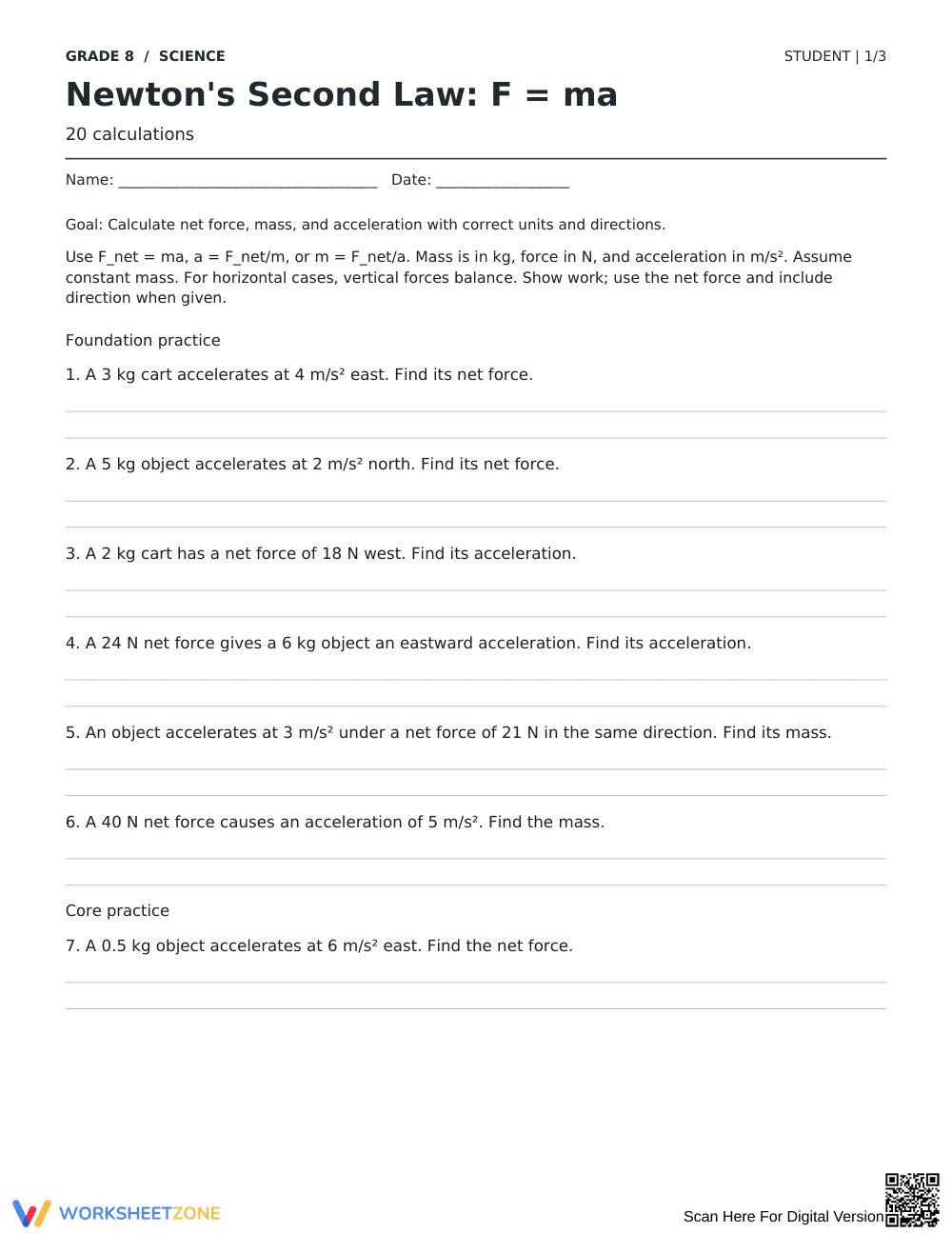
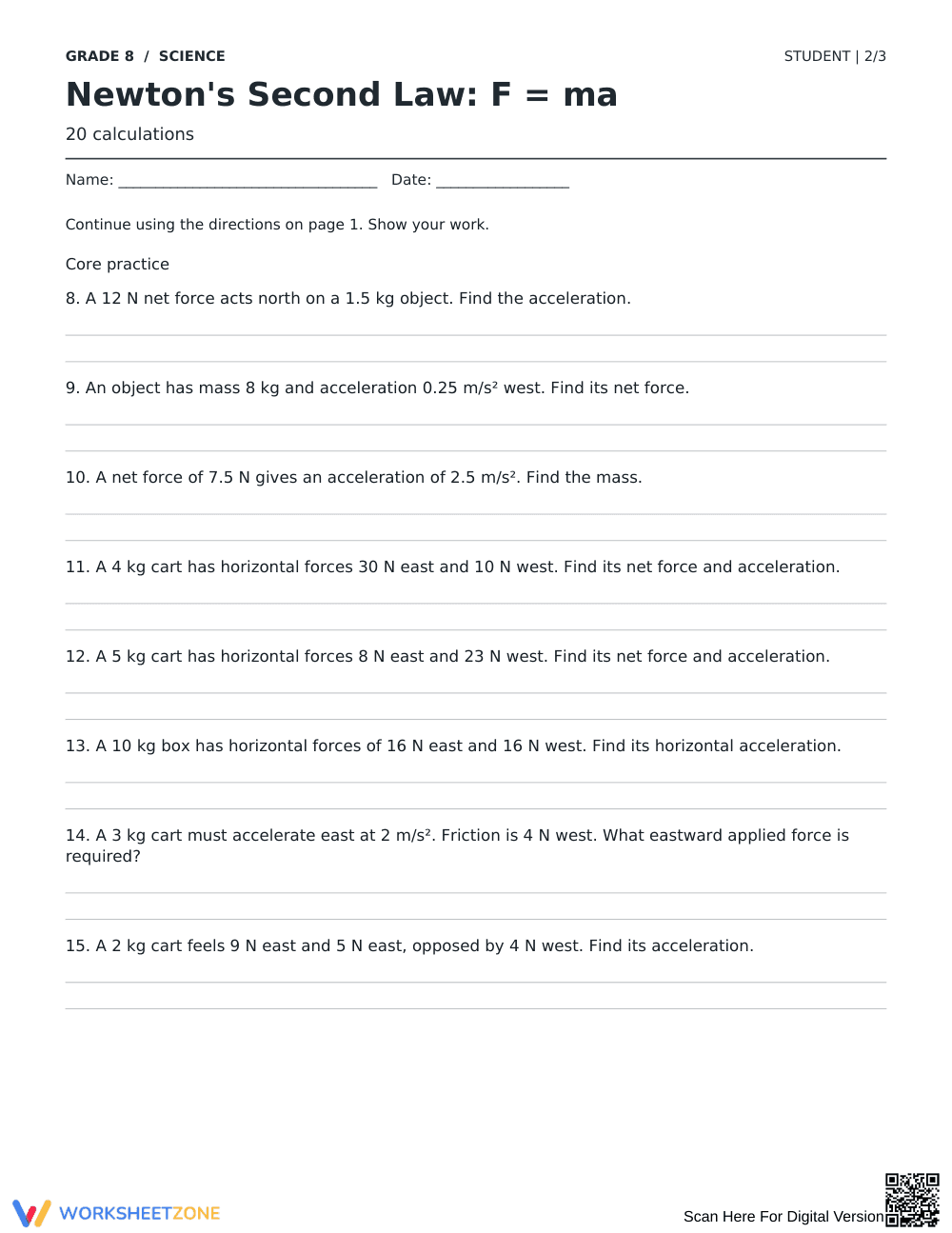
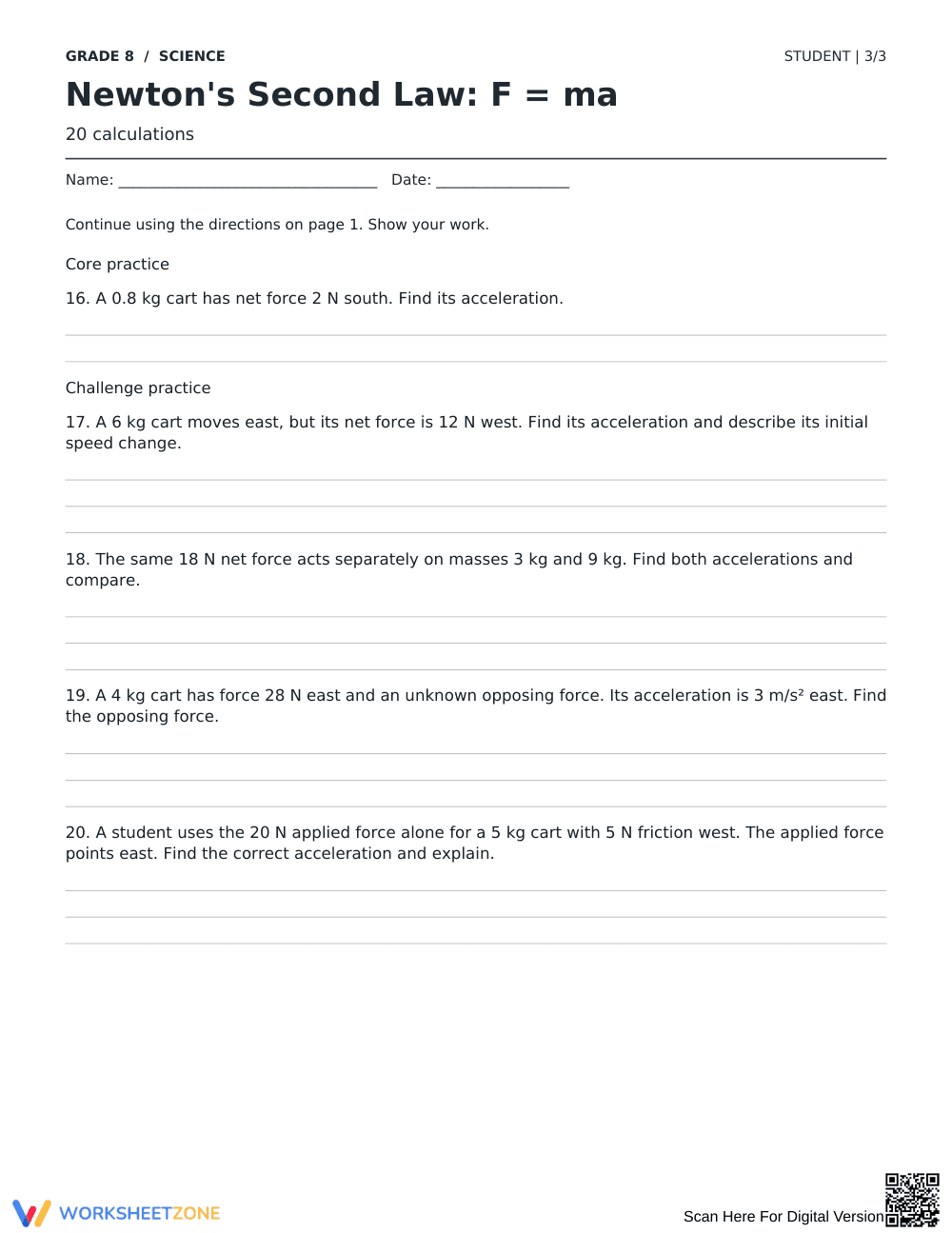
Mastering Newton's second law requires students to connect mathematical equations with physical forces. This 3-page science worksheet delivers 20 targeted calculation problems guiding eighth graders to apply F = ma. Students solve for net force, mass, and acceleration with correct units and directions, building solid quantitative mechanics fluency.
At a Glance
- Grade: 8 · Subject: Science
- Standard:
MS-PS2-2— Plan an investigation to show how force and mass change an object's motion- Skill Focus: Newton's second law calculations (F = ma)
- Format: 3 pages · 20 problems · Answer key included · PDF
- Best For: Independent practice and mechanics review
- Time: 30–45 minutes
What's Inside
This resource includes a 3-page student worksheet with 20 calculation problems and a 2-page answer key showing step-by-step solutions. Top reference notes provide equation variations (F = ma, a = F/m, m = F/a) and metric units. Tasks range from simple single-force equations to complex multi-directional force vectors with friction.
Skill Progression
- Guided practice (Foundation, problems 1–6): Single-variable direct substitution solving for force, mass, or acceleration using whole numbers and designated directions.
- Supported practice (Core, problems 7–16): Multi-step scenarios incorporating decimals, opposing horizontal vectors, and friction to calculate net force.
- Independent practice (Challenge, problems 17–20): Unassisted synthesis problems where students deduce unknown opposing forces and analyze acceleration changes across varying masses.
This progression mirrors the gradual-release model, fostering student confidence before introducing complex mechanics.
Standards Alignment
This worksheet aligns to `MS-PS2-2`: "Plan an investigation to provide evidence that the change in an object's motion depends on the sum of the forces on the object and the mass of the object." It additionally reinforces `CCSS.MATH.CONTENT.7.EE.B.4` through linear equation solving. Both standard codes can be copied directly into lesson plans, IEP goals, or district curriculum mapping tools.
How to Use It
Use this worksheet after direct instruction on net force to reinforce physics formulas. It serves effectively as partner practice or homework. As a formative assessment check, inspect problem 11 to see whether learners calculate net force before finding acceleration. Completion typically requires 30 to 45 minutes.
Who It's For
Designed for middle school physical science students, this printable accommodates varied math backgrounds through clearly tiered calculations. Pair this resource with a hands-on dynamics cart lab or a free-body diagram anchor chart to bridge conceptual motion and quantitative calculation.
According to Fisher & Frey (2014), gradual-release instructional frameworks substantially increase student mastery in analytical problem-solving by transitioning learners systematically from modeled instruction to autonomous execution. This resource operationalizes that research through its tiered structure, guiding eighth-grade science students through the quantitative mechanics of Newton's second law under standard MS-PS2-2. By calculating net force, mass, and acceleration across 20 scaffolded exercises, learners move beyond simple rote arithmetic toward authentic scientific reasoning. The intentional sequencing begins with elementary one-step equations before introducing conflicting directional vectors and frictional forces, directly preventing common cognitive misconceptions regarding unbalanced systems. Middle school students establish lasting competence when mathematical practice reinforces empirical physical concepts, bridging abstract formulas with observable motion dynamics. Consequently, this worksheet serves as an evidence-based tool for developing rigorous calculation habits, promoting analytical persistence, and securing measurable gains in middle school physical science achievement.


