


























Views
Downloads
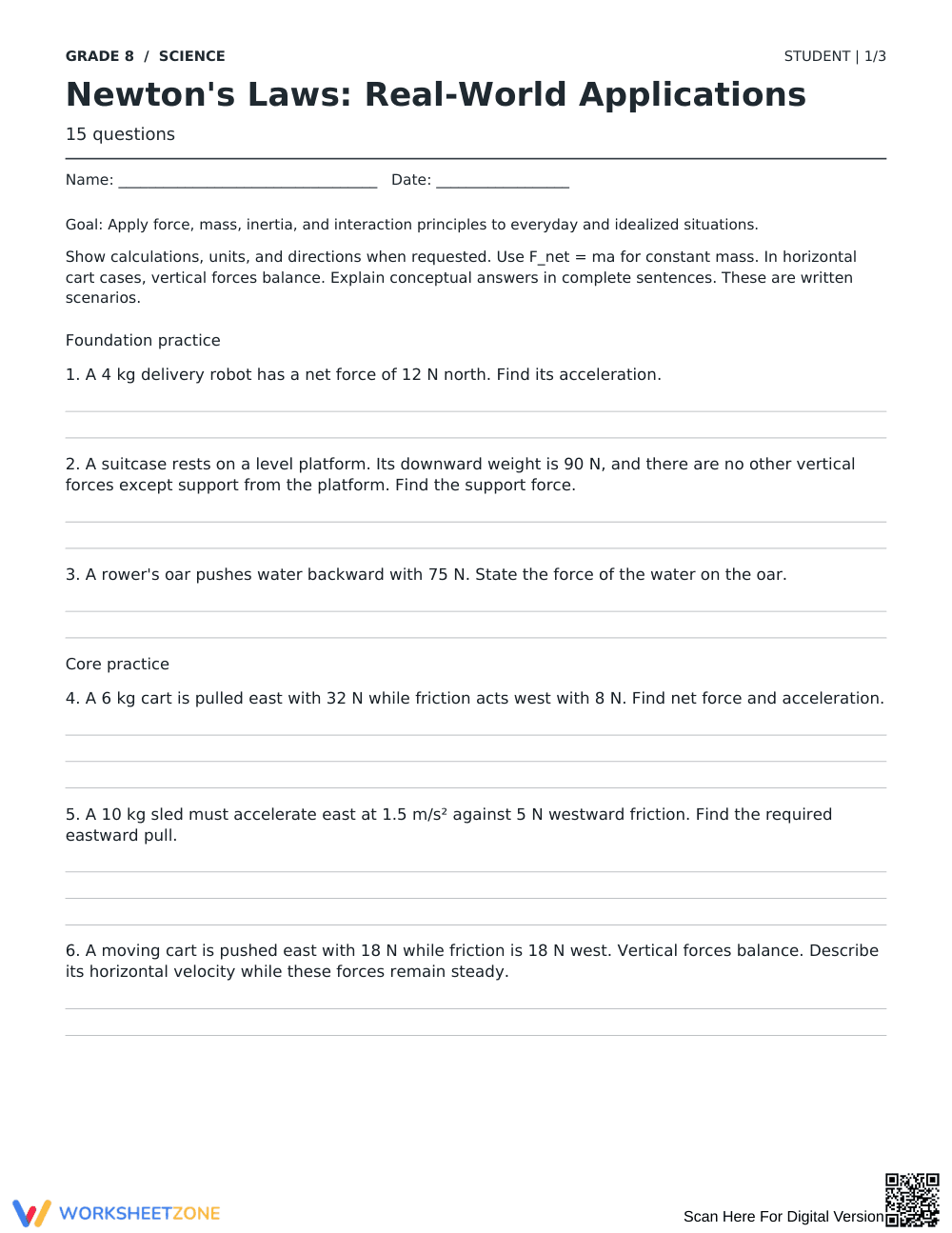
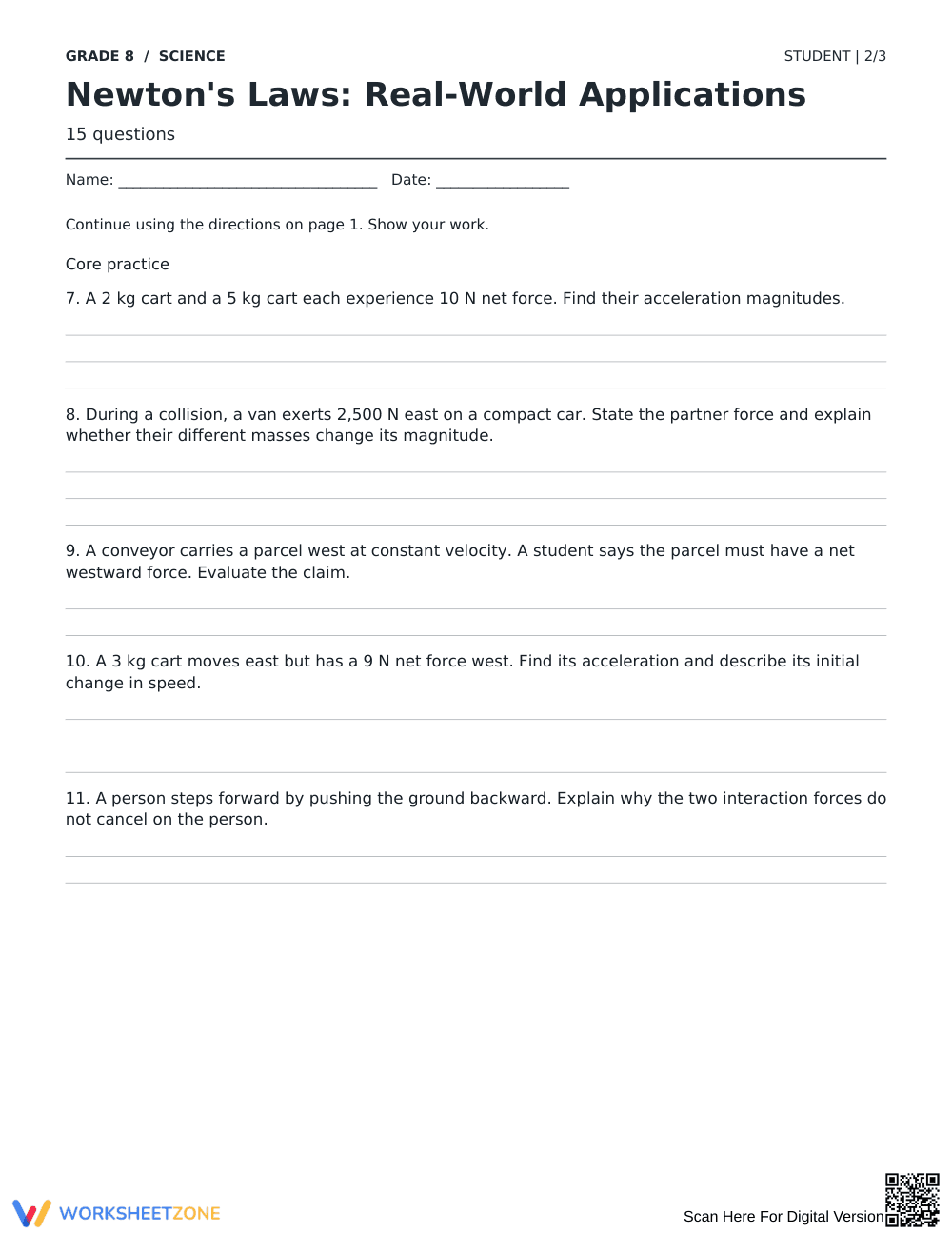
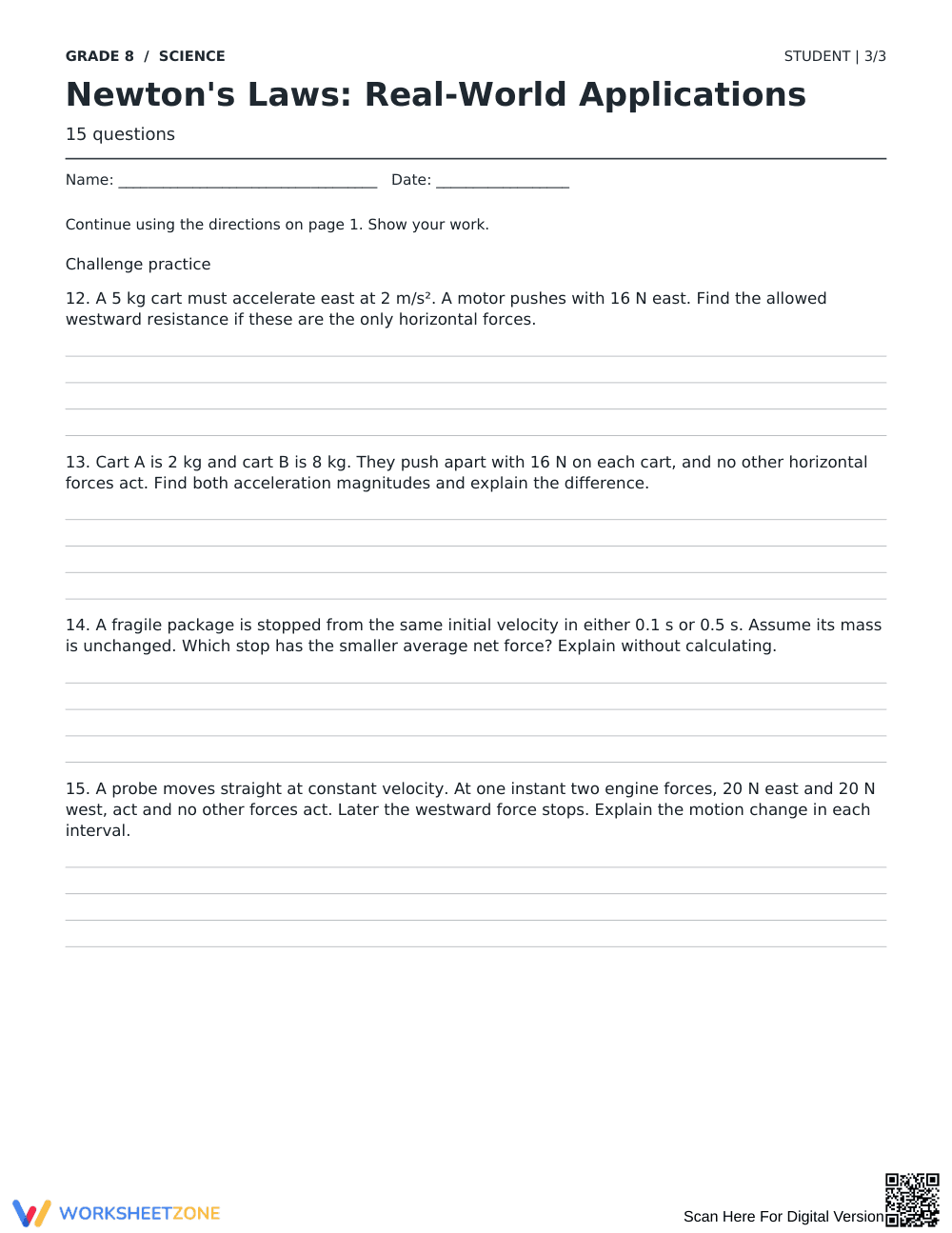

Newton's Laws Worksheet | Grade 8 Science Printable
Paste this activity's link or code into your existing LMS (Google Classroom, Canvas, Teams, Schoology, Moodle, etc.).
Students can open and work on the activity right away, with no student login required.
You'll still be able to track student progress and results from your teacher account.
This Grade 8 science worksheet builds student mastery of Newton's Three Laws of Motion by connecting each law to observable, real-world situations—giving students 18 structured problems that move from identification to explanation and application. Students finish the activity able to distinguish among all three laws and justify their reasoning with evidence-based language.
At a Glance
- Grade: 8 · Subject: Science (Physical Science)
- Standard:
MS-PS2-1— Apply Newton's Third Law to predict forces on objects in a system- Skill Focus: Identifying and applying Newton's First, Second, and Third Laws to real-world scenarios
- Format: 3 pages · 18 problems · Answer key included · PDF
- Best For: Guided or independent practice after direct instruction
- Time: 25–40 minutes
The worksheet spans three pages and includes scenario-based identification tasks, short-answer explanation prompts, and applied calculation problems addressing all three laws. Each section is clearly labeled by law, making it easy for students to track progress. A complete answer key with model responses supports efficient teacher review and self-correction.
- Guided practice: The opening section presents labeled diagrams and scenario stems where students identify which law applies, with sentence-frame support built into the prompts (approximately 6 problems).
- Supported practice: The middle section asks students to explain why a scenario illustrates a specific law, requiring references to force, mass, acceleration, or action-reaction pairs (approximately 6 problems).
- Independent practice: The final section presents novel situations—including a skateboard collision, a rocket launch, and a braking car—where students identify the law, explain forces involved, and in select items calculate net force or acceleration using F = ma (approximately 6 problems).
This gradual-release structure mirrors the I Do, We Do, You Do model, allowing teachers to use the worksheet across a single class period or split it across two days.
Standards Alignment
The primary standard is MS-PS2-1: Apply Newton's Third Law to design a solution to a problem involving the motion of two colliding objects. The worksheet also supports MS-PS2-2, addressing the relationship between force, mass, and acceleration as students complete F = ma calculations. Both codes can be copied directly into lesson plans or curriculum mapping tools.
How to Use It
Assign the guided and supported sections during direct instruction as a check-for-understanding tool, pausing after each section to address misconceptions. Alternatively, use the full worksheet after a Newton's Laws lesson as a formative assessment—observe whether students confuse Newton's First and Second Laws, which signals a need for reteaching inertia vs. net force. Expected completion time is 25–40 minutes.
Who It's For
This worksheet is designed for Grade 8 physical science students in a forces and motion unit. It works as a whole-class assignment, partner activity, or independent seat work. Teachers supporting students with IEPs or English learners can pair this resource with a Newton's Laws anchor chart defining key vocabulary (inertia, net force, action-reaction) to reduce language barriers without lowering cognitive demand.
The three-section design ensures students build conceptual understanding before tackling quantitative application, a sequencing approach consistent with high-quality instructional materials. Teachers can use student performance on the independent section as a data point for standards mastery documentation or progress monitoring.


