




























Views
Downloads

Newton's Laws Worksheet | Essential Grade 8 Science

Paste this activity's link or code into your existing LMS (Google Classroom, Canvas, Teams, Schoology, Moodle, etc.).
Students can open and work on the activity right away, with no student login required.
You'll still be able to track student progress and results from your teacher account.
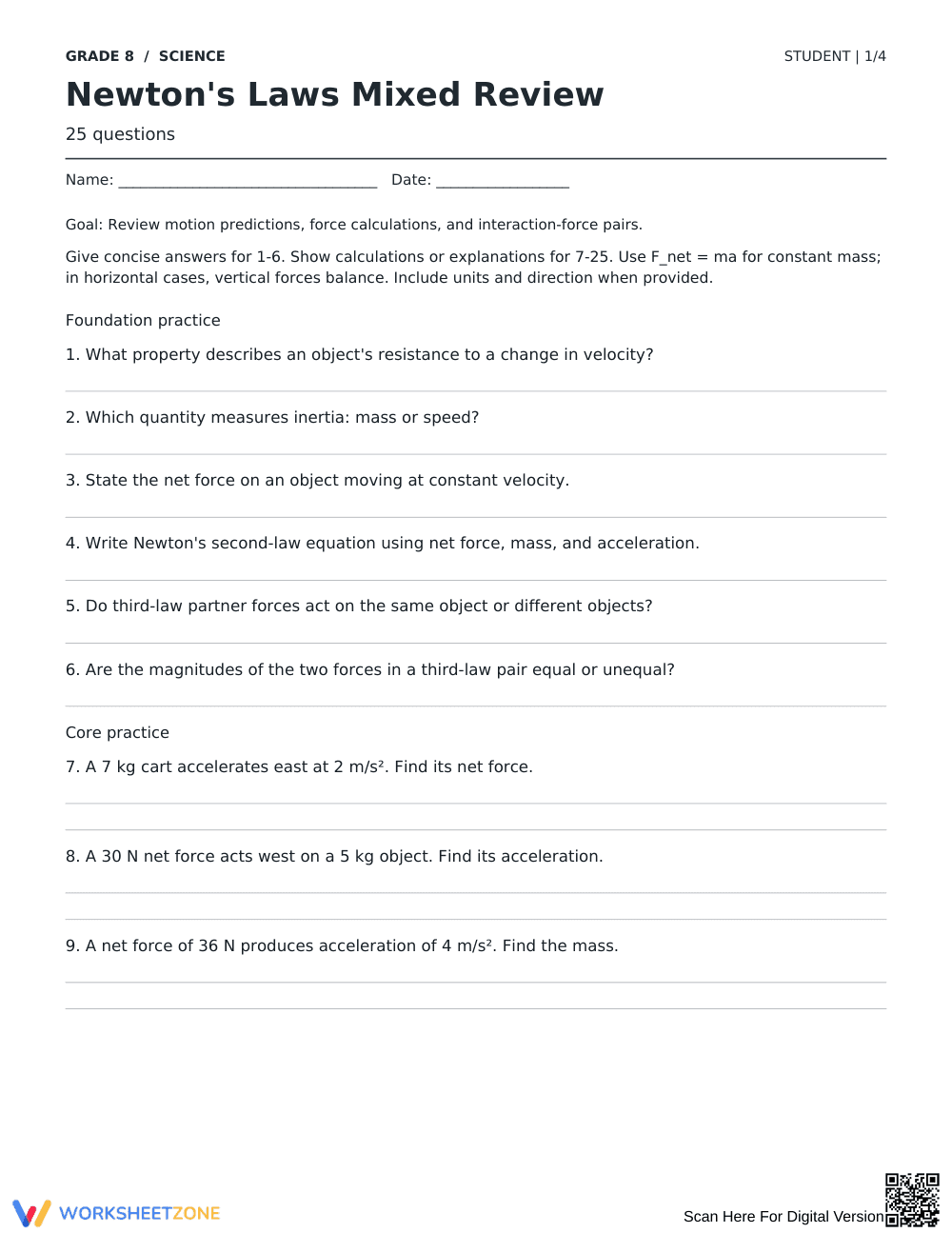
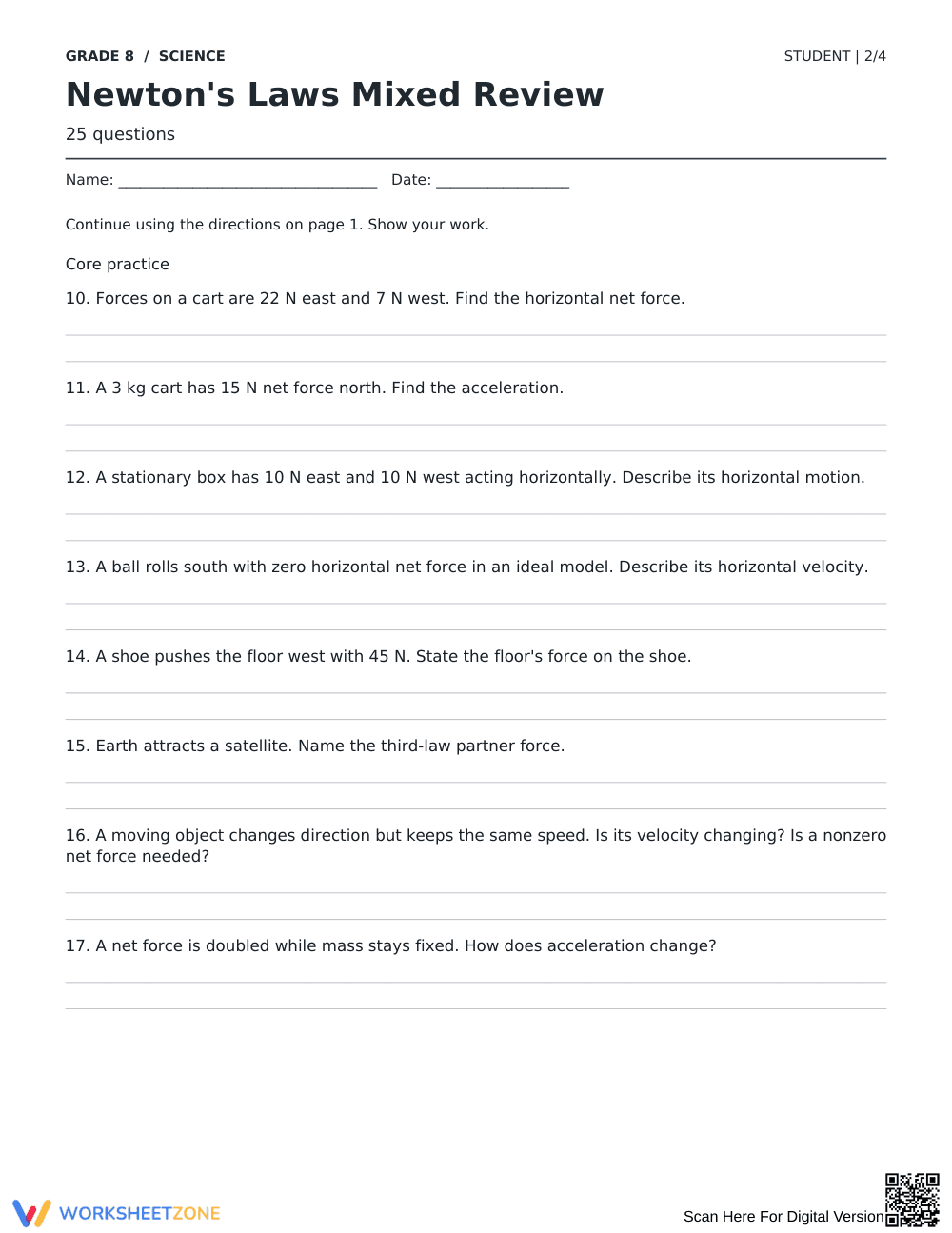
This Newton's laws mixed review worksheet provides eighth-grade students with practice analyzing motion, calculating resultant forces, and evaluating action-reaction pairs. Across twenty-five structured problems, learners build conceptual understanding and mathematical fluency with Newtonian mechanics, predicting motion changes and solving one-dimensional force calculations accurately.
At a Glance
- Grade: 8 · Subject: Science
- Standard:
MS-PS2-2— Predict motion changes by analyzing force sums and object mass- Skill Focus: Newton's Three Laws of Motion and Net Force
- Format: 4 student pages · 25 problems · Answer key included · PDF
- Best For: Mid-unit review and assessment prep
- Time: 30–45 minutes
What's Inside
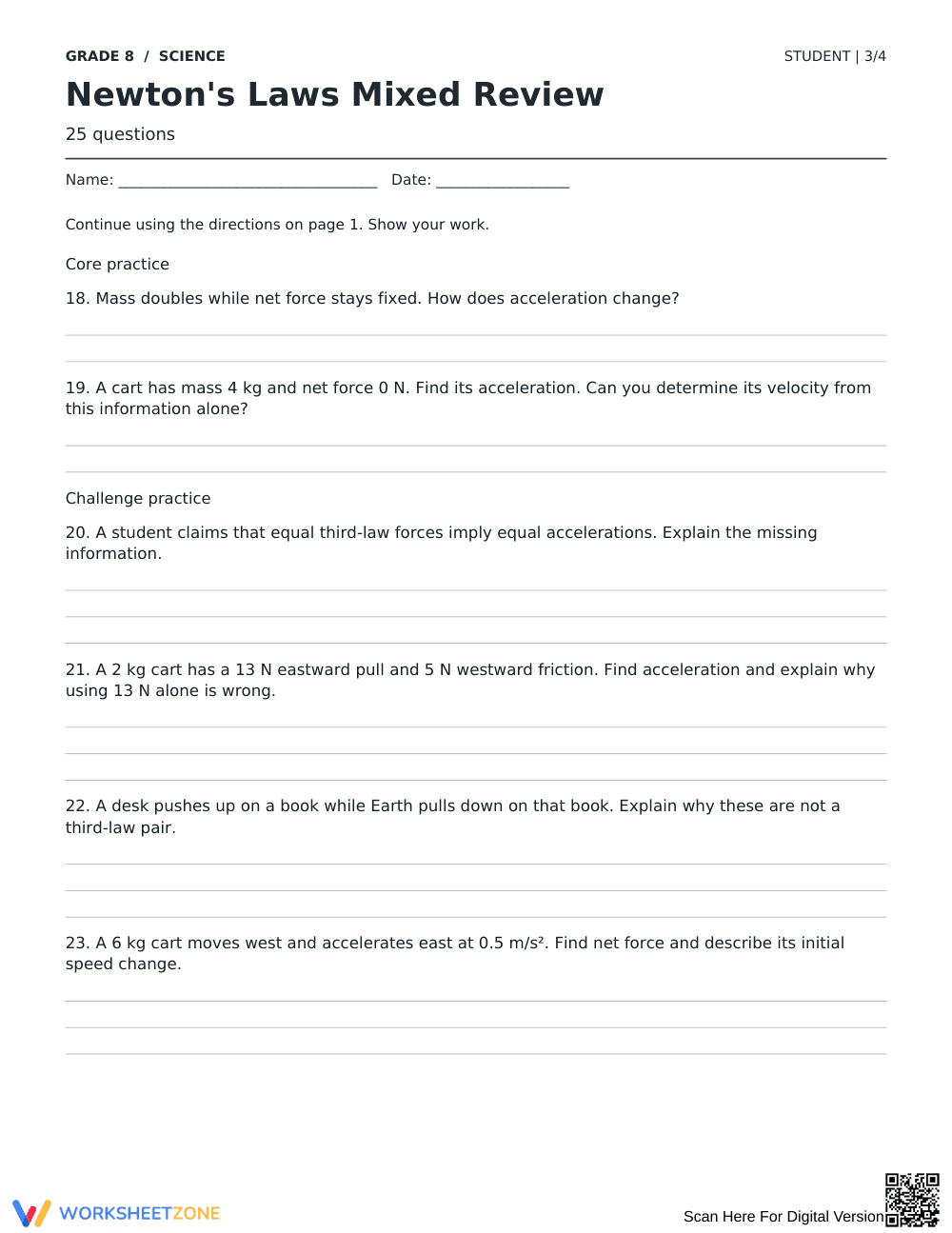
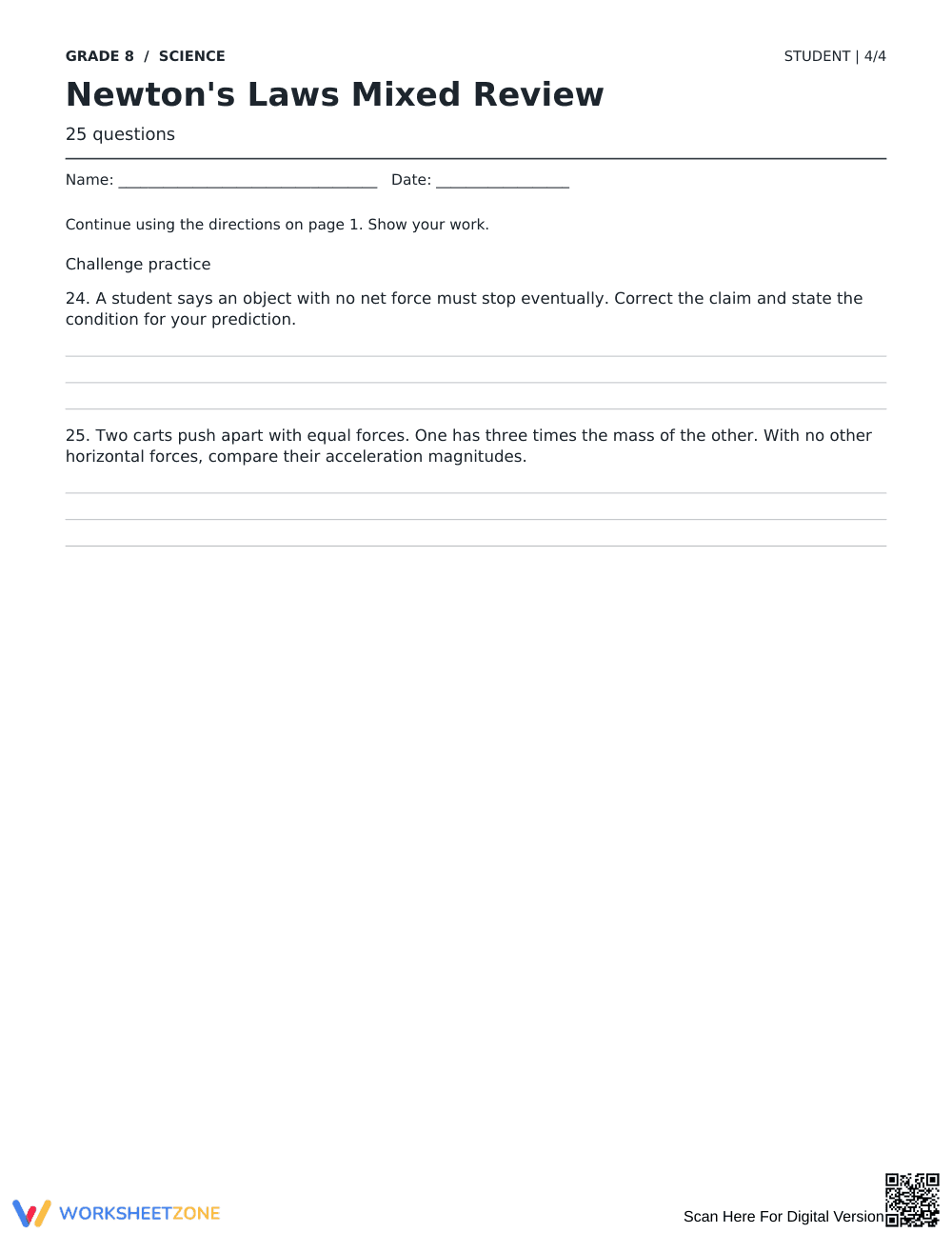
This resource features four student pages with twenty-five sequential problems and a two-page answer key with scoring criteria. Students complete foundational recall questions, calculate net force and acceleration using algebraic equations, resolve opposing vectors, and evaluate common physics misconceptions in short written responses.
Skill Progression
- Guided practice (Problems 1–6): Six foundational recall items review inertia, balanced forces, formula definitions, and third-law action-reaction rules.
- Supported practice (Problems 7–19): Thirteen core application problems prompt students to calculate net force, mass, and acceleration while determining directional motion.
- Independent practice (Problems 20–25): Six challenge questions require error analysis, multi-step reasoning, and evaluation of friction and mass ratios.
This structure follows the gradual release of responsibility model, guiding learners from recall toward independent analytical reasoning.
Standards Alignment
This worksheet aligns directly to MS-PS2-2: Plan an investigation to provide evidence that the change in an object’s motion depends on the sum of the forces on the object and the mass of the object. It also supports MS-PS2-1 regarding interaction pairs. Both standard codes can be copied directly into lesson plans, IEP goals, or district curriculum mapping tools.
How to Use It
Assign this worksheet following direct instruction on Newton's laws for review or partner practice. Monitor students during problem 22 to ensure they do not confuse third-law interaction pairs with balanced forces on a single object. Expected completion requires 30 to 45 minutes of focused class time.
Who It's For
Designed for eighth-grade physical science classes, this resource also supports high school physics review and advanced seventh-grade learners. Provide reference formula sheets for students needing calculation accommodations. Pair this activity with an interactive cart demonstration or a force vector anchor chart.
Eighth grade physical science mastery under standard MS-PS2-2 requires learners to predict changes in an object's motion by calculating net forces and analyzing mass relationships. Research by Fisher & Frey (2014) establishes that structured cognitive instructional models—moving students purposefully from foundational definitions through guided computation to independent error analysis—substantially improve procedural retention and conceptual transfer in science classrooms. This twenty-five-question review operationalizes that pedagogical design by organizing Newtonian mechanics into graduated tiers of cognitive demand. Students first confirm fundamental principles of inertia and action-reaction pairs before calculating algebraic force values and resolving competing directional vectors. The final challenge tasks require critical evaluation of common physical misconceptions, reinforcing durable conceptual schemas over simple rote recall. Consequently, this comprehensive practice provides teachers with actionable diagnostic data while supporting rigorous middle school physical science performance standards during core mechanics units.


