




























Views
Downloads
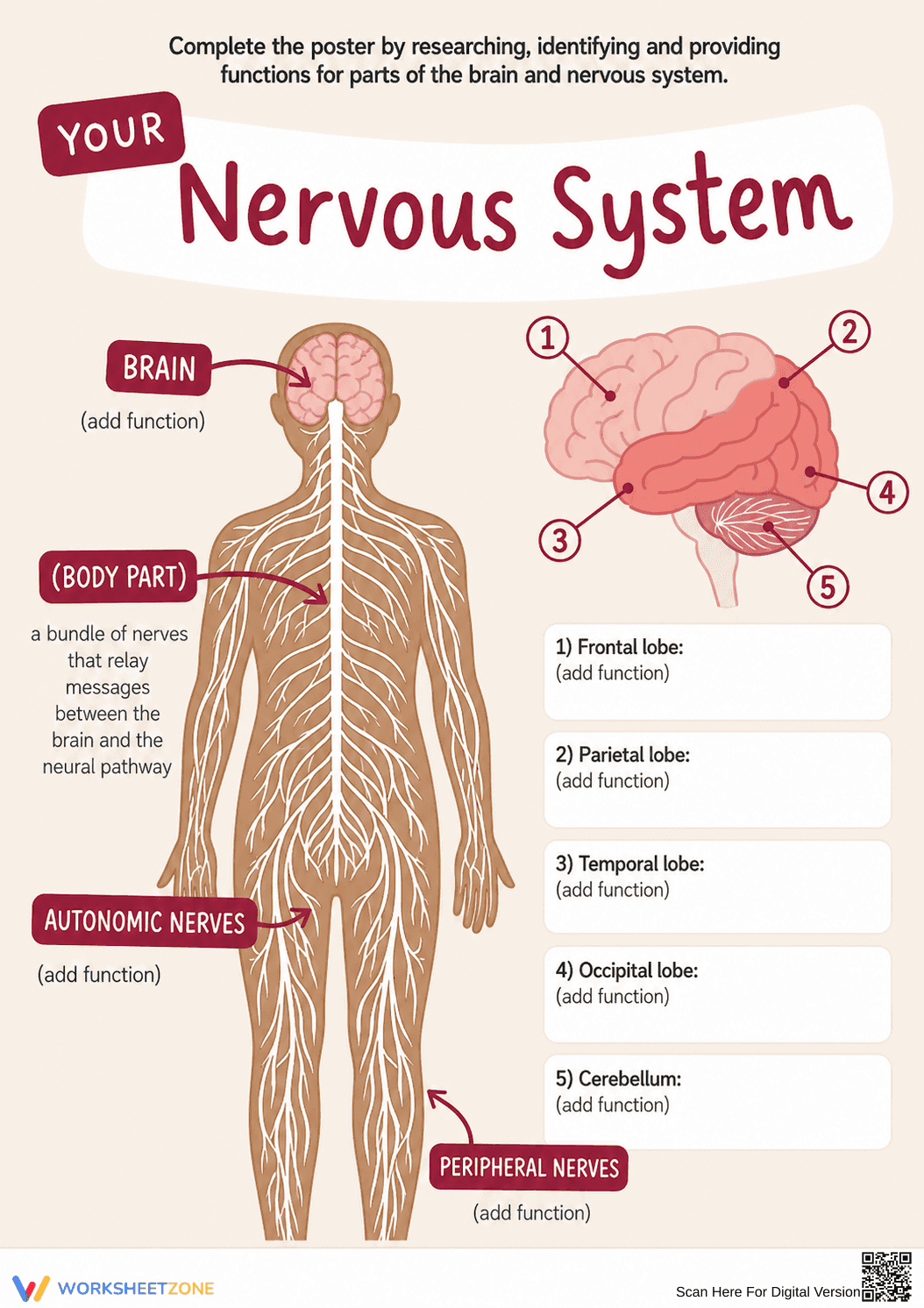

Essential Nervous System Functions Worksheet | Grade 6

Paste this activity's link or code into your existing LMS (Google Classroom, Canvas, Teams, Schoology, Moodle, etc.).
Students can open and work on the activity right away, with no student login required.
You'll still be able to track student progress and results from your teacher account.
Students master human anatomy by connecting complex biological structures to their specific physiological roles. This worksheet provides a visual framework for identifying the central and peripheral nervous systems, ensuring learners can explain how the brain processes information and controls the body. It transforms abstract biological concepts into a concrete, research-based activity.
At a Glance
- Grade: 6 · Subject: Science
- Standard:
MS-LS1-8— Gather and synthesize information on how the brain processes sensory stimuli- Skill Focus: Anatomical identification and functional analysis
- Format: 1 page · 8 problems · Answer key included · PDF
- Best For: Independent research or life science units
- Time: 25–35 minutes
What's Inside
This single-page science poster features a detailed anatomical diagram of the human nervous system and a cross-section of the brain. Students identify and provide functions for 8 critical components, including the frontal, parietal, temporal, and occipital lobes, the cerebellum, and the peripheral nerve network. Dedicated text boxes ensure a clean, organized final product suitable for classroom display.
Zero-Prep Workflow
- Print: Generate copies in seconds using the high-resolution PDF format.
- Distribute: Hand out posters as a transition activity or lesson launch.
- Review: Use the answer key to facilitate a peer-review session or whole-class discussion to verify research accuracy.
This resource is designed for immediate implementation, making it an ideal choice for emergency sub plans or supplemental practice during human body units.
Standards Alignment
This resource is primarily aligned to MS-LS1-8: Gather and synthesize information that sensory receptors respond to stimuli by sending messages to the brain for immediate behavior or storage as memories. By identifying the specific lobes of the brain responsible for processing different types of information, students build the foundational knowledge required for this middle school life science standard. This code can be copied directly into lesson plans or district curriculum mapping tools.
How to Use It
Use this worksheet during the "Explain" phase of a 5E instructional model. After students have been introduced to the nervous system through a lab or lecture, assign this poster as a formative assessment to check for understanding of specific brain regions. It also works effectively as a project-based learning starter where students use textbooks or digital resources to find the "job" of each labeled part. Expect most students to complete the research and labeling within 30 minutes.
Who It's For
This worksheet is designed for Grade 6 science students but is highly adaptable for Grade 5 or Grade 7 learners. It is particularly effective for visual learners who benefit from seeing the physical relationship between the brain and the rest of the body. It pairs naturally with an interactive human body atlas or a direct instruction lesson on the central nervous system.
This instructional resource aligns with the MS-LS1-8 standard, focusing on the synthesis of information regarding how sensory receptors and the brain interact to manage bodily functions. By requiring students to research and define specific roles for the frontal lobe, cerebellum, and peripheral nerves, the worksheet facilitates the transition from rote identification to functional understanding. Visual-spatial organizers significantly improve retention of complex biological systems in middle school learners. The structured layout serves as a cognitive scaffold, allowing students to organize anatomical facts within a coherent physiological context. This approach ensures that learners do not merely memorize names but understand the integrated nature of the human body. Educators can utilize this tool to meet rigorous state requirements while providing a clear evidence base for student mastery in life science curriculum mapping and assessment.


