




























Views
Downloads

Needs of Plants | Essential Grade 3 Science

Paste this activity's link or code into your existing LMS (Google Classroom, Canvas, Teams, Schoology, Moodle, etc.).
Students can open and work on the activity right away, with no student login required.
You'll still be able to track student progress and results from your teacher account.
This Grade 3 science worksheet helps students identify and explain the fundamental requirements for plant survival and growth. By connecting plant structures like roots and stems to their specific functions, learners develop a concrete understanding of how biological systems sustain life. It provides immediate practice in vocabulary application and conceptual synthesis.
At a Glance
- Grade: 3 · Subject: Science
- Standard:
3-LS1-1— Develop models to describe that organisms have unique and diverse life cycles- Skill Focus: Plant needs and structural functions
- Format: 2 pages · 10+ problems · Answer key included · PDF
- Best For: Independent practice or formative assessment
- Time: 15–20 minutes
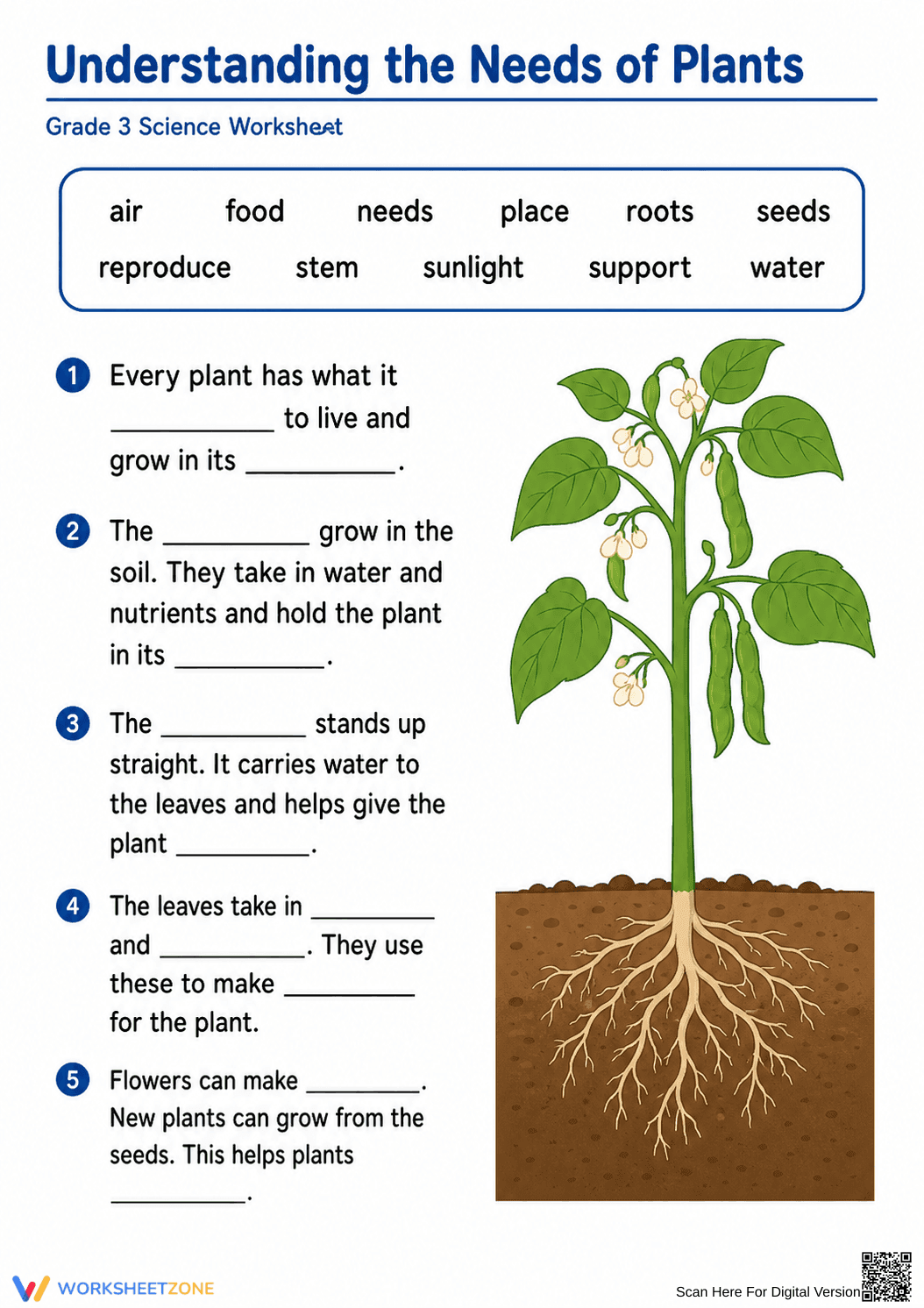
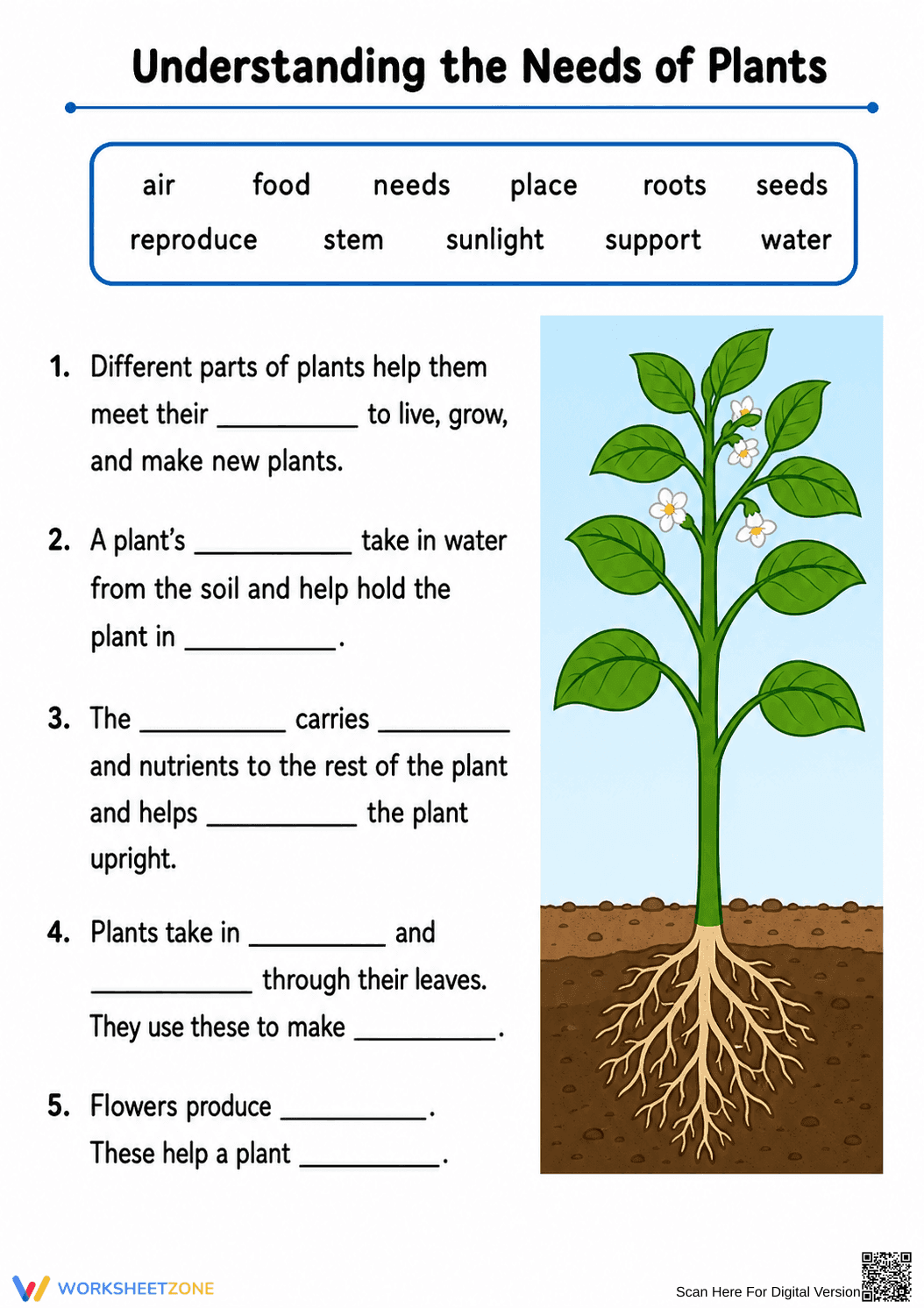
The resource contains two pages of structured fill-in-the-blank exercises supported by a clear word bank. Students use terms such as sunlight, nutrients, and reproduce to complete sentences describing the roles of roots, stems, leaves, and flowers. A detailed botanical illustration accompanies the text, providing a visual reference for the parts of a plant in soil and how they interact with the environment.
This worksheet is designed for a zero-prep classroom environment. Teachers can print the PDF in less than 30 seconds, distribute it to the class in 1 minute, and conduct a whole-group review in under 5 minutes. The self-contained word bank ensures that students can work independently without constant teacher intervention, making it an ideal choice for emergency sub plans or morning work.
Standards Alignment: Primary standard 3-LS1-1. This standard focuses on how organisms have unique and diverse life cycles but all have in common birth, growth, reproduction, and death. This worksheet specifically targets the growth and reproduction phases by examining the needs and structures required for a plant to reach maturity. Both standard codes can be copied directly into lesson plans, IEP goals, or district curriculum mapping tools.
Use this worksheet during the explain phase of a science lesson to reinforce direct instruction about plant biology. It serves as an excellent formative assessment tool; teachers should observe if students correctly associate the stem with support and water transport. Completion typically takes 15 to 20 minutes depending on reading speed and prior knowledge of the vocabulary terms.
This resource is tailored for third-grade students but is also appropriate for second-grade enrichment or fourth-grade review. It supports English Language Learners (ELLs) through the use of a word bank and visual diagrams. Pair this worksheet with a live classroom plant observation or a seed-planting activity to bridge the gap between paper and real-world science applications.
According to Fisher & Frey (2014), the use of scaffolded vocabulary tasks like fill-in-the-blank exercises helps bridge the gap between technical terminology and conceptual understanding in elementary science. This worksheet aligns with the 3-LS1-1 standard by requiring students to articulate how specific plant parts meet the biological needs of the organism. Research from the NAEP indicates that students who can identify the functional relationships between biological structures and environmental needs perform significantly better on standardized science assessments. By integrating visual models with linguistic practice, this resource reinforces the Structure and Function crosscutting concept essential for NGSS mastery. The 10 targeted tasks provide sufficient repetition to ensure that the vocabulary moves from short-term memory to long-term conceptual storage, facilitating a deeper grasp of the life cycle processes required for plant survival in diverse habitats.


