


























Views
Downloads

Neat Handwriting Practice | Grade 9-10 Essential
Paste this activity's link or code into your existing LMS (Google Classroom, Canvas, Teams, Schoology, Moodle, etc.).
Students can open and work on the activity right away, with no student login required.
You'll still be able to track student progress and results from your teacher account.
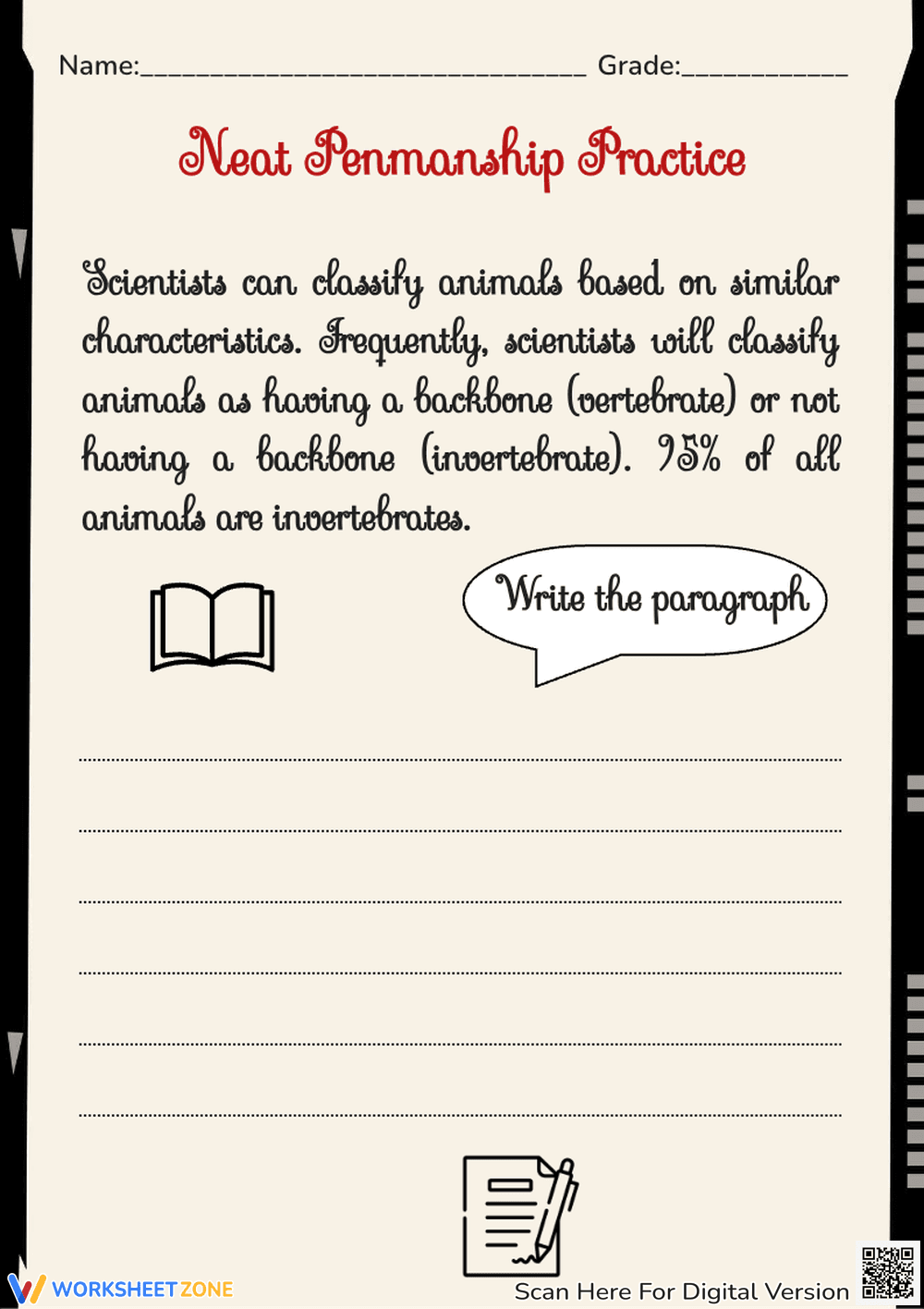
This Grade 9-10 handwriting worksheet helps students refine their penmanship through a science-themed transcription task. By copying a complex paragraph about animal classification, learners focus on letter formation, spacing, and legibility. It provides a sophisticated context for older students to practice fine motor control while reinforcing biological concepts.
At a Glance
- Grade: 9-10 · Subject: Handwriting
- Standard:
CCSS.ELA-LITERACY.L.9-10.1— Demonstrate command of the conventions of standard English grammar and usage when writing- Skill Focus: Neat penmanship and transcription
- Format: 1 page · 1 paragraph · No answer key needed · PDF
- Best For: Daily bell-ringers or fine motor practice
- Time: 10–15 minutes
The worksheet features a clear, stylized header and a 3-sentence paragraph regarding vertebrates and invertebrates. Below the text, six wide-ruled lines provide ample space for students to rewrite the passage. The layout is clean and distraction-free, ensuring the focus remains entirely on the quality of the student's handwriting and the accuracy of their transcription.
Zero-Prep Workflow
- Print: Select the single-page PDF and print enough copies for your class (30 seconds).
- Distribute: Hand out the worksheets as a bell-ringer or transition activity (1 minute).
- Review: Walk the room to provide immediate feedback on letter formation and spacing (30 seconds).
Total teacher preparation time is under 2 minutes, making this an ideal resource for sub plans or daily warm-ups.
Standards Alignment
This resource aligns with `CCSS.ELA-LITERACY.L.9-10.1`, which requires students to demonstrate command of standard English conventions. It also supports `CCSS.ELA-LITERACY.RI.9-10.1` by engaging students with informational text regarding biological classification. Both standard codes can be copied directly into lesson plans, IEP goals, or district curriculum mapping tools.
How to Use It
Use this worksheet as a "Do Now" activity at the start of a biology or English class to settle the room. It serves as a formative assessment for fine motor endurance; observe if students maintain letter consistency from the first line to the last. Expected completion time ranges from 10 to 15 minutes depending on the student's focus on precision.
Who It's For
This is designed for high school students who need to improve the legibility of their written work or those requiring occupational therapy support. It pairs naturally with a science lesson on taxonomy or an English unit on technical writing. The science-themed content ensures the material feels age-appropriate for Grade 9 and 10 learners.
Research by Fisher & Frey (2014) emphasizes that the gradual release of responsibility includes independent practice that reinforces foundational skills in a meaningful context. This worksheet applies that principle by asking students to transcribe informational text, which bridges the gap between mechanical writing and content comprehension. According to the RAND AIRS 2024 report, consistent short-burst practice of fine motor skills significantly improves the legibility of long-form essays in secondary education. By utilizing the `CCSS.ELA-LITERACY.L.9-10.1` standard, this resource ensures that even basic penmanship practice remains tethered to rigorous academic expectations. The inclusion of scientific facts about animal classification—specifically that 95% of animals are invertebrates—provides a dual-purpose learning experience that respects the cognitive level of older students while addressing their specific mechanical needs. This standalone practice module is designed to be easily integrated into existing curriculum maps.


