


























Views
Downloads
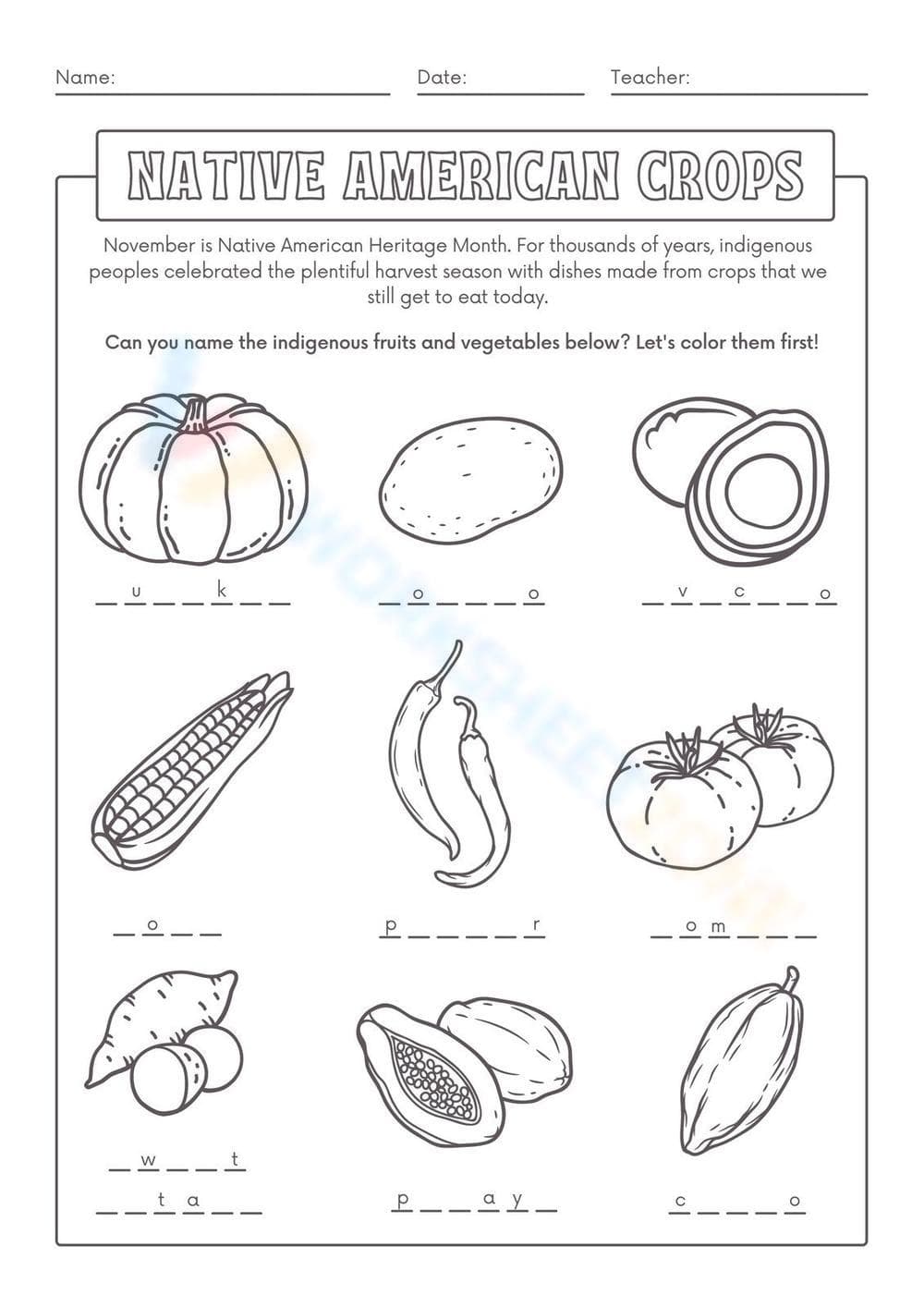

Grade 3 Native American Crops — Printable No-Prep Worksheet
Paste this activity's link or code into your existing LMS (Google Classroom, Canvas, Teams, Schoology, Moodle, etc.).
Students can open and work on the activity right away, with no student login required.
You'll still be able to track student progress and results from your teacher account.
This printable worksheet teaches students to identify and spell nine indigenous fruits and vegetables cultivated by Native Americans. Students build vocabulary and historical awareness by completing letter-fill spelling puzzles and coloring detailed illustrations. It connects language arts with social studies during Native American Heritage Month.
At a Glance
- Grade: Grade 3 · Subject: English Language Arts (ELA)
- Standard:
CCSS.ELA-LITERACY.L.3.4— Determine the meaning of domain-specific words and phrases- Skill Focus: Vocabulary acquisition and spelling
- Format: 1 page · 9 problems · Coloring activity · PDF
- Best For: Social studies integration and morning work
- Time: 15–20 minutes
This single-page resource features nine distinct black-and-white illustrations of traditional indigenous crops, including pumpkin, corn, and cacao. Below each illustration, students find a fill-in-the-blank spelling prompt with select letters provided as scaffolds. The clean layout offers clear visual cues to support word recognition, while the coloring elements keep young learners engaged as they practice spelling.
This resource requires zero teacher preparation. First, print the single-page PDF for your class, taking less than one minute. Next, distribute the sheets to students as an independent activity or morning warm-up, requiring no prior instruction. Finally, review the spelling answers as a whole group in under five minutes. This straightforward workflow makes the activity ideal for emergency substitute plans or quick transition periods.
This activity aligns directly with the Common Core State Standard CCSS.ELA-LITERACY.L.3.4 by prompting students to determine and clarify the meaning of domain-specific words related to agriculture and history. Additionally, it supports spelling development under CCSS.ELA-LITERACY.L.3.2 by reinforcing phonics patterns through word completion. Both standard codes can be copied directly into lesson plans, IEP goals, or district curriculum mapping tools.
Use this worksheet during direct instruction to introduce a social studies unit on Native American history. Students can complete the spelling tasks individually after a brief discussion about indigenous agriculture. Alternatively, assign this activity as a formative assessment during morning work to gauge spelling proficiency and vocabulary retention. The entire activity takes approximately 15 to 20 minutes to complete.
This worksheet is designed for third and fourth-grade students learning about early American history and vocabulary. It provides excellent support for English language learners through visual aids and letter scaffolding. Pair this worksheet with an introductory reading passage about the Three Sisters agricultural method or a short video explaining Native American harvest traditions.
This educational resource supports vocabulary acquisition and spelling development aligned with standard CCSS.ELA-LITERACY.L.3.4. By combining visual illustrations with contextual spelling tasks, the worksheet reinforces word-meaning relationships and orthographic mapping. According to research from Fisher & Frey (2014) on vocabulary instruction, integrating visual representations with word-study tasks significantly improves retention and comprehension for elementary students. This worksheet provides structured practice that helps students connect historical concepts with specific terminology. The scaffolded spelling blanks offer targeted support, allowing students to apply phonics rules to unfamiliar domain-specific words. Educators can confidently integrate this tool into their curriculum to support cross-curricular learning between language arts and social studies. The design ensures that students remain focused on the core learning objectives while enjoying a creative coloring component that aids cognitive processing.


