


























Views
Downloads
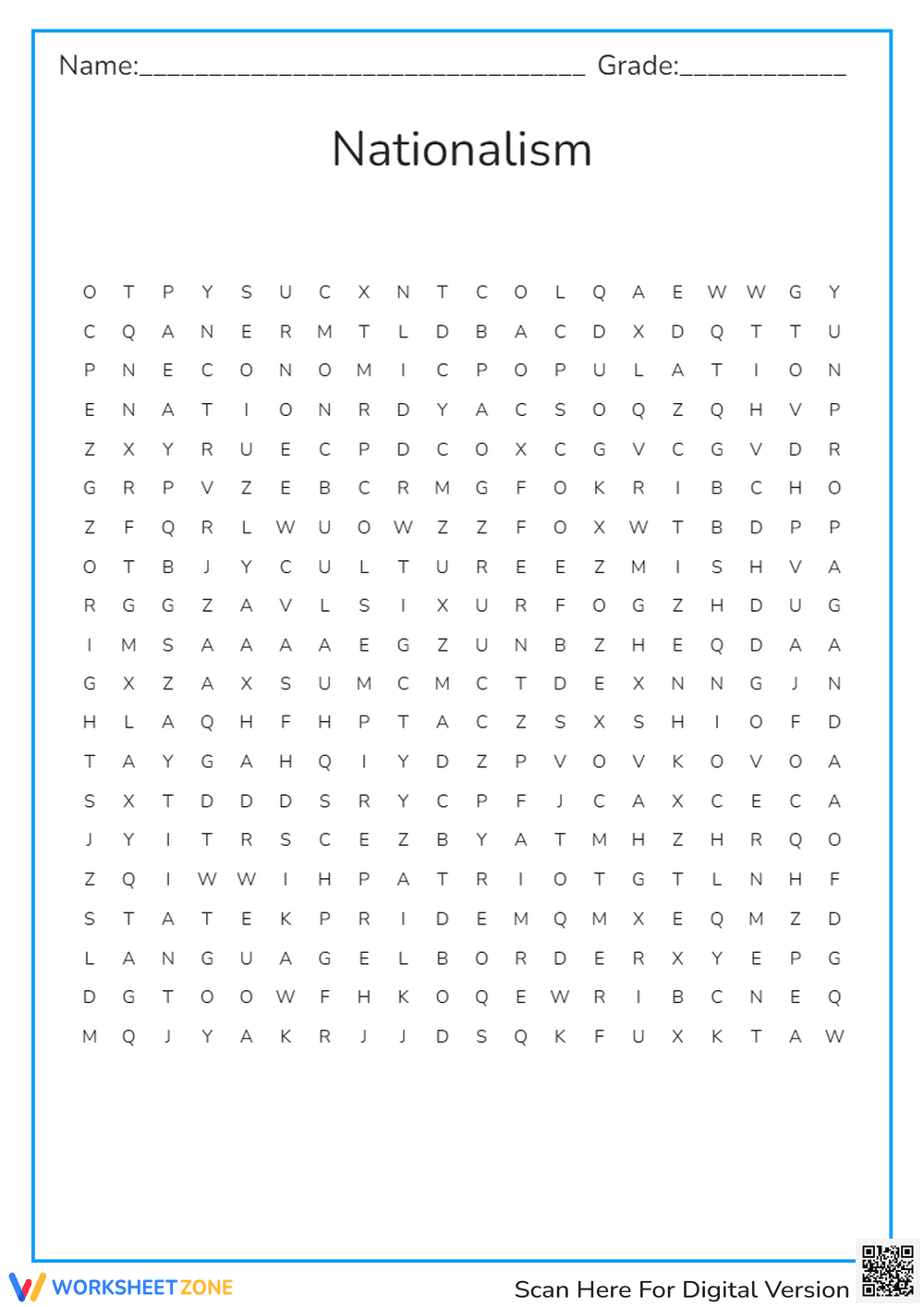


Nationalism Word Search | Grade 4 Essential Worksheet
Paste this activity's link or code into your existing LMS (Google Classroom, Canvas, Teams, Schoology, Moodle, etc.).
Students can open and work on the activity right away, with no student login required.
You'll still be able to track student progress and results from your teacher account.
This Grade 4 Nationalism word search provides a focused way for students to recognize and internalize key social studies vocabulary. By identifying 14 domain-specific terms, learners build the foundational language necessary to discuss complex historical and political concepts. It serves as an effective bridge between initial exposure and active usage in classroom discussions.
At a Glance
- Grade: Grade 4 · Subject: Social Studies
- Standard:
CCSS.ELA-LITERACY.L.4.6— Acquire and use accurately grade-appropriate general academic and domain-specific words- Skill Focus: Vocabulary Recognition
- Format: 2 pages · 14 problems · PDF
- Best For: Early finishers and unit introductions
- Time: 15–20 minutes
The resource consists of a large-grid word search puzzle and a dedicated word list page. The 14 terms selected—ranging from Government and Citizen to Propaganda and Empire—are essential for understanding the development of nations. The clear, legible font ensures accessibility for all learners, while the separate word list allows for flexible instructional use during social studies blocks.
This worksheet is designed for a zero-prep workflow. Teachers can print the two-page PDF in less than 30 seconds. Distribution takes approximately 1 minute, and the activity requires no prior setup or specialized materials. Because the task is self-explanatory, it functions perfectly as an emergency sub plan or a quiet transition activity during busy instructional blocks, requiring less than 2 minutes of total teacher preparation.
This activity aligns with CCSS.ELA-LITERACY.L.4.6, which requires students to acquire and use accurately grade-appropriate general academic and domain-specific words and phrases. By engaging with terms like Economic and Patriot in a visual format, students strengthen their orthographic processing of complex vocabulary. This standard-aligned practice supports broader literacy goals across the social studies curriculum. Both standard codes can be copied directly into lesson plans, IEP goals, or district curriculum mapping tools.
Use this worksheet as a hook at the start of a unit on world history or civics to gauge prior knowledge of the terms. Alternatively, assign it as a formative assessment for early finishers to reinforce spelling and word recognition. Teachers should observe which students struggle to locate longer words like Propaganda to identify those who may need additional phonemic or structural analysis support. Expected completion time is 15 to 20 minutes.
This resource is ideal for fourth-grade students beginning their study of political systems. It is particularly beneficial for English Language Learners (ELLs) who need repeated exposure to high-utility academic vocabulary in a low-stakes environment. Pair this with a visual anchor chart or a short reading passage about national symbols to provide context for the terms found in the grid.
According to research by Fisher & Frey (2014), intentional vocabulary exposure is a critical component of academic success in the content areas. This worksheet addresses CCSS.ELA-LITERACY.L.4.6 by providing students with a structured environment to interact with 14 domain-specific terms related to nationalism. Word searches assist in developing pattern recognition and orthographic memory, which are essential for reading fluency. By focusing on words like Government, Rights, and Culture, the activity ensures that Grade 4 students are building the lexicon required for more advanced historical analysis. Data from NAEP suggests that students with a robust command of academic vocabulary perform significantly better on standardized social studies assessments. This printable resource offers a practical, research-backed method for reinforcing these vital linguistic building blocks within a standard classroom timeframe, ensuring students are ready for complex text engagement.


