




























Views
Downloads

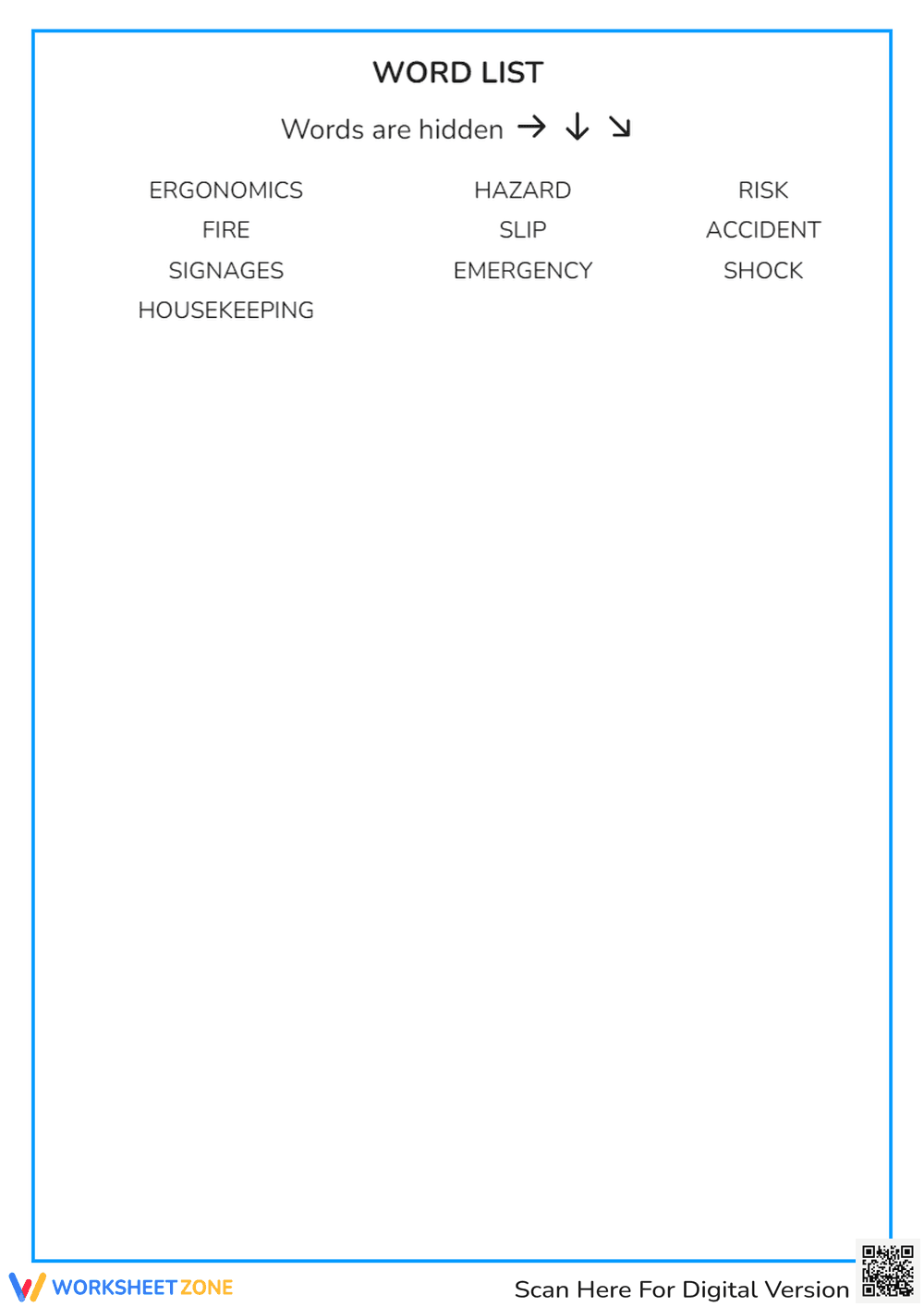

Workplace Safety Word Search | Essential Grade 3 ELA

Paste this activity's link or code into your existing LMS (Google Classroom, Canvas, Teams, Schoology, Moodle, etc.).
Students can open and work on the activity right away, with no student login required.
You'll still be able to track student progress and results from your teacher account.
This Grade 3 workplace safety worksheet helps students master domain-specific vocabulary through a structured word search activity. By identifying key terms like ergonomics and hazard, learners strengthen their spelling and pattern recognition skills while building essential awareness of safety protocols. It provides a clear student outcome of vocabulary retention and contextual understanding.
At a Glance
- Grade: 3 · Subject: ELA / Health
- Standard:
CCSS.ELA-LITERACY.L.3.6— Acquire and use accurately grade-appropriate general academic and domain-specific words- Skill Focus: Vocabulary & Spelling
- Format: 2 pages · 10 problems · Answer key included · PDF
- Best For: Morning work or early finishers
- Time: 15–20 minutes
What's Inside: This 2-page PDF includes a high-density letter grid and a dedicated word list page. Students are tasked with finding 10 specific safety-related terms, including complex words like housekeeping and signages. The layout is clean and distraction-free, ensuring students focus entirely on the linguistic patterns within the puzzle. The separate word list allows for flexible printing options.
The zero-prep workflow is designed for maximum efficiency. First, print the two pages in approximately 30 seconds. Second, distribute the worksheets to students as they enter the room or transition between subjects. Third, review the definitions of the found words as a whole-class wrap-up for 5 minutes. Total teacher preparation time is under 2 minutes, making it an ideal resource for busy mornings or unexpected substitute teacher days.
Standards Alignment: The primary focus is `CCSS.ELA-LITERACY.L.3.6`, which requires students to acquire and use accurately grade-appropriate conversational, general academic, and domain-specific words and phrases. This activity specifically targets domain-specific vocabulary related to health and safety. Both standard codes can be copied directly into lesson plans, IEP goals, or district curriculum mapping tools.
How to Use It: Use this worksheet as a formative assessment during a Health and Safety unit to gauge student familiarity with technical terms. Alternatively, assign it as a quiet-time activity after direct instruction on workplace hazards. Observe how quickly students identify diagonal versus horizontal words to assess their visual scanning and pattern recognition proficiency. Completion typically takes 15 to 20 minutes.
Who It's For: This resource is tailored for Grade 3 students but serves as an excellent vocabulary builder for English Language Learners (ELL) who need exposure to workplace terminology. It pairs naturally with a classroom anchor chart on safety signs or a short informational text about National Safety Month. It is also suitable for special education settings focusing on functional life skills.
According to the RAND AIRS 2024 report on supplemental materials, structured word-finding tasks significantly improve orthographic mapping in elementary learners. This worksheet aligns with CCSS.ELA-LITERACY.L.3.6 by providing targeted practice with domain-specific vocabulary such as ergonomics and hazard. Research indicates that engaging with technical terms in a low-stakes, gamified format like a word search increases student confidence and retention of complex spelling patterns. By isolating 10 high-frequency safety terms, the resource ensures that students are not overwhelmed while still meeting the rigorous demands of third-grade language standards. This standalone summary confirms the worksheet's utility as a research-backed tool for developing linguistic fluency and situational awareness in a classroom setting.


