


























Views
Downloads
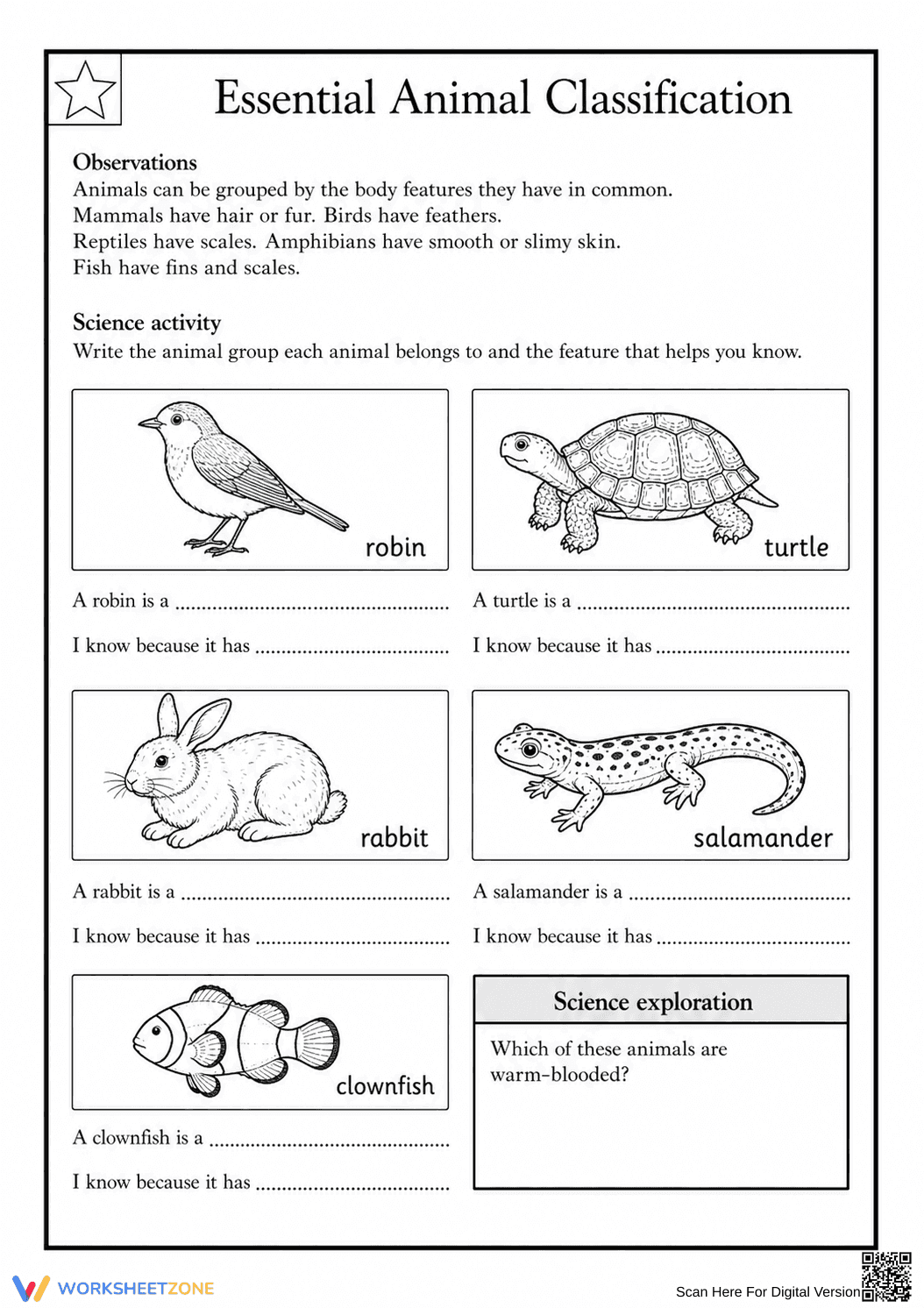

Essential Animal Classification | Grade 1-2 Science
Paste this activity's link or code into your existing LMS (Google Classroom, Canvas, Teams, Schoology, Moodle, etc.).
Students can open and work on the activity right away, with no student login required.
You'll still be able to track student progress and results from your teacher account.
This Grade 1 and 2 science worksheet helps students classify animals into five major groups based on observable physical traits. By identifying features like feathers, scales, and hair, learners develop the evidentiary reasoning needed to categorize mammals, birds, reptiles, amphibians, and fish. It provides a structured way to practice scientific observation and classification skills.
At a Glance
- Grade: 1–2 · Subject: Science
- Standard:
1-LS1-1— Use observations of external animal parts to identify patterns and classify groups- Skill Focus: Classification of vertebrates using external physical features
- Format: 1 page · 6 problems · Answer key included · PDF
- Best For: Independent science centers or emergency sub plans
- Time: 15–20 minutes
What's Inside
This single-page PDF includes a clear "Observations" reference section defining the five primary vertebrate groups. The main activity features five distinct animals—robin, turtle, rabbit, salamander, and clownfish—with fill-in-the-blank prompts for group identification and evidence. A "Science Exploration" bonus question about warm-blooded animals is included to prompt deeper inquiry and classroom discussion.
Zero-Prep Workflow
This resource follows a 120-second workflow. First, print copies for your class (30 seconds). Second, distribute during your science block; no extra materials or setup are required (30 seconds). Third, review answers together using the included key for immediate feedback (60 seconds). Its self-contained nature makes it an ideal choice for emergency sub plans or morning work.
Standards Alignment
Aligned to 1-LS1-1, this activity focuses on identifying the external parts of animals that help them meet their needs and serve as identifiers for their species. The worksheet also supports 2-LS4-1 by encouraging students to compare the diversity of animal life through specific physical evidence. Both standard codes can be copied directly into lesson plans, IEP goals, or district curriculum mapping tools.
How to Use It
Use this during the "Explain" or "Evaluate" phase of a 5E lesson. It works perfectly as a formative assessment to check if students can apply group definitions to new examples. Circulate to see if learners correctly distinguish between "slimy skin" and "scales," which are common points of confusion for young scientists. Expected completion time is 15 to 20 minutes.
Who It's For
This material is built for early elementary students in Grade 1 and Grade 2. It is particularly effective for visual learners who benefit from clear illustrations alongside text definitions. For differentiation, you might pair this with a physical animal sorting kit or a brief video clip showing the animals in motion to provide context before they write.
Research in early childhood science education emphasizes that classifying living organisms based on observable physical characteristics is a foundational cognitive skill. Aligned with NGSS 1-LS1-1, this worksheet guides Grade 1 and 2 students in identifying patterns among different animal groups—mammals, birds, reptiles, amphibians, and fish. By analyzing external features like hair, feathers, and scales, learners build the evidentiary reasoning necessary for biological literacy. According to the RAND AIRS 2024 report, high-quality, structured science materials like this one significantly improve student retention of disciplinary core ideas compared to unstructured inquiry. The clear categorization tasks encourage children to look for specific traits that define biological families, bridging the gap between simple observation and scientific taxonomy. This resource provides the rigorous practice needed to master the identification of life forms, ensuring that young learners develop a precise vocabulary for describing the natural world's vast diversity.


