


























Views
Downloads


My Dog Max Reading Comprehension | Essential Grade 4 ELA
Paste this activity's link or code into your existing LMS (Google Classroom, Canvas, Teams, Schoology, Moodle, etc.).
Students can open and work on the activity right away, with no student login required.
You'll still be able to track student progress and results from your teacher account.
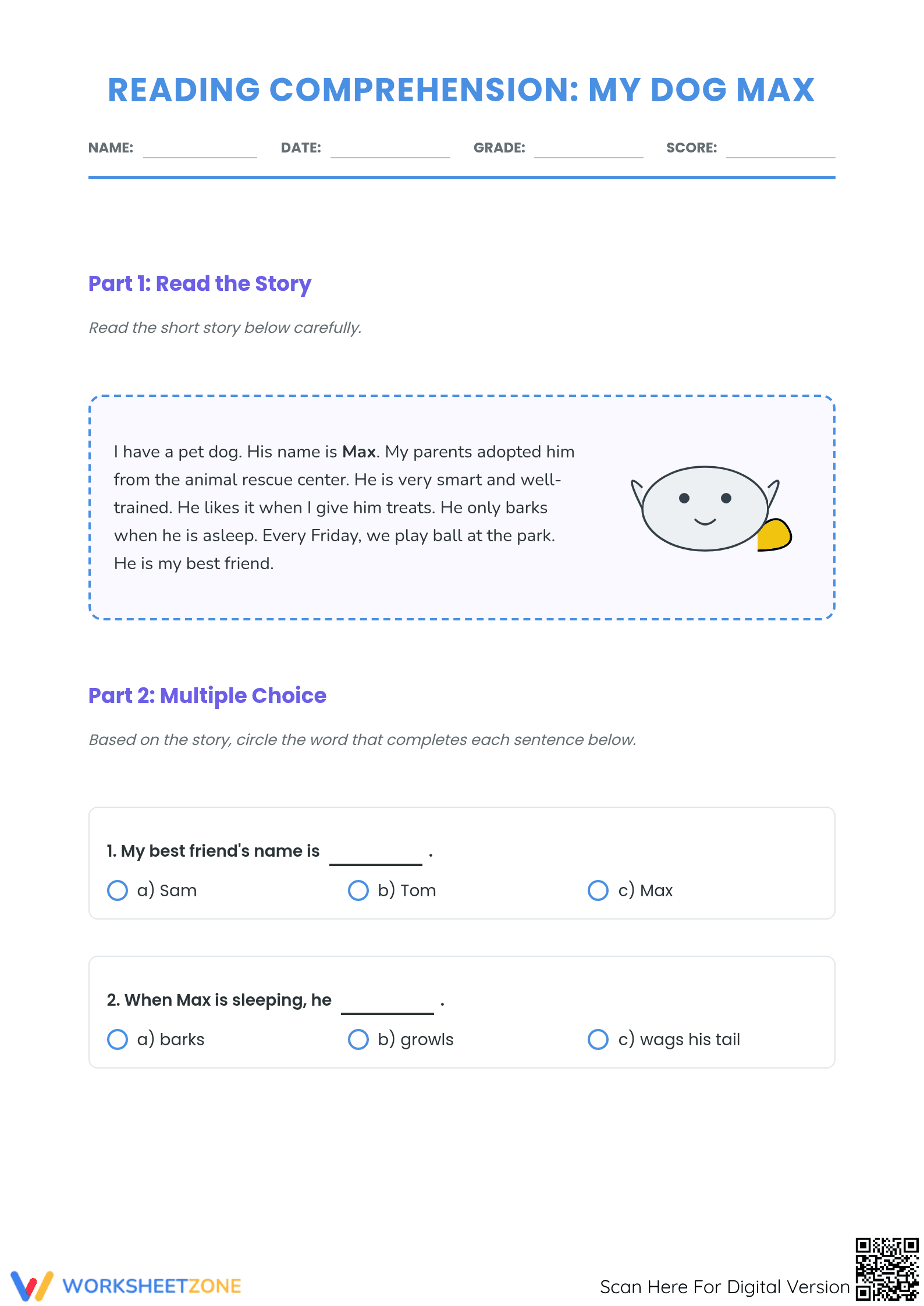
This Grade 4 reading comprehension worksheet helps students build foundational literacy skills through an engaging narrative about a pet dog named Max. By analyzing the text to answer specific questions, learners develop the ability to locate explicit information and draw logical conclusions. It provides a balanced mix of literal comprehension and creative expression.
At a Glance
- Grade: 4 · Subject: ELA
- Standard:
CCSS.ELA-LITERACY.RI.4.1— Refer to details and examples in a text when explaining what the text says- Skill Focus: Reading Comprehension & Evidence
- Format: 3 pages · 9 problems · Answer key included · PDF
- Best For: Independent reading practice or literacy centers
- Time: 20–30 minutes
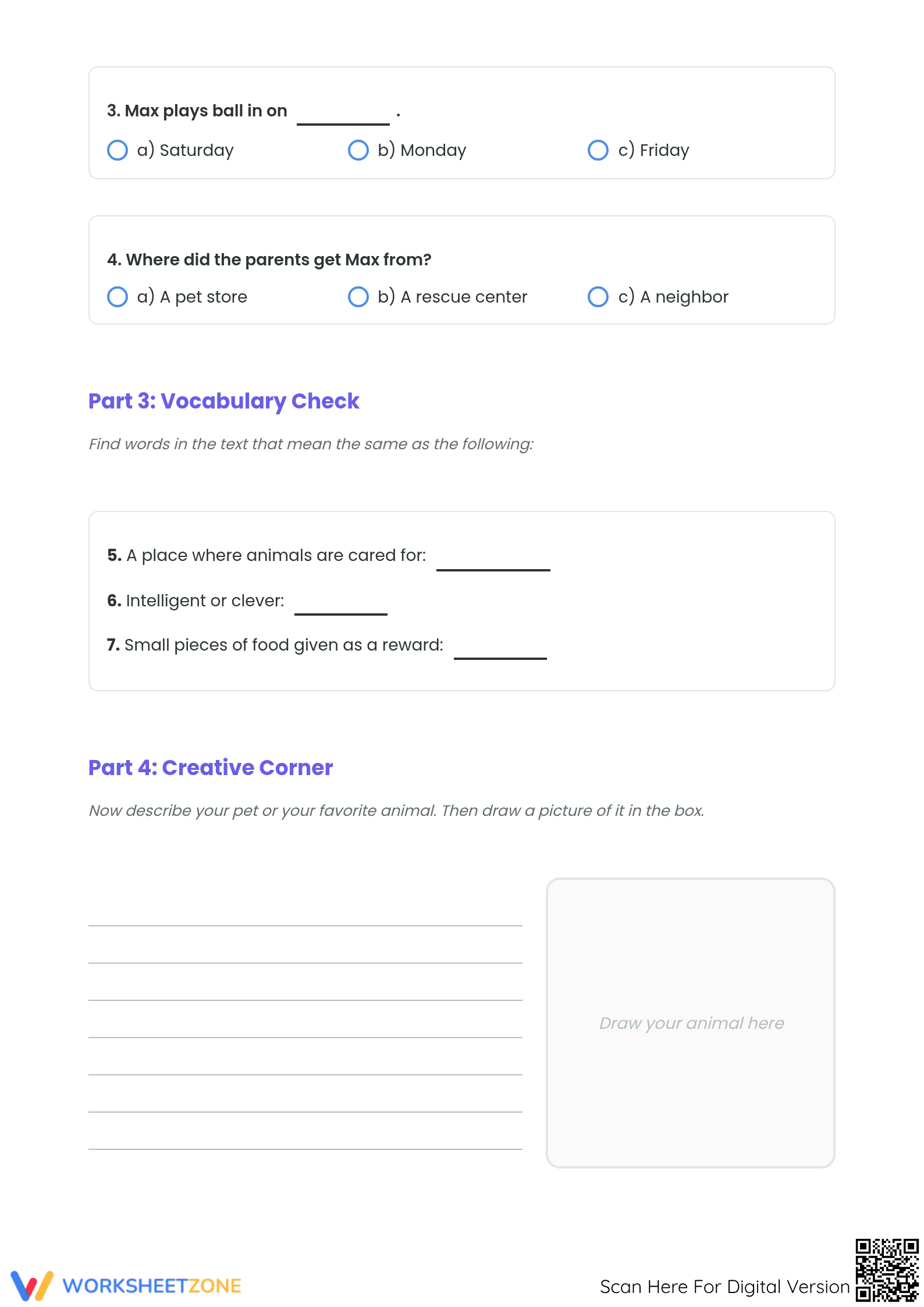
This 3-page PDF includes a short, accessible narrative followed by four distinct sections. Students encounter 4 multiple-choice questions to check for literal understanding, 3 vocabulary matching tasks to identify synonyms like "intelligent" and "rescue center," and a creative writing prompt with a dedicated drawing box. A final bonus question requires students to cite specific evidence from the text.
The worksheet follows a structured skill progression. It begins with Guided Practice through multiple-choice questions that mirror the story's sequence. It moves to Supported Practice in the vocabulary section, where students use context clues to define terms. Finally, Independent Practice is achieved in the Creative Corner and Bonus Question, where students must synthesize information and apply it to their own experiences. This gradual-release model ensures students feel confident before tackling open-ended responses.
The primary focus is CCSS.ELA-LITERACY.RI.4.1: "Refer to details and examples in a text when explaining what the text says explicitly and when drawing inferences from the text." Additionally, the creative writing portion supports W.4.3 by allowing students to develop brief descriptive narratives. Both standard codes can be copied directly into lesson plans, IEP goals, or district curriculum mapping tools.
Use this as a formative assessment after a lesson on identifying key details. Assign it during a "Read to Self" block to monitor individual comprehension levels. Teachers should observe if students flip back to the first page to find the answer to the "Friday" question, which serves as a great indicator of active reading habits. Total completion time is approximately 25 minutes.
This resource is designed for Grade 4 students but is highly effective for Grade 5 learners needing a confidence boost or RTI support. It is an excellent pairing for an anchor chart on "Finding Evidence" or as a follow-up to a classroom read-aloud about animals.
According to the RAND AIRS 2024 report, structured reading interventions that combine literal comprehension with creative application significantly improve long-term retention of vocabulary and text-dependent analysis skills. This worksheet targets CCSS.ELA-LITERACY.RI.4.1 by requiring students to extract specific facts about "Max" to justify their answers. By integrating a "Creative Corner," the resource adheres to Fisher & Frey’s (2014) gradual release of responsibility framework, moving students from teacher-led identification to independent synthesis. The inclusion of a bonus question specifically demanding text evidence ensures that students practice the high-leverage skill of justification, which is a core component of modern state assessments. This multi-modal approach—combining reading, writing, and drawing—supports diverse learners by providing multiple entry points into the text, ensuring that the plain-English skill of using details to explain a story is mastered effectively.


