


























Views
Downloads

Grade 5 Sound Waves — Printable No-Prep Worksheet
Paste this activity's link or code into your existing LMS (Google Classroom, Canvas, Teams, Schoology, Moodle, etc.).
Students can open and work on the activity right away, with no student login required.
You'll still be able to track student progress and results from your teacher account.
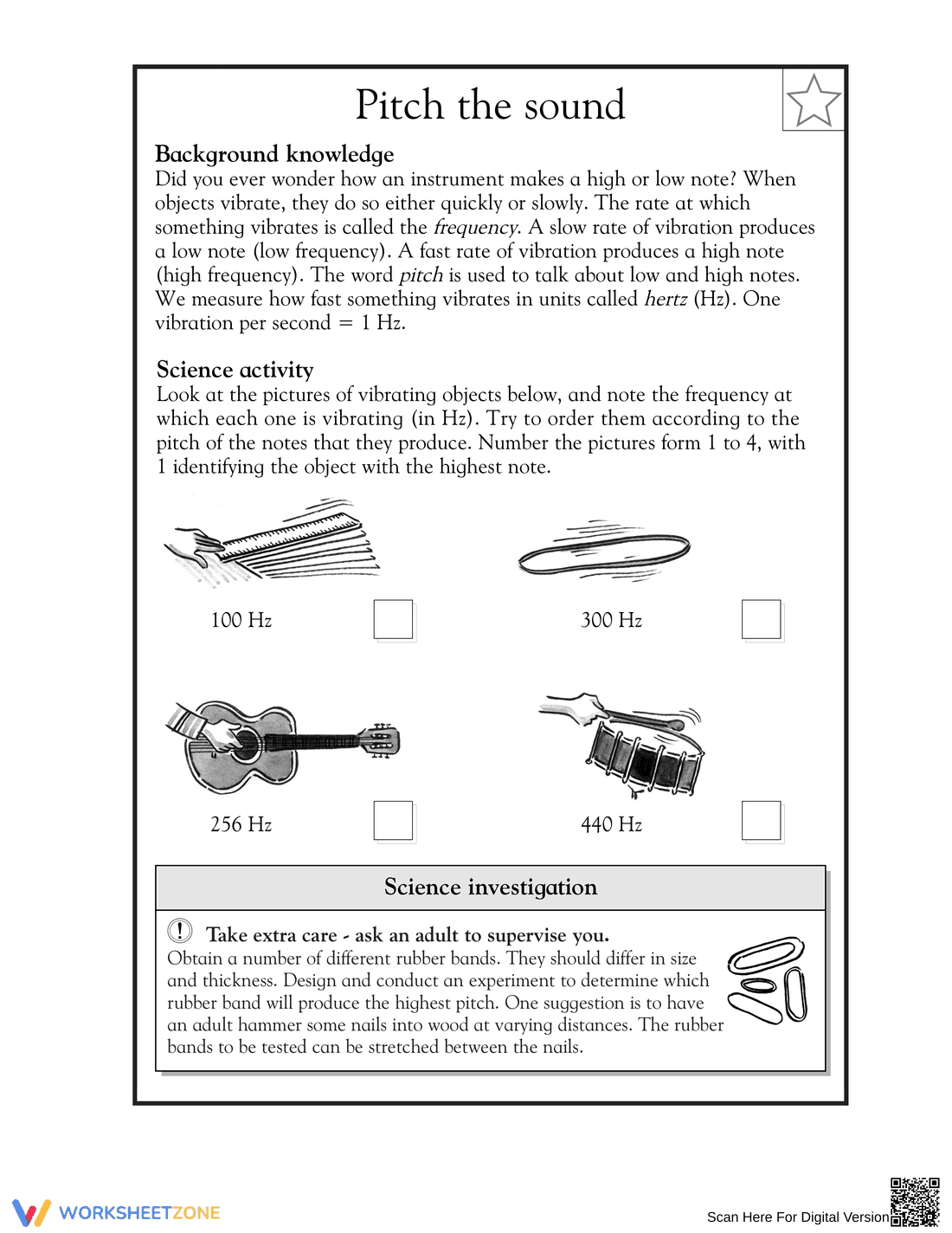
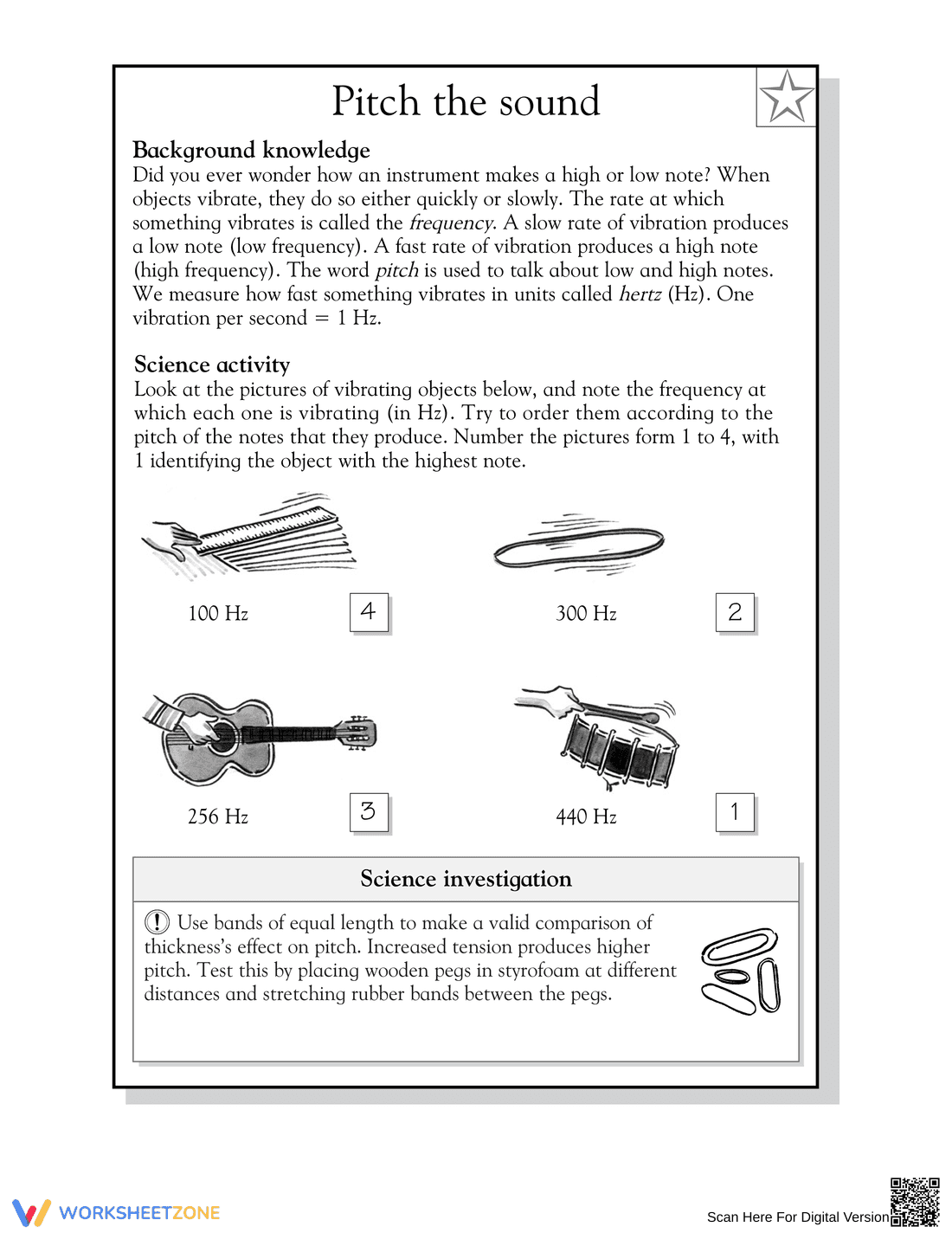
This Grade 5 science worksheet provides a clear introduction to the relationship between frequency and pitch. Students will analyze how the speed of vibrations affects sound, ordering objects by their frequency to identify the highest pitch. The included hands-on investigation extends learning by tasking students with designing their own experiment to test pitch.
At a Glance
- Grade: 5 · Subject: Science
- Standard:
4-PS4-1— Describe wave patterns with amplitude and wavelength.- Skill Focus: Relating frequency and pitch
- Format: 2 pages · 2 problems · Answer key included · PDF
- Best For: Introduction to sound waves
- Time: 15–20 minutes
What's Inside
This two-page resource contains a focused lesson on sound. The first page presents background knowledge on frequency and pitch, followed by an ordering activity. A second, hands-on "Science investigation" task challenges students to design an experiment. A complete answer key for the main activity is provided on the second page for easy review.
Zero-Prep Workflow
This worksheet requires less than two minutes of teacher prep. 1. Print (1 min): Print the two-page PDF. 2. Distribute (30 sec): Hand out the first page to students. 3. Review (30 sec): Use the provided answer key to facilitate a quick review. Its self-contained nature makes it an ideal resource for a sub plan, formative assessment, or homework.
Standards Alignment
This worksheet supports a key concept within the Next Generation Science Standards. The primary alignment is to 4-PS4-1, which involves describing patterns in waves. The worksheet's focus on frequency and pitch addresses fundamental properties of wave patterns. The standard code can be copied directly into lesson plans or curriculum maps.
How to Use It
Use this resource to introduce the science of sound waves. It works well as a "Do Now" or a station rotation task. For a formative assessment, observe if students can correctly order the objects by hertz (Hz); this reveals their understanding that higher frequency equals higher pitch. The activity takes approximately 15-20 minutes.
Who It's For
Built for 5th-grade students being introduced to sound properties, this can also serve as a review for 6th graders. The combination of a knowledge-based activity and a hands-on investigation supports different learning styles. It pairs effectively with a vocabulary anchor chart for frequency, pitch, and hertz.
This worksheet provides focused practice on the foundational physics of sound, directly supporting NGSS standard 4-PS4-1. By asking students to connect an object's vibration frequency (measured in hertz) to its resulting musical pitch, the activity makes an abstract wave property concrete and observable. This approach aligns with research demonstrating that hands-on investigation and concrete models are critical for building scientific understanding in elementary grades. As noted by Fisher & Frey (2014), such focused, inquiry-based tasks are essential for developing the deep conceptual knowledge required for more complex scientific reasoning. The worksheet’s structure—providing background knowledge before a task—scaffolds the learning process, ensuring students have the necessary information to draw accurate conclusions about the relationship between wave frequency and perceived sound, a core component of understanding wave properties.


