


























Views
Downloads

Essential Grade 3 Multiplication Word Problems Worksheet
Paste this activity's link or code into your existing LMS (Google Classroom, Canvas, Teams, Schoology, Moodle, etc.).
Students can open and work on the activity right away, with no student login required.
You'll still be able to track student progress and results from your teacher account.
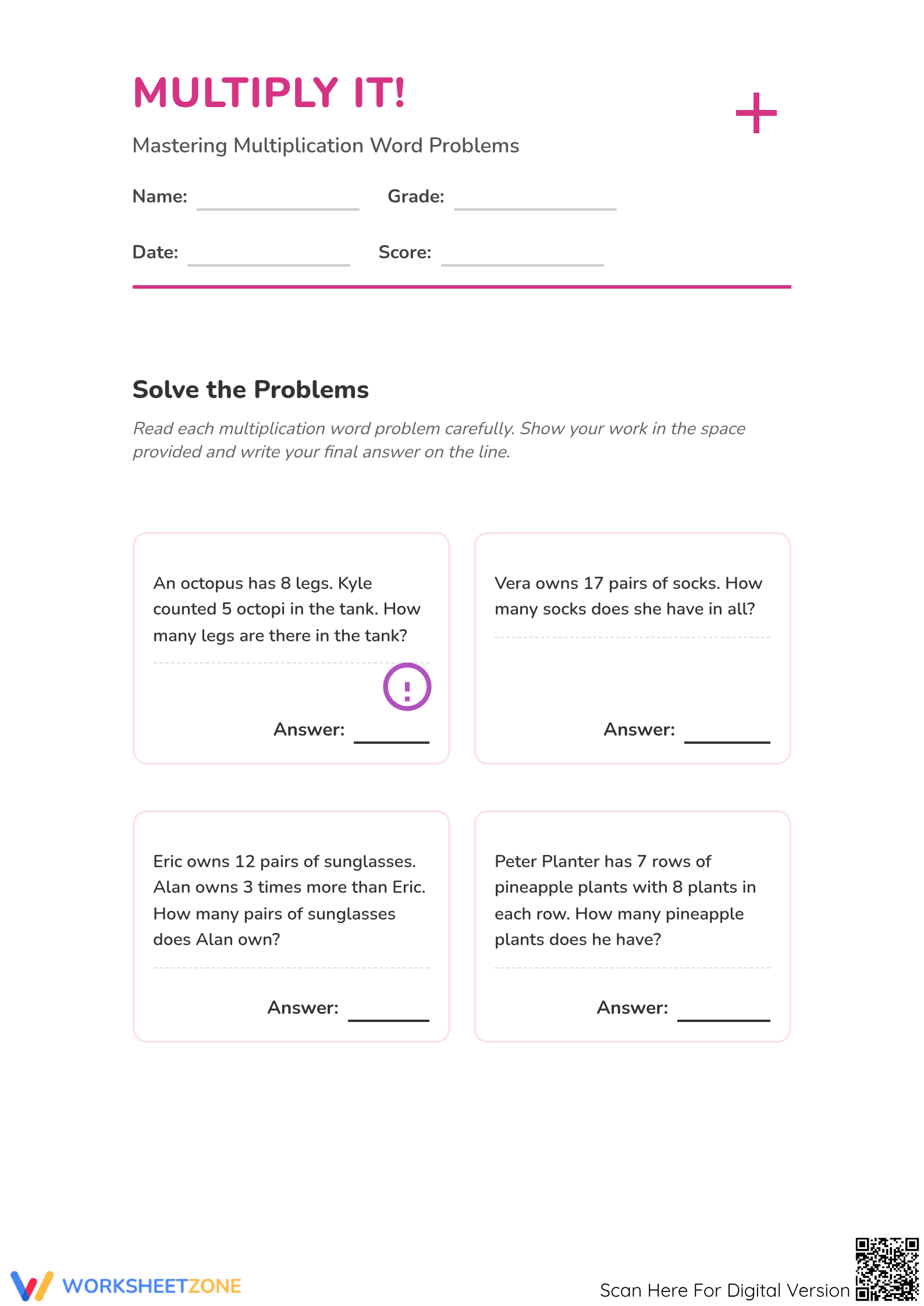
Mastering multiplication is more than just memorizing facts; it's about applying them to real-world scenarios. This worksheet helps third graders bridge the gap between abstract numbers and practical application through ten engaging word problems. Students will build confidence as they translate text into equations and solve for accurate results in this comprehensive multiplication practice set.
At a Glance
- Grade: 3 · Subject: Math
- Standard:
3.OA.A.3— Use multiplication within 100 to solve word problems in situations involving equal groups- Skill Focus: Multi-step Multiplication Word Problems
- Format: 2 pages · 10 problems · Answer key included · PDF
- Best For: Independent practice and formative assessment
- Time: 20–30 minutes
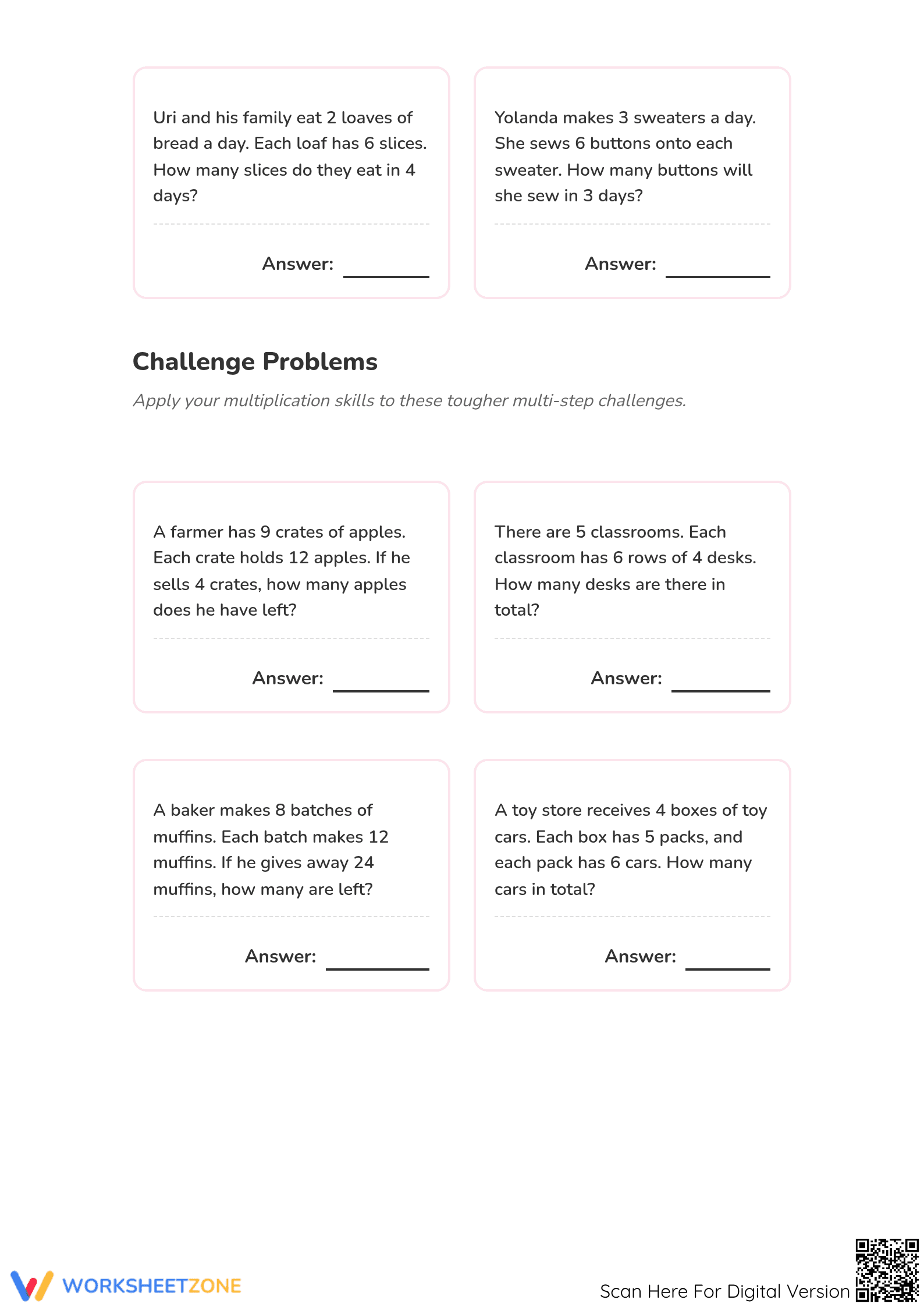
Inside this two-page resource, you will find ten diverse multiplication word problems ranging from simple one-step calculations to more complex multi-step "Challenge Problems." The layout provides ample workspace for students to show their thinking, including designated lines for final answers. A full answer key is included, allowing for quick grading or student self-correction during math centers or independent work time.
Skill Progression
- Guided Practice: The first four problems focus on basic one-digit multiplication scenarios with clear prompts to "show your work" and calculate total legs or items.
- Supported Practice: Problems five and six introduce slightly more complex context, requiring students to identify the correct factors within a short narrative about slices and buttons.
- Independent Practice: The final four "Challenge Problems" demand higher-order thinking as students navigate multi-step operations involving subtraction and multiple factors.
This structure scaffolds the learning process, moving from foundational skill application to independent mastery of complex word problem solving using a gradual-release instructional model.
Standards Alignment
The primary focus of this worksheet is `3.OA.A.3`, which requires students to "Use multiplication and division within 100 to solve word problems in situations involving equal groups, arrays, and measurement quantities." Additionally, it supports `3.OA.C.7` by promoting fluency in multiplying within 100. Both standard codes can be copied directly into lesson plans, IEP goals, or district curriculum mapping tools.
How to Use It
This resource is ideal for use during the independent practice phase of a lesson on multiplication applications. Teachers can distribute it after a whole-group modeling session to gauge individual student understanding. For a formative assessment observation tip, watch for students who struggle to identify which numbers in the multi-step problems represent the number of groups versus the size of each group. Completion typically takes 20 to 30 minutes.
Who It's For
This worksheet is designed for third-grade students who have already mastered basic multiplication facts and are ready to apply them to text-based scenarios. It provides excellent differentiation for advanced second graders or as a review for fourth graders. It pairs naturally with an anchor chart on word problem keywords or a direct instruction lesson on identifying equal groups in real-world contexts.
The transition from rote multiplication drills to conceptual word problem solving is a critical milestone in elementary mathematics. Research from RAND AIRS 2024 highlights that embedding mathematical operations within narrative contexts significantly improves long-term retention and the ability to transfer skills to novel situations. By requiring students to interpret 3.OA.A.3 through multi-step scenarios, this worksheet aligns with rigorous evidence-based instructional practices. The inclusion of challenge problems specifically addresses the need for depth over breadth, encouraging students to decompose complex tasks into manageable operations. This approach mirrors findings from Fisher & Frey (2014) regarding the importance of scaffolding in mathematical literacy. Teachers using this resource can be confident that they are providing high-quality, standards-aligned practice that builds both procedural fluency and conceptual understanding, ensuring students are prepared for more advanced algebraic thinking in subsequent grade levels.


