


























Views
Downloads



Grade 3 Multiplication Using Arrays | Essential Printable
Paste this activity's link or code into your existing LMS (Google Classroom, Canvas, Teams, Schoology, Moodle, etc.).
Students can open and work on the activity right away, with no student login required.
You'll still be able to track student progress and results from your teacher account.
Students master the concept of multiplication by visualizing products as structured rows and columns. This Multiplication Using Arrays worksheet provides Grade 3 learners with consistent practice in translating visual representations into formal multiplication sentences. By connecting abstract numbers to concrete visual arrays, students build a deeper understanding of repeated addition and multiplicative reasoning.
At a Glance
- Grade: Grade 3 · Subject: Elementary Mathematics, Multiplication, and Numeracy
- Standard:
CCSS.MATH.CONTENT.3.OA.A.1— Interpret products of whole numbers by viewing objects organized into rectangular rows and columns- Skill Focus: Multiplication arrays, repeated addition, and formal multiplicative structures
- Format: 5 pages · 20 problems · Answer key included · PDF
- Best For: Introduction to multiplication and independent practice
- Time: 20–30 minutes
What's Inside
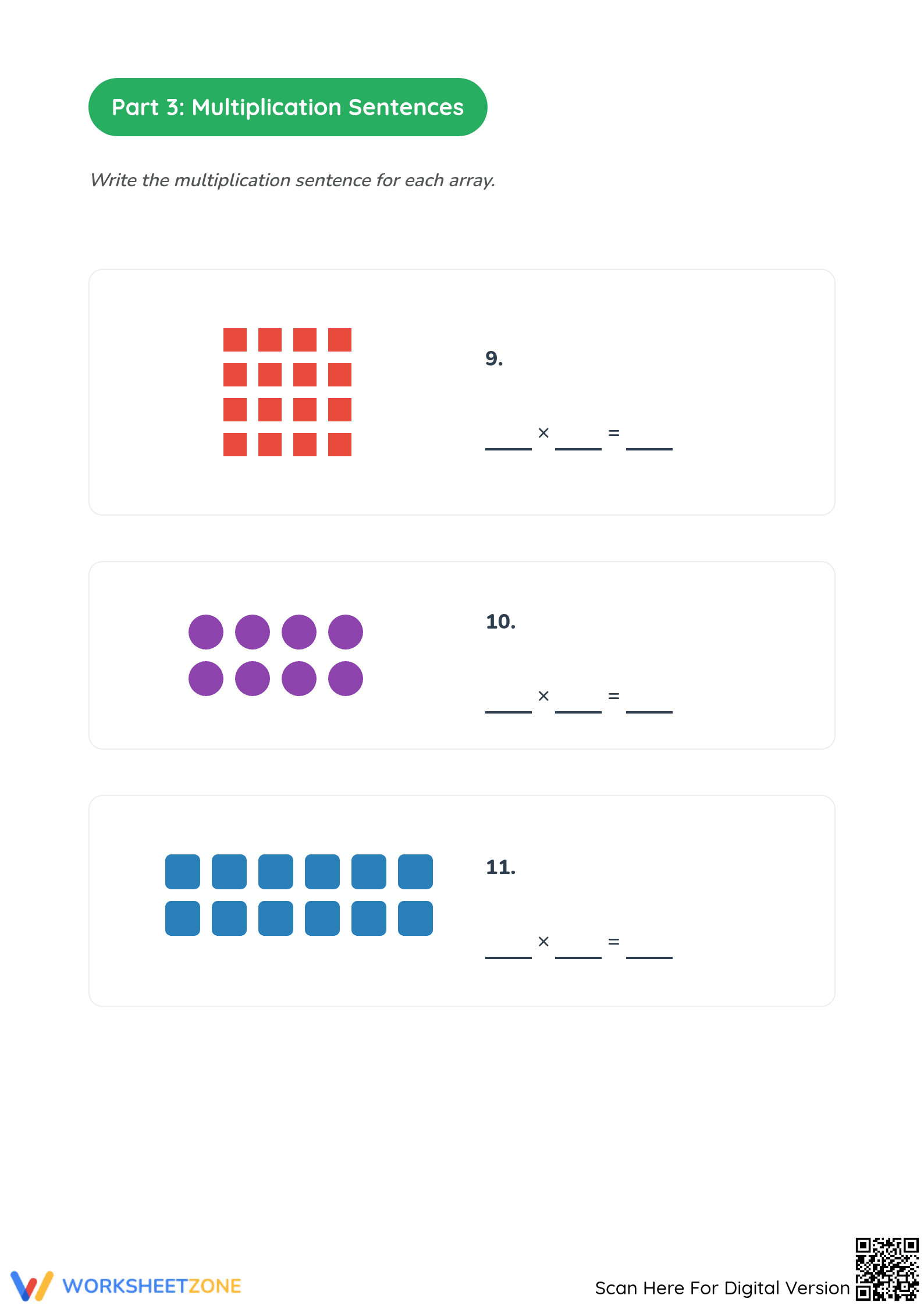
This comprehensive 5-page PDF resource contains 20 distinct array-based multiplication problems. Each page features four clear, high-contrast visual models consisting of neatly organized objects. Students are prompted to observe the rows and columns, determine the factors, and write the corresponding multiplication sentence in the provided workspace. A full answer key is included for quick grading or student self-check.
Zero-Prep Workflow
This resource follows a streamlined three-step implementation: Print (30 seconds), Distribute (30 seconds), and Review (15 minutes). With a total teacher prep time of less than one minute, this worksheet is ideal for immediate classroom use. Because the instructions are intuitive, it is an excellent choice for unexpected substitute teacher plans or morning transition work.
Standards Alignment
The primary focus of this worksheet is CCSS.MATH.CONTENT.3.OA.A.1, which requires students to interpret products of whole numbers as equal groups. By specifically modeling multiplication through arrays, students learn that the total count of objects is the product of the number of rows and the number of columns. This standard code can be copied directly into lesson plans, IEP goals, or district curriculum mapping tools.
How to Use It
Use this worksheet as a formative assessment after introducing the concept of multiplication arrays with physical manipulatives like counters. Observe whether students can accurately count the rows and columns before writing their sentences. It also serves as an effective homework assignment to reinforce classroom learning; expect most learners to complete the entire set of 20 problems within 25 minutes.
Who It's For
This resource is tailored for Grade 3 students but provides high-quality remedial support for Grade 4 learners who need to strengthen their foundational understanding of multiplicative structures. It pairs naturally with a lesson on the commutative property of multiplication, as students can rotate the page to see how row and column counts swap while the product remains identical.
Effective mathematical instruction in the early grades relies on the "Concrete-Representational-Abstract" (CRA) sequence to ensure long-term mastery of multiplicative reasoning. According to EdReports 2024, high-quality instructional materials that emphasize visual models like arrays significantly improve student performance on standardized assessments compared to rote memorization of facts alone. This worksheet bridges the gap between physical manipulatives and abstract equations by providing 20 structured opportunities for representational practice. By identifying CCSS.MATH.CONTENT.3.OA.A.1 through arrays, students develop the mental frameworks necessary for more complex multi-digit multiplication and division tasks encountered in later elementary years. Teachers can utilize this printable to monitor progress and identify students who may require additional scaffolding or intervention. The inclusion of a full answer key ensures that feedback can be provided promptly, which is a critical factor in closing achievement gaps in foundational numeracy according to recent NAEP trends.


