




























Views
Downloads


Essential Grade 6 Multiplication Review Worksheet

Paste this activity's link or code into your existing LMS (Google Classroom, Canvas, Teams, Schoology, Moodle, etc.).
Students can open and work on the activity right away, with no student login required.
You'll still be able to track student progress and results from your teacher account.
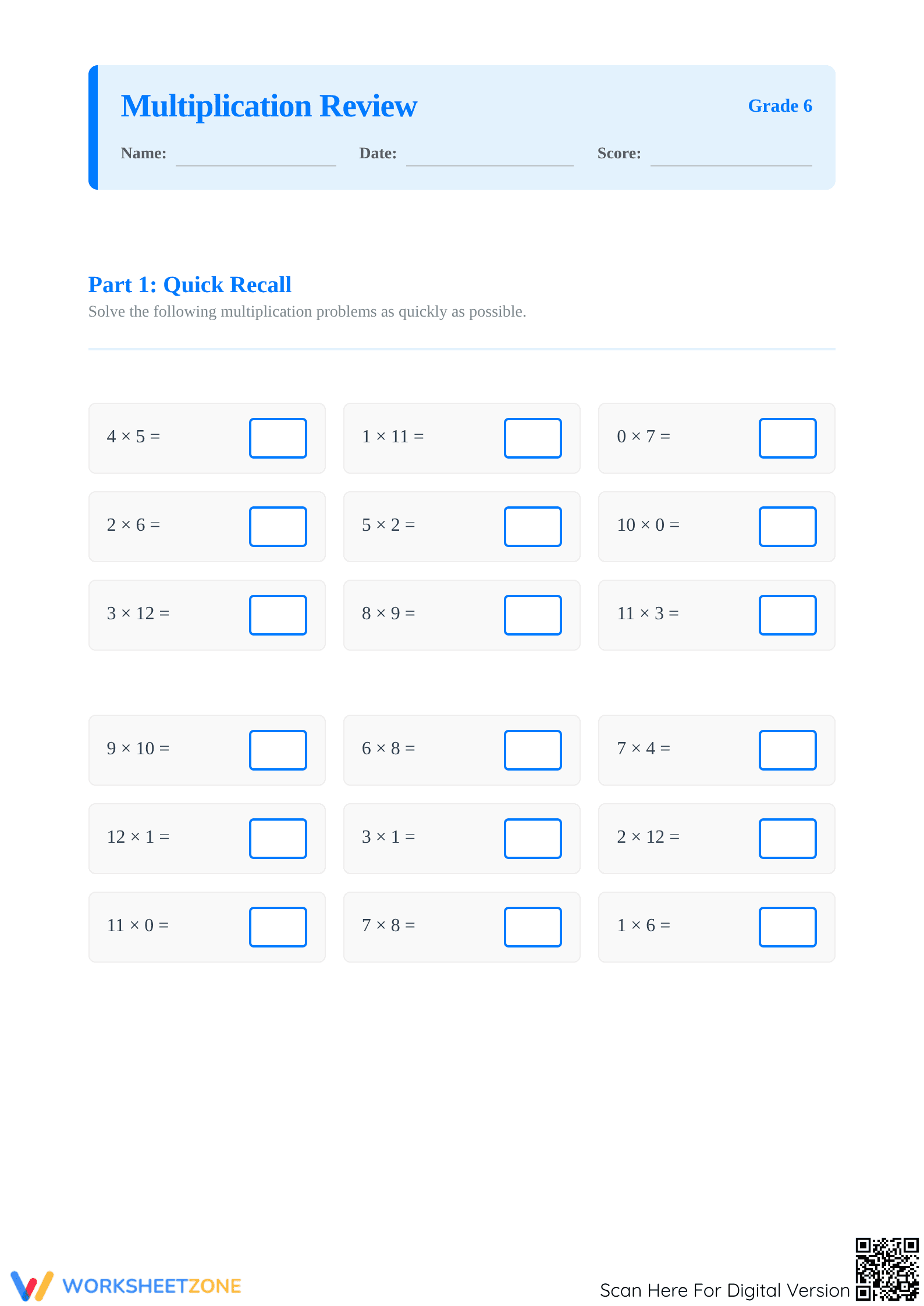
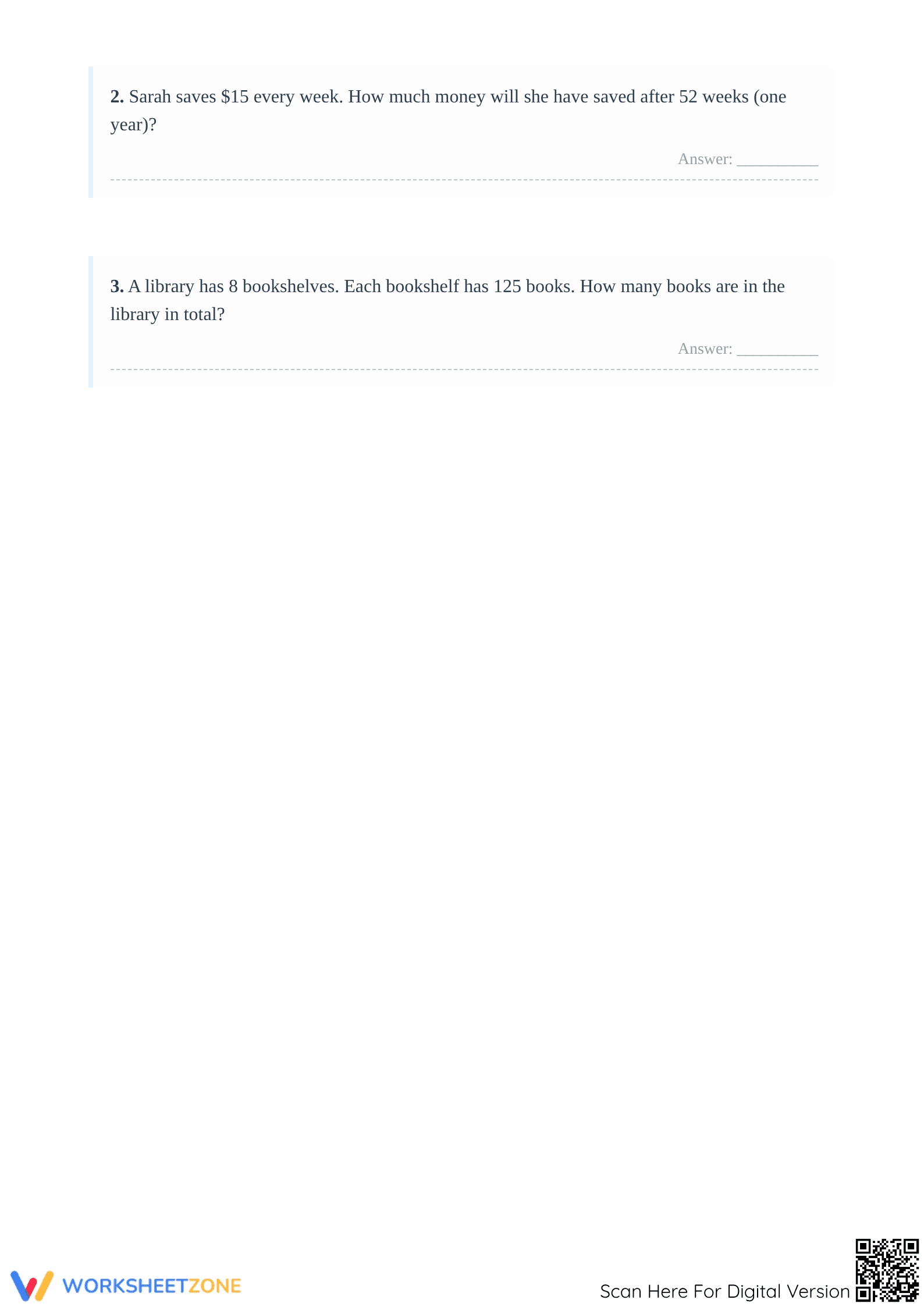
This Grade 6 multiplication review worksheet provides a comprehensive assessment of student fluency across three distinct levels of complexity. Students move from rapid mental recall to formal vertical algorithms and finally apply their knowledge to multi-step word problems. It ensures learners have mastered the foundational operations required for more advanced middle school ratios and algebraic expressions.
At a Glance
- Grade: 6 · Subject: Math
- Standard:
CCSS.MATH.CONTENT.6.NS.B.3— Fluently multiply multi-digit numbers using the standard algorithm for mathematical operations- Skill Focus: Multiplication Fluency & Word Problems
- Format: 3 pages · 38 problems · Answer key included · PDF
- Best For: End-of-unit review or substitute teacher plans
- Time: 30–45 minutes
What's Inside: This 3-page packet contains 38 total tasks designed to build and verify multiplication mastery. Part 1 features 27 quick-recall horizontal problems to test mental math speed. Part 2 transitions to 8 vertical multi-digit problems, including 3-digit by 1-digit calculations. Part 3 concludes with 3 real-world application word problems. A full 3-page answer key is provided for immediate feedback and grading.
Zero-Prep Workflow
- Print: Select the three content pages and the corresponding answer key (approx. 30 seconds).
- Distribute: Hand out the packet as a warm-up, independent practice session, or homework assignment (1 minute).
- Review: Use the provided answer key for student self-correction or rapid grading to inform future instruction (5 minutes).
Total teacher preparation time is under 2 minutes, making this an ideal resource for busy classrooms or emergency sub plans.
Standards Alignment: This resource is aligned to CCSS.MATH.CONTENT.6.NS.B.3: "Fluently add, subtract, multiply, and divide multi-digit decimals using the standard algorithm for each operation." While the focus here is on whole numbers, it provides the essential prerequisite fluency needed for decimal operations. Both standard codes can be copied directly into lesson plans, IEP goals, or district curriculum mapping tools.
How to Use It: Use this as a formative assessment after a unit on multiplication to identify students struggling with the standard algorithm. It also serves as an excellent "Friday Review" or sub plan. Completion time ranges from 30 to 45 minutes depending on student fluency levels. For a quick check, assign only the first page as a timed "mad minute" style drill.
Who It's For: Designed for 6th-grade general education students, but highly effective for 5th-grade enrichment or 7th-grade intervention. Pair this with a multiplication anchor chart or a short video tutorial on the vertical algorithm for students needing extra support during independent work time.
According to the RAND AIRS 2024 report, consistent practice with mixed-format mathematical tasks—combining mental recall with procedural algorithms—significantly improves long-term retention of arithmetic facts. This worksheet aligns with these findings by scaffolding from simple horizontal equations to complex word problems. By requiring students to "show their work" in the vertical section, the resource supports the development of mathematical precision and error analysis skills. Research indicates that students who engage in regular fluency drills are better prepared for the cognitive demands of Grade 6 ratios and proportional relationships. This resource provides the necessary repetition to move students toward the mastery level defined by CCSS.MATH.CONTENT.6.NS.B.3. Educators can utilize this structured approach to bridge the gap between basic computation and real-world application, ensuring students meet the rigorous expectations of national mathematics frameworks and standardized testing environments.


