




























Views
Downloads
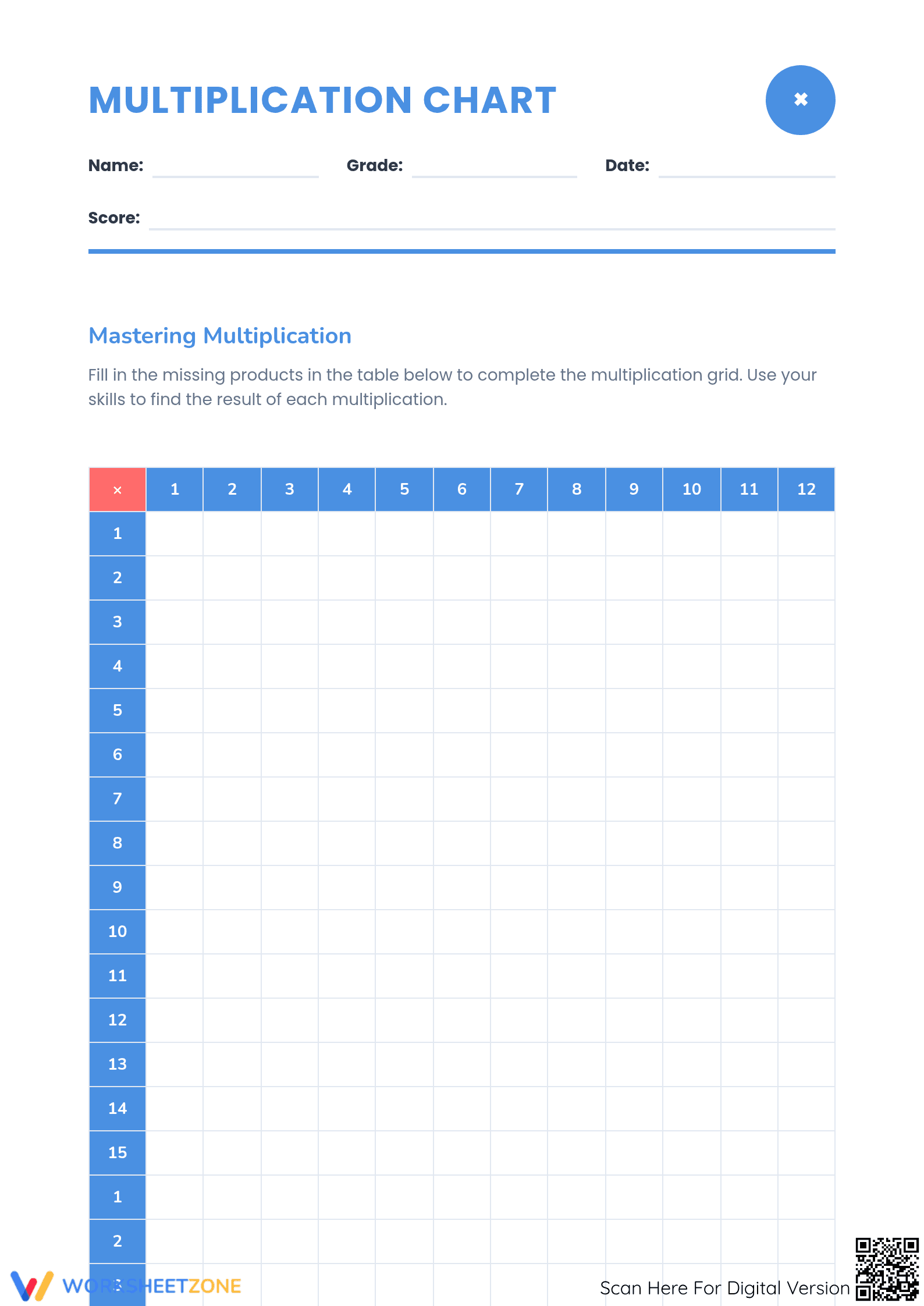


Essential Multiplication Chart Worksheet | Grade 3-5

Paste this activity's link or code into your existing LMS (Google Classroom, Canvas, Teams, Schoology, Moodle, etc.).
Students can open and work on the activity right away, with no student login required.
You'll still be able to track student progress and results from your teacher account.
This Grade 3-5 math worksheet provides a comprehensive framework for mastering multiplication fluency through active recall and pattern discovery. By completing the extensive multiplication grid and solving targeted mental math problems, students develop the automaticity required for complex multi-digit operations. It transforms rote memorization into a structured exploration of numerical relationships and algebraic thinking.
At a Glance
- Grade: 3-5 · Subject: Math
- Standard:
CCSS.MATH.CONTENT.3.OA.C.7— Fluently multiply and divide within 100 using strategies and properties of operations- Skill Focus: Multiplication facts 1-12 and pattern recognition
- Format: 2 pages · 185 problems · Answer key included · PDF
- Best For: Daily fluency practice and formative assessment
- Time: 15–20 minutes
This two-page PDF resource features a large-scale multiplication grid spanning factors 1 through 12 horizontally and 1 through 15 vertically. The first page is dedicated to the "Mastering Multiplication" grid, providing over 180 individual cells for product entry. The second page includes a "Quick Mental Math" section with three application problems and a "Pattern Spotting" section with two open-ended questions. A full answer key is provided for rapid grading.
Zero-Prep Workflow
The zero-prep design allows for immediate classroom implementation. First, print the two-page PDF and create enough copies for your cohort in under 30 seconds. Second, distribute the worksheets as a bell-ringer or independent center activity. Finally, use the included answer key to conduct a whole-class check or have students peer-grade to identify common calculation errors. This workflow requires minimal teacher preparation, making it an ideal resource for substitute folders.
Standards Alignment
The primary focus is `CCSS.MATH.CONTENT.3.OA.C.7`: "Fluently multiply and divide within 100, using strategies such as the relationship between multiplication and division or properties of operations." Additionally, the pattern-spotting section supports `CCSS.MATH.CONTENT.3.OA.D.9`, which asks students to identify arithmetic patterns. Both standard codes can be copied directly into lesson plans, IEP goals, or district curriculum mapping tools.
How to Use It
Use this worksheet during the independent practice phase of a lesson on multiplication properties. It serves as an excellent formative assessment tool; by observing which sections of the grid a student leaves blank, teachers can identify specific factor pairs that require intervention. For a 20-minute session, assign the grid first, followed by the pattern-spotting questions to encourage higher-order thinking and discussion about numerical behavior.
Who It's For
This resource is designed for third-grade students building initial fluency, as well as fourth and fifth graders who need a refresher on basic facts before tackling long division. It pairs naturally with an interactive multiplication anchor chart or a set of physical manipulatives for students who require tactile support during the calculation process.
Research from RAND AIRS 2024 emphasizes that high-frequency retrieval practice, such as filling out multiplication grids, is essential for reducing cognitive load during complex problem-solving. By automating basic fact recall, students free up working memory for multi-step word problems and algebraic reasoning. This worksheet aligns with the distributed practice model, which suggests that short, intense bursts of fact review lead to better long-term retention than isolated sessions. The inclusion of pattern-spotting questions further bridges the gap between procedural fluency and conceptual understanding, ensuring students do not just memorize products but understand the underlying structure of the base-ten system. Utilizing this structured approach supports the NAEP framework for mathematical complexity by moving students from simple recall to the analysis of numerical properties.


