




























Views
Downloads


Multiple Meaning Words Worksheet | Kindergarten Printable

Paste this activity's link or code into your existing LMS (Google Classroom, Canvas, Teams, Schoology, Moodle, etc.).
Students can open and work on the activity right away, with no student login required.
You'll still be able to track student progress and results from your teacher account.
This Kindergarten vocabulary worksheet helps students identify and understand multiple meaning words through engaging visual matching. By connecting single words to two distinct pictures, early readers build essential context clues and expand their everyday vocabulary.
At a Glance
- Grade: Kindergarten · Subject: ELA
- Standard:
CCSS.ELA-LITERACY.L.K.4.A— Identify new meanings for familiar words- Skill Focus: Multiple Meaning Words
- Format: 2 pages · 16 problems · PDF
- Best For: Independent practice or literacy centers
- Time: 10–15 minutes
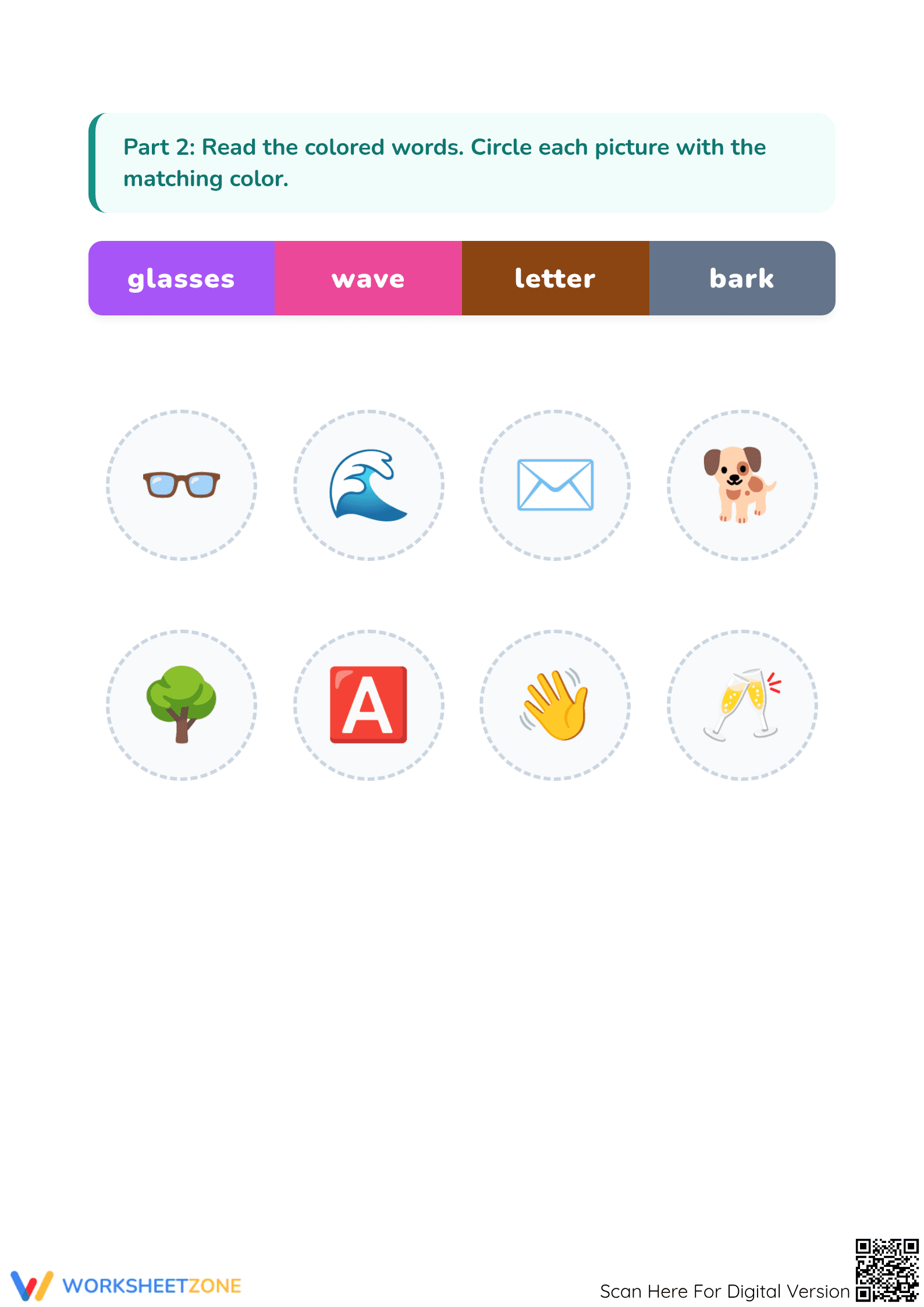
This two-page resource features a highly visual, color-coded matching activity designed specifically for early learners. Across the two pages, students will read eight common multiple meaning words—such as "seal," "box," "wave," and "bark"—and match each word to two different illustrations representing its distinct meanings. The clear layout and familiar icons make the task intuitive and accessible for young students developing their reading comprehension skills.
Zero-Prep Workflow
- Print (1 minute): Simply print the two-page PDF. The color-coded instructions are easy to follow, but the worksheet functions perfectly in grayscale as well.
- Distribute (1 minute): Hand out the worksheets along with crayons or markers for students to color-code their circles.
- Review (3 minutes): Quickly check student matches visually. The distinct picture pairs make it easy to spot correct answers at a glance.
With under two minutes of total teacher prep time, this activity is an ideal addition to emergency sub plans, morning work routines, or quiet independent centers.
Standards Alignment
This worksheet is directly aligned to CCSS.ELA-LITERACY.L.K.4.A, requiring students to identify new meanings for familiar words and apply them accurately. It also supports CCSS.ELA-LITERACY.RF.K.3 by reinforcing basic word recognition skills. Both standard codes can be copied directly into lesson plans, IEP goals, or district curriculum mapping tools.
How to Use It
Introduce this worksheet after a whole-class lesson on homonyms or words with more than one meaning. It works beautifully as a literacy center activity where students can discuss the different pictures with a partner. For a formative assessment observation tip, watch how students approach words like "bark" or "wave"—if they only circle one picture, prompt them to think about other ways they have heard the word used. Expected completion time is 10 to 15 minutes.
Who It's For
This resource is designed for Kindergarten and early first-grade students building their foundational vocabulary. The heavy reliance on visual supports makes it highly effective for English Language Learners (ELLs) and students requiring visual accommodations. Pair this worksheet with a read-aloud book that features puns or multiple meaning words to reinforce the concept in context.
Understanding multiple meaning words is a critical step in early reading comprehension and vocabulary acquisition for young learners. According to Fisher & Frey (2014), explicit vocabulary instruction that includes exploring the nuanced, multiple meanings of familiar words significantly improves students' ability to use context clues during independent reading. When children realize that a single word can represent entirely different concepts, their reading flexibility grows. By practicing with visual representations of standard CCSS.ELA-LITERACY.L.K.4.A (Identify new meanings for familiar words), young learners develop the cognitive flexibility required to comprehend complex texts as they progress through elementary school. This foundational skill prevents future reading roadblocks by teaching children that words can shift meaning based on their context, ensuring they are fully prepared for more advanced literacy tasks and complex sentence structures in later grades.


