


























Views
Downloads

Essential Irregular Verbs Matching Worksheet | Grades 3-5
Paste this activity's link or code into your existing LMS (Google Classroom, Canvas, Teams, Schoology, Moodle, etc.).
Students can open and work on the activity right away, with no student login required.
You'll still be able to track student progress and results from your teacher account.
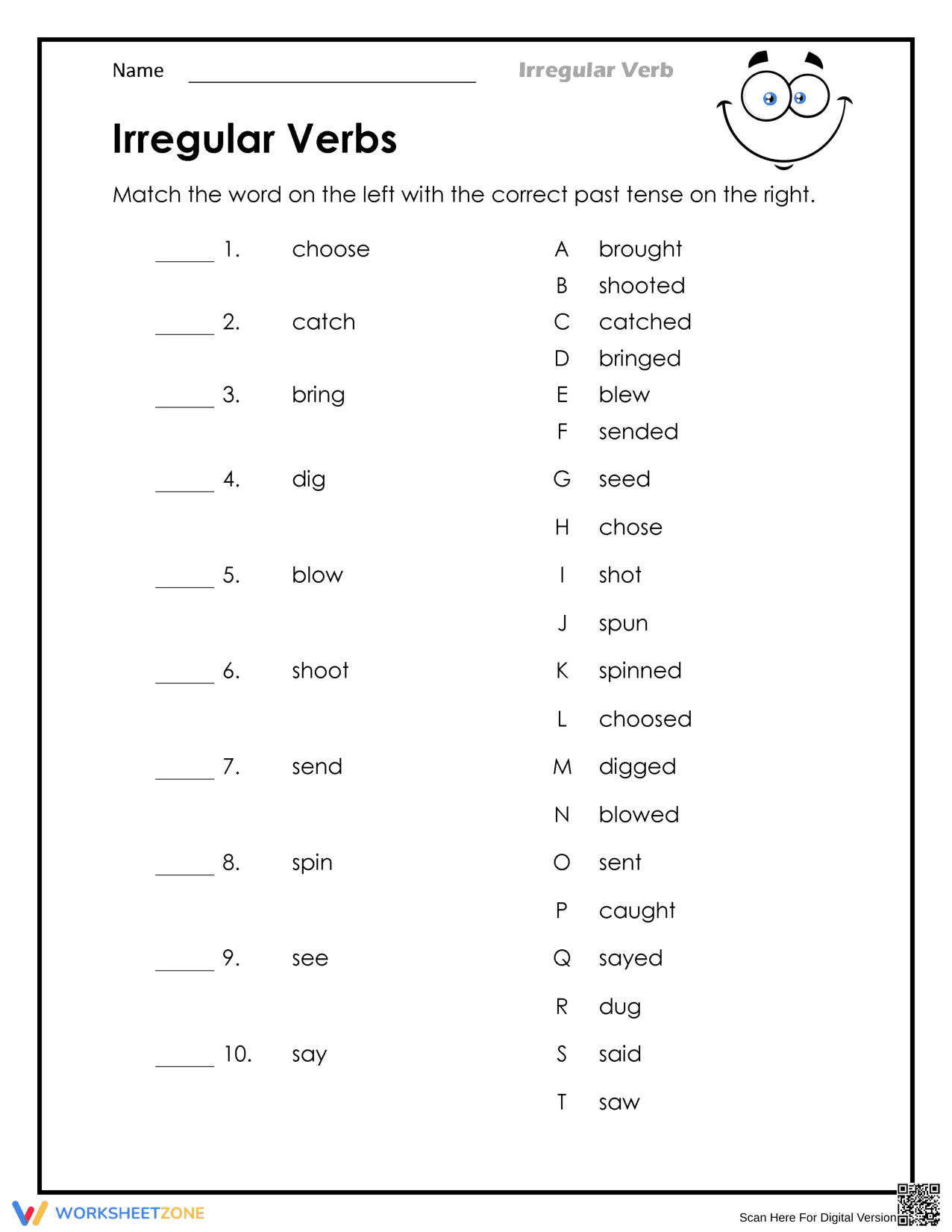
This printable irregular verbs worksheet provides Grades 3-5 students with targeted practice matching common present-tense verbs to their correct irregular past-tense forms. Students analyze ten specific verb pairs, distinguishing correct morphological changes from common "ed" overgeneralization errors. This focused resource ensures students build the linguistic accuracy required for fluent writing and speaking across the elementary curriculum.
At a Glance
- Grade: 3-5 · Subject: English Language Arts
- Standard:
CCSS.ELA-LITERACY.L.3.1.D— Form and use regular and irregular verbs correctly in sentences- Skill Focus: Irregular Past Tense Verb Matching
- Format: 1 page · 10 problems · Answer key included · PDF
- Best For: Independent grammar practice or sub plans
- Time: 10–15 minutes
This one-page matching activity features ten high-frequency present-tense verbs such as "bring," "choose," and "say." The right column provides twenty past-tense options, including both correct irregular forms and common distractor errors like "bringed" or "choosed." This specific design forces students to rely on internal grammar rules rather than simple pattern recognition. A complete answer key is included to facilitate rapid grading and immediate student feedback.
Zero-Prep Workflow
The zero-prep design of this worksheet facilitates an efficient three-step classroom workflow. First, print the single-page PDF for your entire class or a small intervention group. Second, distribute the copies; the clear, self-explanatory instructions mean students can begin working immediately without lengthy verbal explanations. Finally, review the answers using the included key for a quick formative check. This entire process requires less than two minutes of teacher preparation time.
Standards Alignment
This worksheet is directly aligned with CCSS.ELA-LITERACY.L.3.1.D, which requires students to form and use regular and irregular verbs. By targeting verbs that do not follow standard rules, the activity helps students master the linguistic exceptions that often lead to writing errors in upper elementary grades. It also supports CCSS.ELA-LITERACY.L.4.1 for standard English grammar conventions. Both standard codes can be copied directly into lesson plans, IEP goals, or district curriculum mapping tools.
How to Use It
Use this worksheet as a bell-ringer activity to activate prior knowledge or as a targeted exit ticket after a grammar lesson. For a formative assessment observation tip, monitor students as they work to see if they hesitate on high-frequency distractors like "seed" instead of "saw." This observation can help identify students who may need additional scaffolding or small-group intervention. Most students will complete the matching tasks within 10 to 15 minutes.
Who It's For
This resource is ideal for Grade 3, 4, and 5 students who are refining their mastery of English grammar. It is particularly effective for English Language Learners (ELLs) who often struggle with the unpredictable nature of irregular verb forms. To maximize impact, pair this worksheet with a past-tense mentor text passage, allowing students to see these verbs used in a natural context immediately after completing the isolated matching practice.
Mastering irregular past-tense verbs is a critical milestone in elementary language development. According to the RAND AIRS 2024 analysis, systematic exposure to irregular morphological patterns significantly reduces "over-regularization" errors—where students incorrectly apply standard rules to irregular forms—and accelerates the transition to fluent, conventional writing. This worksheet facilitates that transition by requiring students to choose between correct irregular forms (like "brought" and "caught") and their common, incorrect regularized counterparts (like "bringed" and "catched"). By providing ten structured matching tasks aligned to CCSS.ELA-LITERACY.L.3.1.D, teachers can efficiently assess a student's ability to "Form and use regular and irregular verbs" within a focused, low-stakes environment. This type of explicit grammar instruction remains a core recommendation for building foundational literacy skills tracked by NAEP and other national assessment frameworks.


