


























Views
Downloads

Money Word Problems Worksheet | Grade 1 Essential
Paste this activity's link or code into your existing LMS (Google Classroom, Canvas, Teams, Schoology, Moodle, etc.).
Students can open and work on the activity right away, with no student login required.
You'll still be able to track student progress and results from your teacher account.
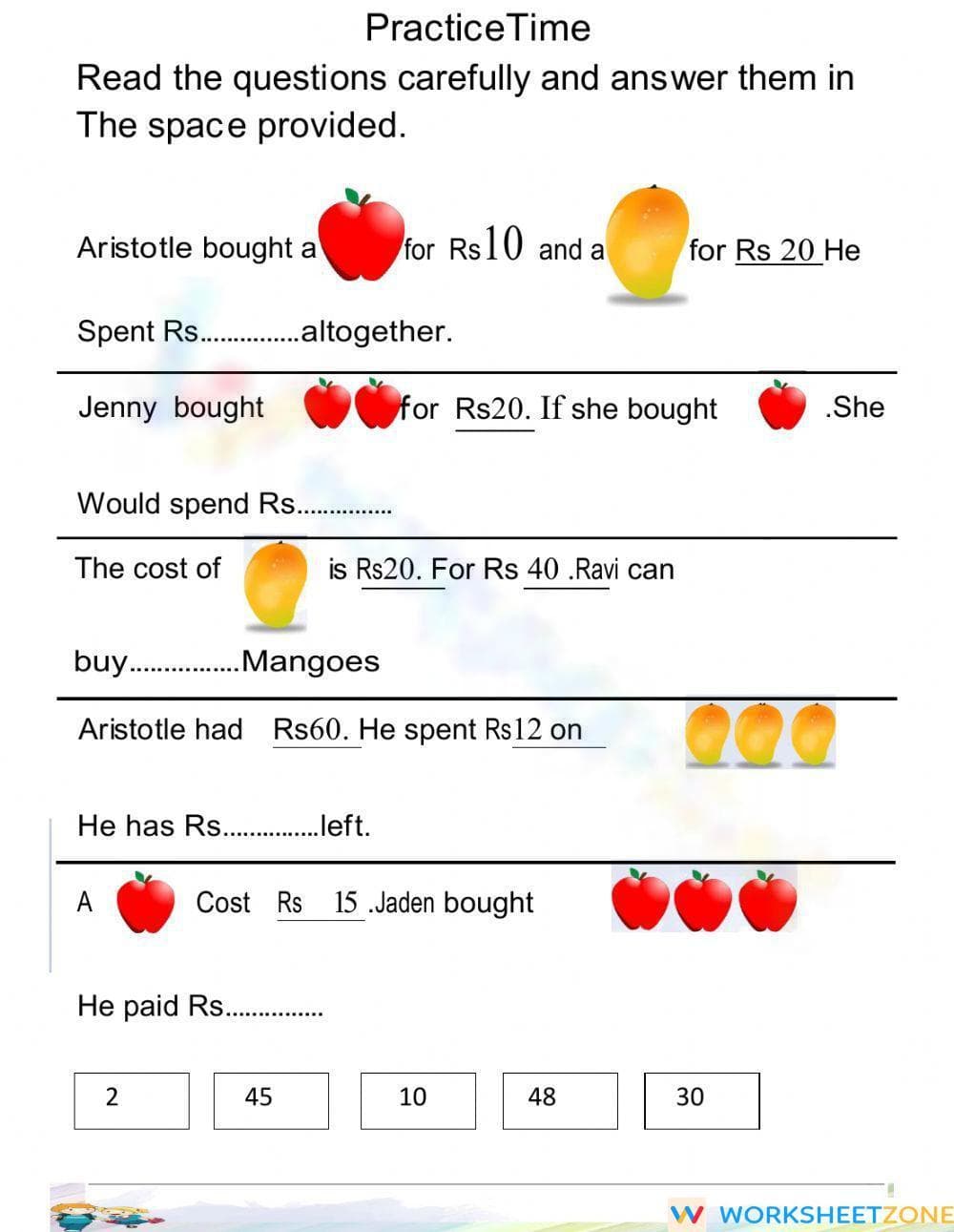
This Grade 1 money math worksheet helps students solve real-world word problems involving currency. By calculating totals and remaining balances, learners develop critical arithmetic skills and financial literacy. Students will read short scenarios, identify the mathematical operation required, and provide the correct numerical answer in the provided spaces.
At a Glance
- Grade: 1 · Subject: Math & Currency
- Standard:
CCSS.MATH.CONTENT.1.OA.A.1— Use addition and subtraction within 20 to solve word problems- Skill Focus: Currency Word Problems
- Format: 1 page · 5 problems · Answer key included · PDF
- Best For: Independent practice or formative assessment
- Time: 15–20 minutes
This single-page PDF features five distinct word problems centered on buying fruit. Each problem includes visual cues like apples and mangoes to support reading comprehension. The worksheet provides a clear layout with dedicated lines for answers and a helpful number bank at the bottom to assist students in self-correcting their calculations during the activity.
Skill Progression
- Guided Practice: The first two problems focus on simple addition of two items to find a total sum, using small whole numbers.
- Supported Practice: The middle tasks introduce subtraction concepts, requiring students to calculate the remaining balance after a purchase.
- Independent Practice: The final challenge requires students to determine the cost of multiple identical items, introducing early multiplication logic.
This gradual-release approach ensures students master the logic of word problems before moving to complex multi-step equations.
Standards Alignment
This resource is aligned with CCSS.MATH.CONTENT.1.OA.A.1, which requires students to use addition and subtraction within 20 to solve word problems involving situations of adding to, taking from, putting together, and comparing. It also touches upon early financial literacy concepts by applying math to commerce. Both standard codes can be copied directly into lesson plans, IEP goals, or district curriculum mapping tools.
How to Use It
Use this worksheet during the independent practice phase of a lesson on addition and subtraction. It serves as an excellent formative assessment tool to check if students can translate text into math equations. For a classroom activity, have students use physical play money to act out the scenarios described in the problems before writing their answers. Completion typically takes 15 to 20 minutes.
Who It's For
This worksheet is designed for Grade 1 students but is also suitable for Kindergarteners ready for a challenge or Preschoolers working on advanced number recognition. It is particularly effective for English Language Learners due to the visual fruit icons. Pair this with a classroom grocery store center or a direct instruction lesson on counting coins and currency.
According to the RAND AIRS 2024 report, integrating contextualized word problems into early elementary mathematics significantly improves long-term retention of arithmetic operations. This worksheet focuses on CCSS.MATH.CONTENT.1.OA.A.1 by requiring students to decode text-based scenarios into mathematical expressions. By using familiar objects like fruit and currency, the resource lowers cognitive load, allowing students to focus on the underlying logic of addition and subtraction. Research from Fisher & Frey (2014) emphasizes that visual scaffolds, such as the icons used here, are essential for supporting developing readers as they engage with technical math vocabulary. This 5-problem set provides the necessary repetition for mastery without overwhelming the learner. Educators can utilize the included number bank to facilitate self-monitoring, a key component of metacognitive development in early childhood education. This resource ensures that students meet foundational standards while building practical life skills related to money management.


