


























Views
Plays

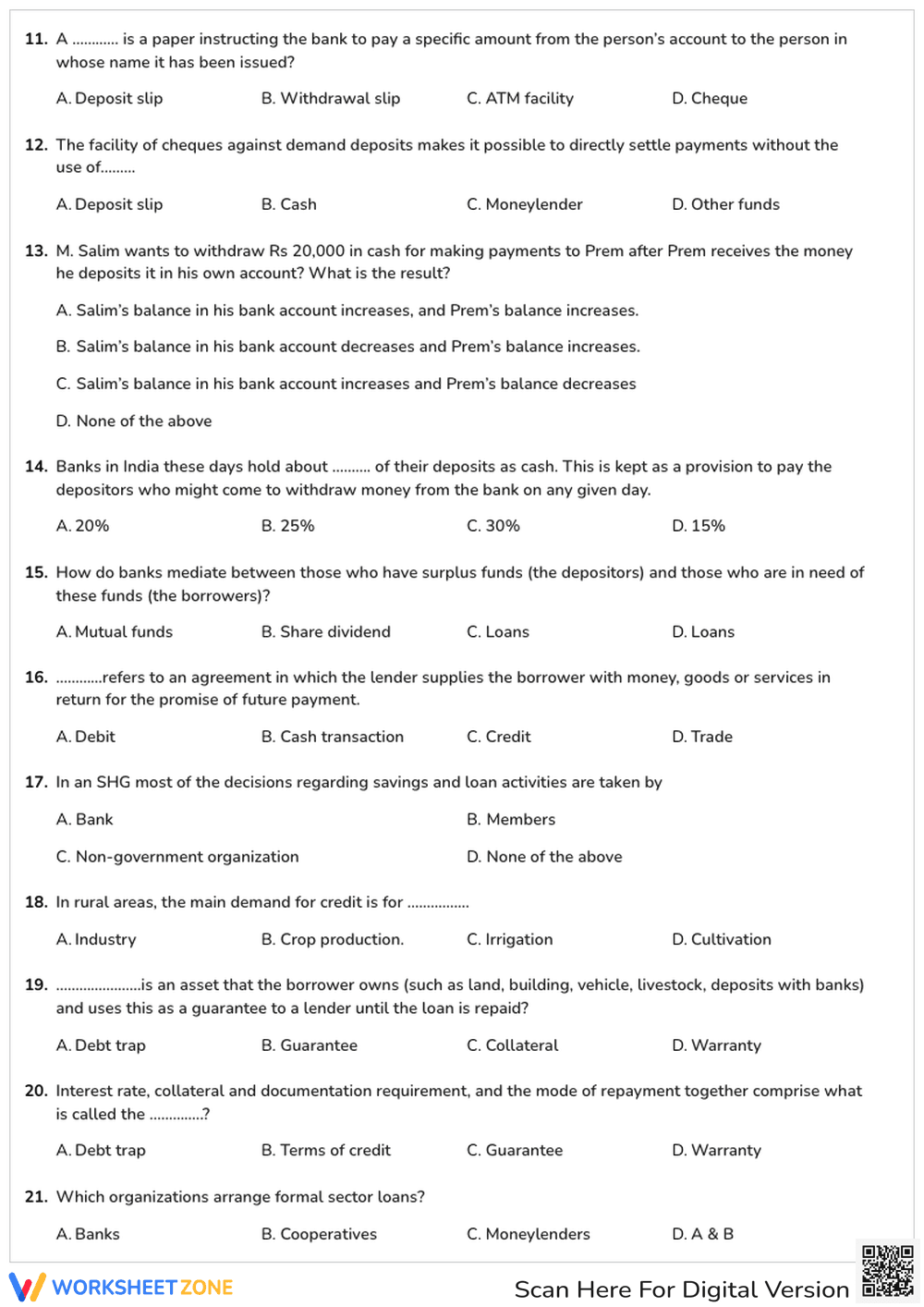


Money and Credit Essential Quiz | Grade 10 Math
Paste this activity's link or code into your existing LMS (Google Classroom, Canvas, Teams, Schoology, Moodle, etc.).
Students can open and work on the activity right away, with no student login required.
You'll still be able to track student progress and results from your teacher account.
This Grade 10 Money and Credit worksheet provides a comprehensive assessment of essential financial literacy concepts, ranging from the history of currency to modern banking mechanisms. Students will demonstrate their understanding of how credit functions within an economy and the role of formal financial institutions. This resource ensures learners can distinguish between various forms of money and credit instruments effectively.
At a Glance
- Grade: 10 · Subject: Math
- Standard:
HSF-LE.A.1— Distinguish between situations that can be modeled with linear and exponential functions- Skill Focus: Financial Literacy & Banking
- Format: 3 pages · 30 problems · Answer key included · PDF
- Best For: End-of-unit summative assessment or quiz
- Time: 40–50 minutes
This 3-page PDF contains 30 carefully crafted multiple-choice questions designed to test high school students on the complexities of modern finance. The assessment covers diverse topics including demonetization, digital banking, the "double coincidence of wants," and the structural differences between formal and informal credit sectors. It includes specific scenarios regarding Self-Help Groups (SHGs) and the Grameen Bank, providing a global perspective on microfinance and collateral requirements.
Zero-Prep Workflow
- Print (1 minute): Select the 3-page PDF and print enough copies for your class. The layout is optimized for clear reading and easy marking.
- Distribute (1 minute): Hand out the quiz as a quiet, independent activity. The multiple-choice format allows students to focus on conceptual retrieval.
- Review (5 minutes): Use the included answer key to grade papers rapidly or conduct a peer-review session to discuss the rationale behind each economic concept.
Standards Alignment: This resource is primarily aligned with HSF-LE.A.1, focusing on the conceptual foundations of credit and interest that lead to mathematical modeling. It also supports secondary standards related to quantitative literacy and economic reasoning. Both standard codes can be copied directly into lesson plans, IEP goals, or district curriculum mapping tools.
How to Use It: Assign this worksheet as a summative quiz after completing a unit on financial systems or as a diagnostic tool before starting lessons on compound interest and exponential growth. During the session, observe if students struggle with the distinction between formal and informal credit, as this often indicates a need for further direct instruction on interest rate regulation. Completion typically takes 45 minutes.
Who It's For: This assessment is tailored for Grade 10 students in Math or Economics tracks. It is particularly useful for learners requiring structured practice with technical vocabulary. Pair this resource with a banking anchor chart or a direct instruction lesson on the Federal Reserve or central banking systems for maximum impact.
According to the RAND AIRS 2024 report on secondary financial literacy, the integration of real-world banking scenarios into mathematics curriculum significantly improves student retention of complex economic concepts. This worksheet aligns with these findings by presenting 30 distinct problems that challenge students to apply theoretical knowledge to practical situations, such as understanding collateral and the terms of credit. Research from Fisher & Frey (2014) emphasizes that structured assessments like this quiz facilitate the gradual release of responsibility, allowing teachers to identify specific gaps in student understanding of fiscal systems before moving to advanced algebraic modeling of interest rates. By utilizing this resource, educators provide a rigorous framework for mastering the HSF-LE.A.1 standard, ensuring that Grade 10 learners develop the quantitative reasoning skills necessary for navigating modern financial landscapes. The inclusion of diverse institutional examples further supports a globalized understanding of currency and credit distribution across different socioeconomic sectors.


