


























0
Views
0
Downloads

0.0
0
Save
0 Likes
Share
Mixed Up Idioms Worksheet
0 Views
0 Downloads
Paste this activity's link or code into your existing LMS (Google Classroom, Canvas, Teams, Schoology, Moodle, etc.).
Students can open and work on the activity right away, with no student login required.
You'll still be able to track student progress and results from your teacher account.
Information
Description
What It Is:
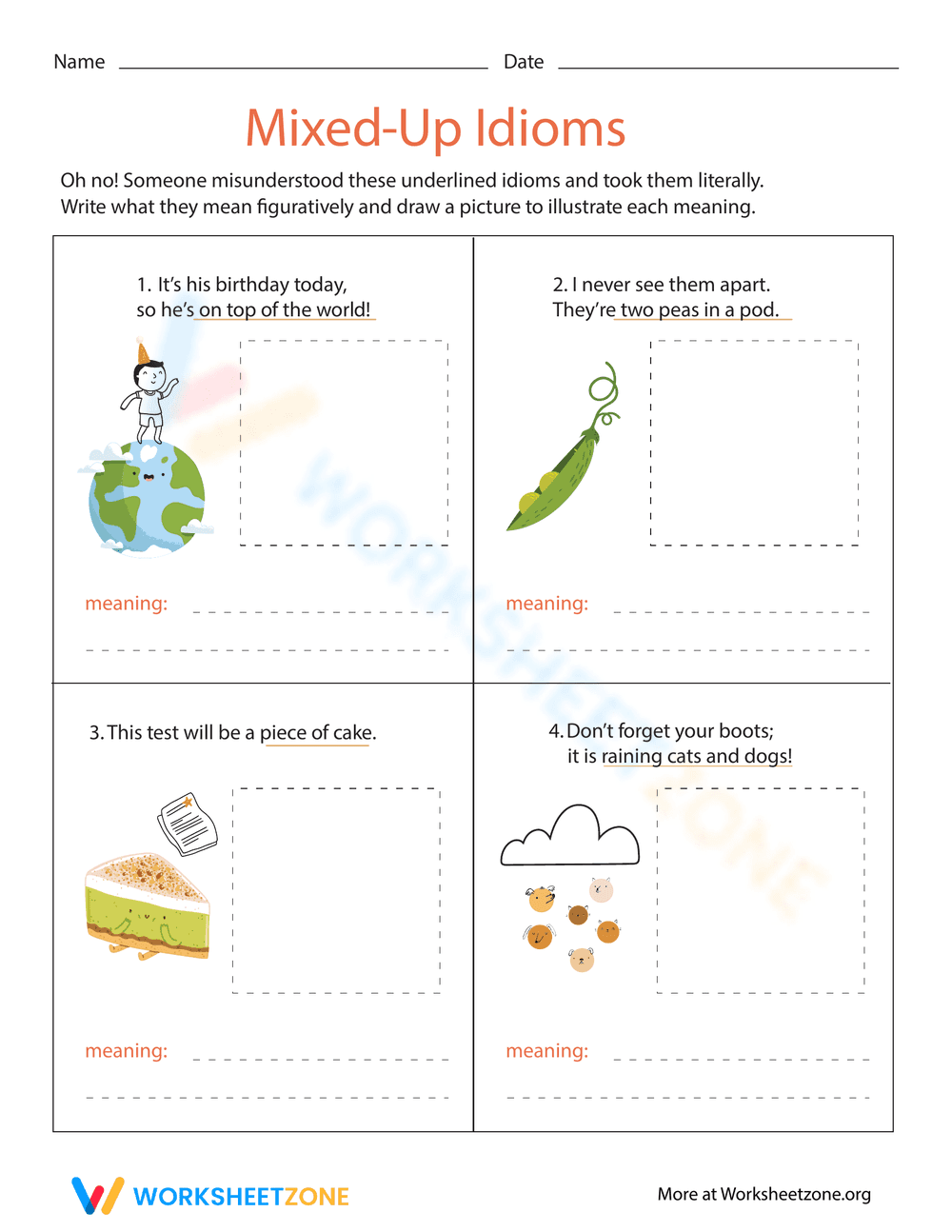
This is a language arts worksheet titled 'Mixed-Up Idioms.' It presents four common idioms with literal illustrations. Students are instructed to write the figurative meaning of each underlined idiom and draw a picture to illustrate its figurative meaning in the provided space. The idioms include 'on top of the world,' 'two peas in a pod,' 'a piece of cake,' and 'raining cats and dogs.'
Grade Level Suitability:
This worksheet is suitable for grades 3-5. The idioms are common enough for this age range, and the activity of writing definitions and drawing pictures is appropriate for developing comprehension and creative thinking skills.
Why Use It:
This worksheet helps students understand the difference between literal and figurative language. It encourages critical thinking and creative expression while reinforcing vocabulary and comprehension skills. It's a fun way to learn and practice idioms.
How to Use It:
First, explain what idioms are to the students. Then, have them read each sentence and identify the underlined idiom. Next, ask them to write what they think the idiom really means (its figurative meaning) on the lines provided. Finally, they should draw a picture in the box that represents the figurative meaning of the idiom.
Target Users:
This worksheet is designed for elementary school students, specifically those in grades 3-5, who are learning about idioms and figurative language. It can also be used for ESL students to expand their vocabulary and understanding of English expressions.
This is a language arts worksheet titled 'Mixed-Up Idioms.' It presents four common idioms with literal illustrations. Students are instructed to write the figurative meaning of each underlined idiom and draw a picture to illustrate its figurative meaning in the provided space. The idioms include 'on top of the world,' 'two peas in a pod,' 'a piece of cake,' and 'raining cats and dogs.'
Grade Level Suitability:
This worksheet is suitable for grades 3-5. The idioms are common enough for this age range, and the activity of writing definitions and drawing pictures is appropriate for developing comprehension and creative thinking skills.
Why Use It:
This worksheet helps students understand the difference between literal and figurative language. It encourages critical thinking and creative expression while reinforcing vocabulary and comprehension skills. It's a fun way to learn and practice idioms.
How to Use It:
First, explain what idioms are to the students. Then, have them read each sentence and identify the underlined idiom. Next, ask them to write what they think the idiom really means (its figurative meaning) on the lines provided. Finally, they should draw a picture in the box that represents the figurative meaning of the idiom.
Target Users:
This worksheet is designed for elementary school students, specifically those in grades 3-5, who are learning about idioms and figurative language. It can also be used for ESL students to expand their vocabulary and understanding of English expressions.


