


























Views
Downloads


Printable Missing Multiplication Factors Worksheet
Paste this activity's link or code into your existing LMS (Google Classroom, Canvas, Teams, Schoology, Moodle, etc.).
Students can open and work on the activity right away, with no student login required.
You'll still be able to track student progress and results from your teacher account.
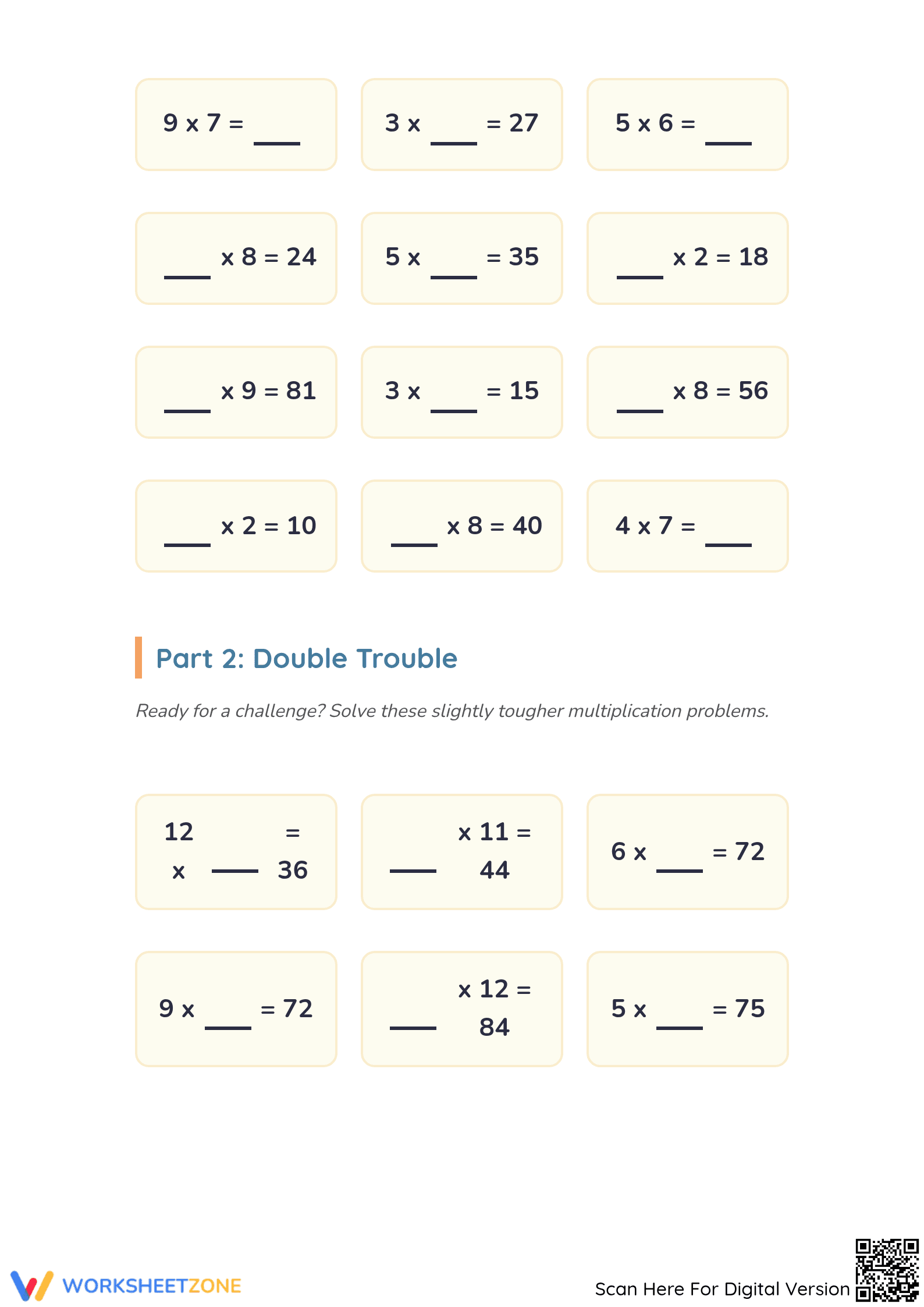
This comprehensive three-page worksheet helps students master their multiplication facts by identifying missing factors and products. By focusing on the inverse relationship between numbers, students strengthen the foundational skills required for division. This resource moves beyond simple calculation, requiring learners to apply algebraic thinking to solve 33 unique problems in a structured, printable format.
At a Glance
- Grade: 3–4 · Subject: Math
- Standard:
CCSS.MATH.CONTENT.3.OA.A.4— Determine the unknown whole number in a multiplication equation relating three whole numbers- Skill Focus: Missing Factor Identification
- Format: 3 pages · 33 problems · Answer key included · PDF
- Best For: Independent Practice and Math Centers
- Time: 25–35 minutes
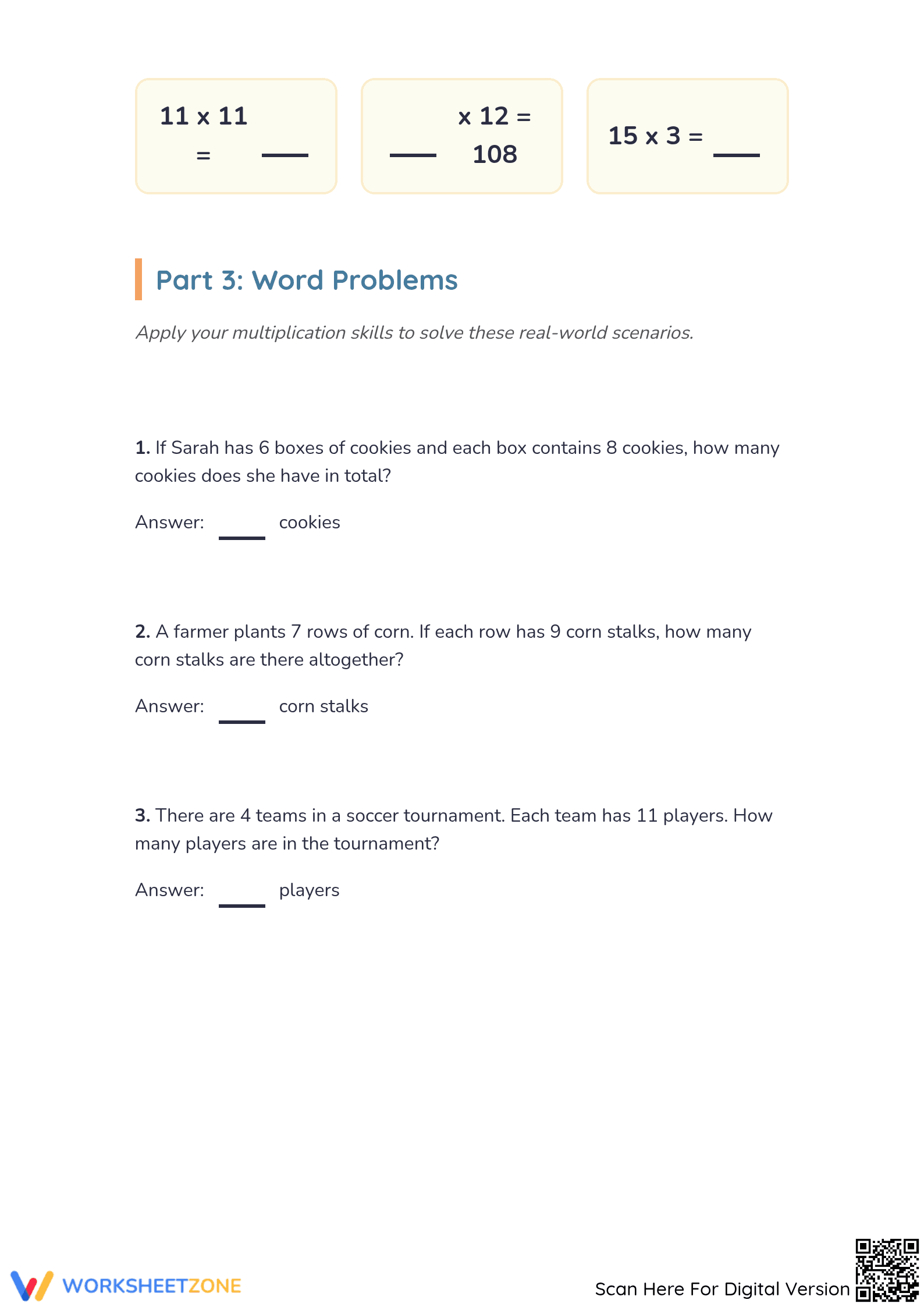
Inside this packet, you will find three distinct pages of increasing complexity. The first page features nine basic multiplication equations with missing components. The second page introduces eighteen more challenging problems, including 'Double Trouble' equations involving factors of 11 and 12. Finally, the third page provides three additional equations followed by three realistic word problems. A full answer key is included for rapid grading.
The zero-prep workflow for this resource is designed for maximum efficiency. Teachers can print the three-page set in under 30 seconds. Distribution to a standard class takes approximately one minute, with no additional manipulatives or setup required. Students typically spend 25–35 minutes completing the sections, allowing for a seamless review phase where the provided answer key enables immediate feedback. Total preparation time remains under two minutes, making this an ideal solution for emergency sub plans or high-utility math centers.
Aligned to `CCSS.MATH.CONTENT.3.OA.A.4`, this worksheet requires students to 'Determine the unknown whole number in a multiplication or division equation relating three whole numbers.' It also supports 4.OA.A.1 by emphasizing multiplicative comparisons. Both standard codes can be copied directly into lesson plans, IEP goals, or district curriculum mapping tools.
Deploy this worksheet during the 'Independent Practice' phase of a multiplication lesson to monitor student progress in factor fluency. Use the word problems on page three as a formative assessment to observe how well students translate verbal scenarios into mathematical equations. The 25–35 minute completion time makes it perfect for a rotation-based math center or a quiet morning work activity.
This resource is designed for Grade 3 and 4 students who are moving from basic multiplication fact recall to conceptual mastery. It is particularly effective for learners needing extra practice with the commutative property. For best results, pair this worksheet with a multiplication anchor chart or a short direct instruction lesson on inverse operations.
According to the RAND AIRS 2024 report, structured practice with missing factors is essential for bridging the conceptual gap between multiplicative reasoning and algebraic thinking. This worksheet targets CCSS.MATH.CONTENT.3.OA.A.4 by requiring students to determine the unknown whole number in equations relating three whole numbers. By moving beyond rote memorization of products and focusing on the relationship between factors, students build the cognitive schema necessary for successful division and future equation solving. Research from ScienceDirect TpT Analysis indicates that worksheets combining abstract equations with contextual word problems significantly improve retention rates among Grade 3 and 4 learners. This resource provides 33 high-quality problems that transition from basic facts to 'Double Trouble' challenges, ensuring that students achieve procedural fluency while developing a deep understanding of mathematical properties. The inclusion of word problems anchors abstract concepts in real-world scenarios, a practice supported by Fisher & Frey (2014) for effective numeracy development.


