


























Views
Downloads



Missing Addition and Subtraction Sign Worksheet | Ready
Paste this activity's link or code into your existing LMS (Google Classroom, Canvas, Teams, Schoology, Moodle, etc.).
Students can open and work on the activity right away, with no student login required.
You'll still be able to track student progress and results from your teacher account.
This Grade 3-5 math worksheet challenges students to identify missing addition and subtraction signs to balance equations. By analyzing numerical relationships, learners develop deep operational fluency and algebraic thinking. It provides a structured path from basic single-digit logic to complex multi-step word problems that require critical thinking.
At a Glance
- Grade: 3-5 · Subject: Math
- Standard:
CCSS.MATH.CONTENT.3.OA.D.8— Solve two-step word problems using the four operations and represent with equations- Skill Focus: Operational logic and equation balancing
- Format: 5 pages · 30 problems · Answer key included · PDF
- Best For: Math centers and differentiated independent practice
- Time: 20–35 minutes
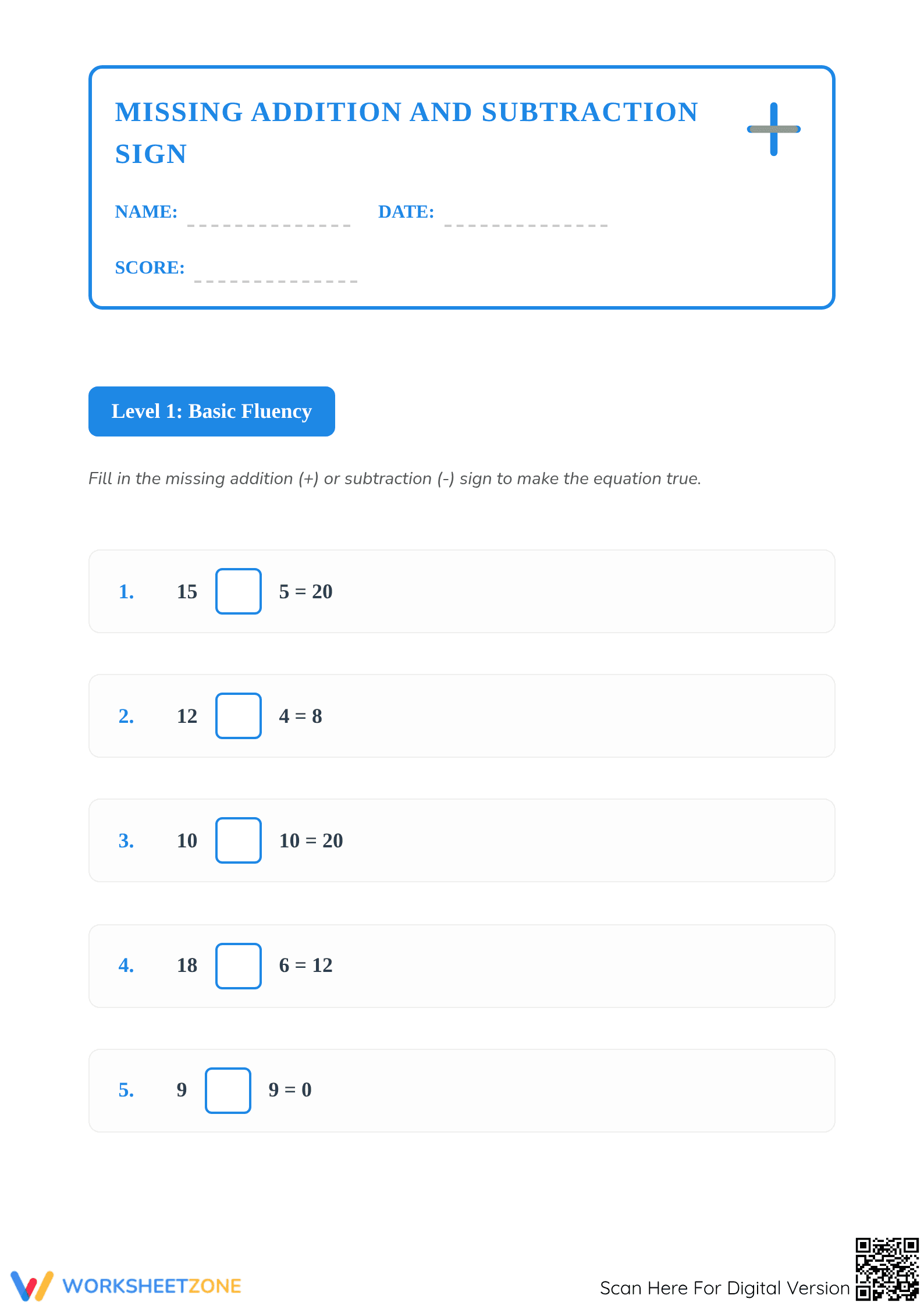
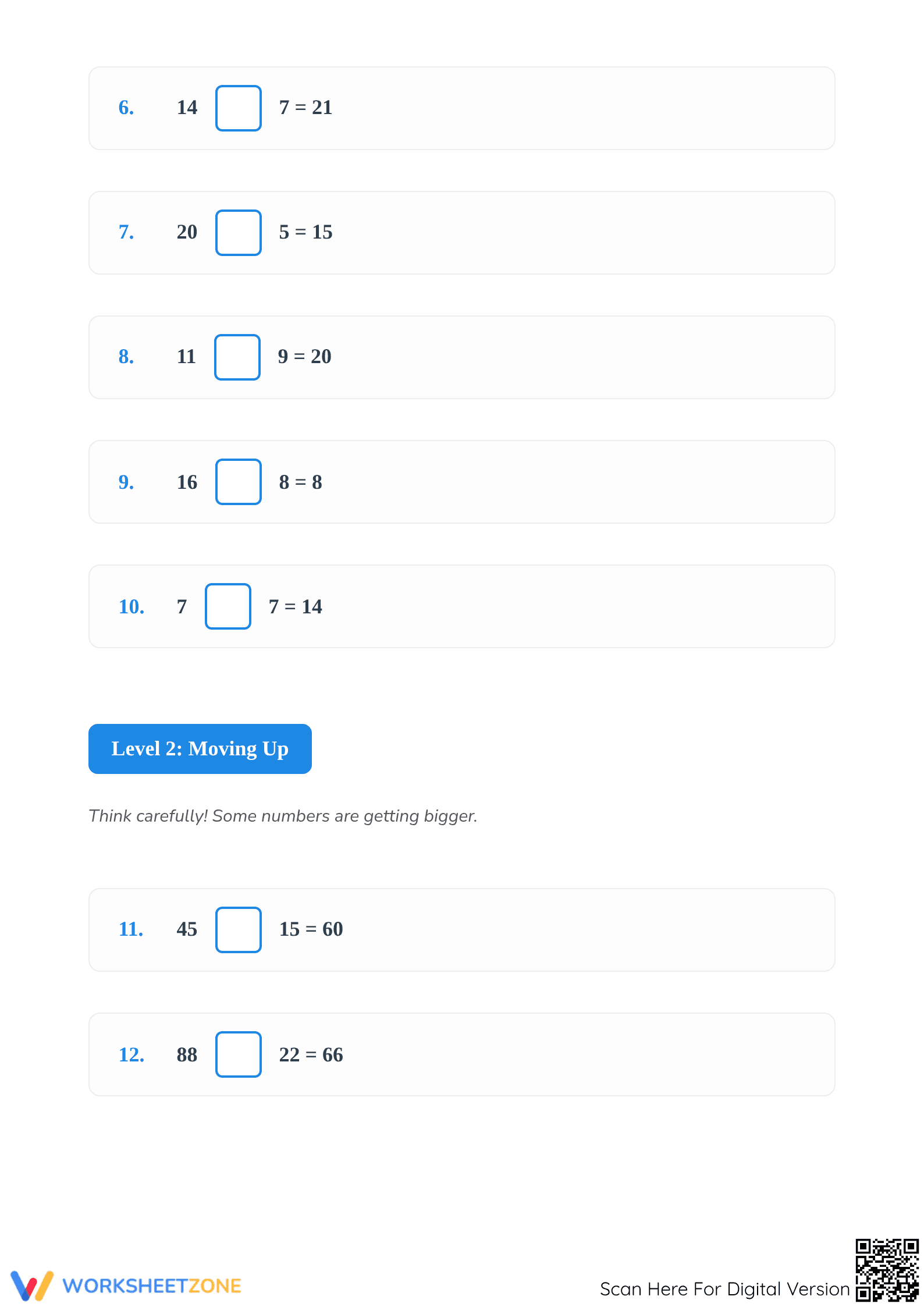
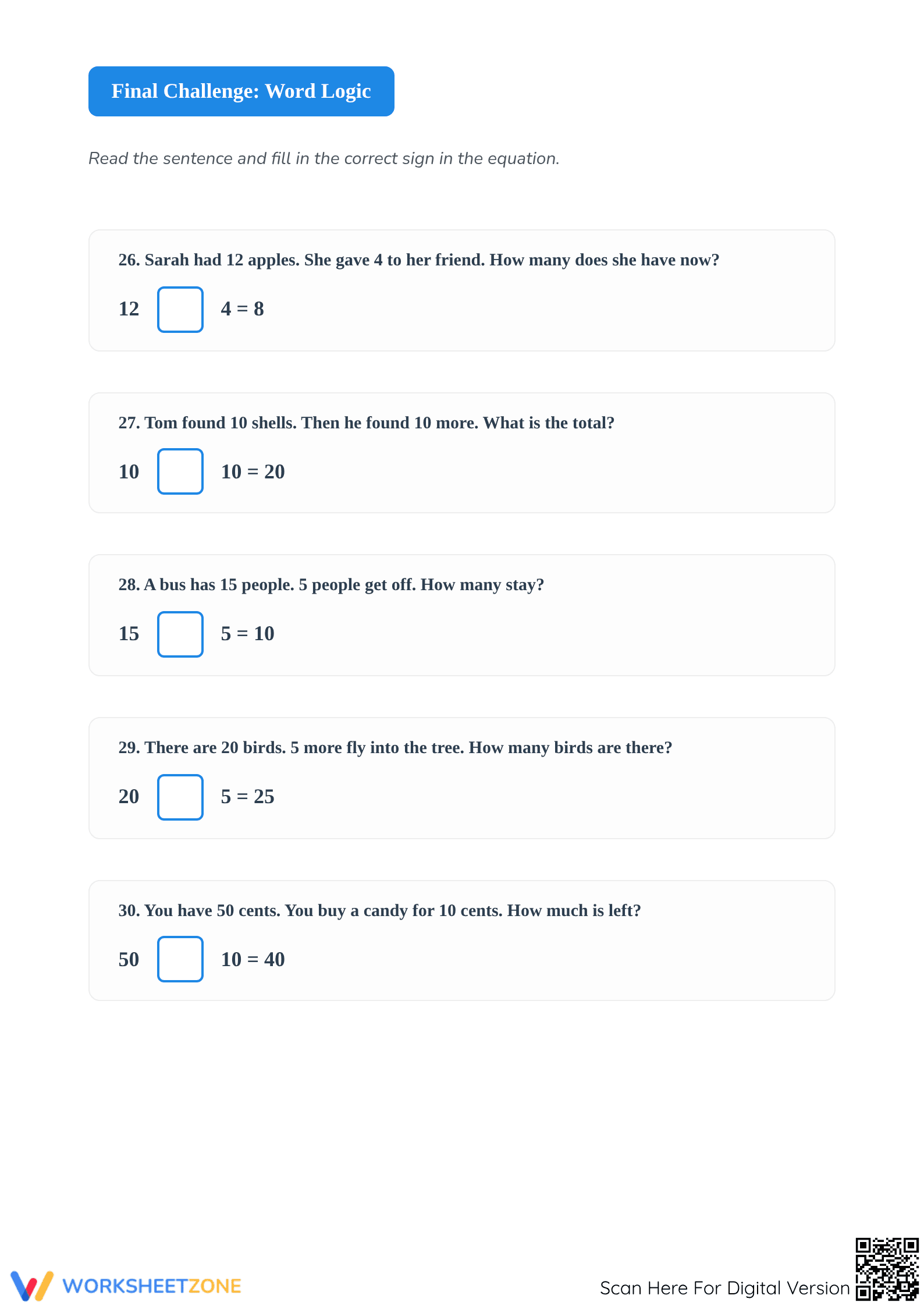
This comprehensive 5-page PDF contains 30 distinct tasks organized by increasing complexity. It includes a clear header for student identification, large legible font for accessibility, and a dedicated answer key for every page. The layout transitions from simple horizontal equations to multi-sign challenges and contextual word logic scenarios, ensuring students remain engaged as the difficulty scales.
- Below grade (Level 1): Focuses on basic fluency with 10 problems using small integers and single missing operators to build confidence and reinforce the relationship between addition and subtraction.
- On grade (Level 2 & 3): Introduces larger numbers and "Double Trouble" equations where two signs are missing, requiring multi-step mental math and trial-and-error strategies.
- Above grade (Final Challenge): Applies operational logic to word problems, forcing students to translate linguistic cues into mathematical symbols and verify their results against the provided totals.
The primary focus is CCSS.MATH.CONTENT.3.OA.D.8, which requires students to solve problems using the four operations and represent these problems using equations. This worksheet specifically targets the representation and operational choice aspect of the standard. Both standard codes can be copied directly into lesson plans, IEP goals, or district curriculum mapping tools.
Use this resource during the independent practice phase of a gradual release model. After teaching the relationship between inverse operations, assign Level 1 as a quick check for understanding. For advanced learners, skip directly to the "Double Trouble" section to stimulate higher-order thinking. Completion typically takes 25 minutes depending on the selected level and student proficiency.
This resource is designed for third through fifth-grade students needing to reinforce their understanding of inverse operations. It is particularly effective for RTI (Response to Intervention) groups or as a supplemental activity alongside a core curriculum. The tiered structure makes it an ideal choice for inclusive classrooms with diverse learning needs.
According to the RAND AIRS 2024 report on mathematical instructional materials, high-quality worksheets that incorporate tiered difficulty levels significantly improve student engagement and retention of algebraic concepts. This worksheet aligns with the Fisher & Frey (2014) model of scaffolded instruction by providing a clear progression from guided fluency to independent word logic. By targeting CCSS.MATH.CONTENT.3.OA.D.8, the material ensures that students are not merely performing rote calculation but are actively analyzing the structure of equations. Research indicates that identifying missing operators helps bridge the gap between arithmetic and early algebra, a critical milestone in the upper elementary grades. This 30-problem set provides the necessary volume of practice required for mastery while maintaining a low-floor, high-ceiling approach through its four distinct challenge tiers.


