


























Views
Downloads



Missing Addends Worksheet | Grade 3 Math Printable
Paste this activity's link or code into your existing LMS (Google Classroom, Canvas, Teams, Schoology, Moodle, etc.).
Students can open and work on the activity right away, with no student login required.
You'll still be able to track student progress and results from your teacher account.
This comprehensive missing addends worksheet helps third-grade students master multi-digit addition and inverse operations. By solving for unknown numbers in three-digit and four-digit equations, learners build strong algebraic thinking and computational fluency. The structured progression ensures students develop confidence before tackling complex word problems.
At a Glance
- Grade: 3 · Subject: Math
- Standard:
CCSS.MATH.CONTENT.3.NBT.A.2— Fluently add and subtract within 1000- Skill Focus: Missing Addends
- Format: 4 pages · 25 problems · Answer key included · PDF
- Best For: Independent practice and review
- Time: 25–35 minutes
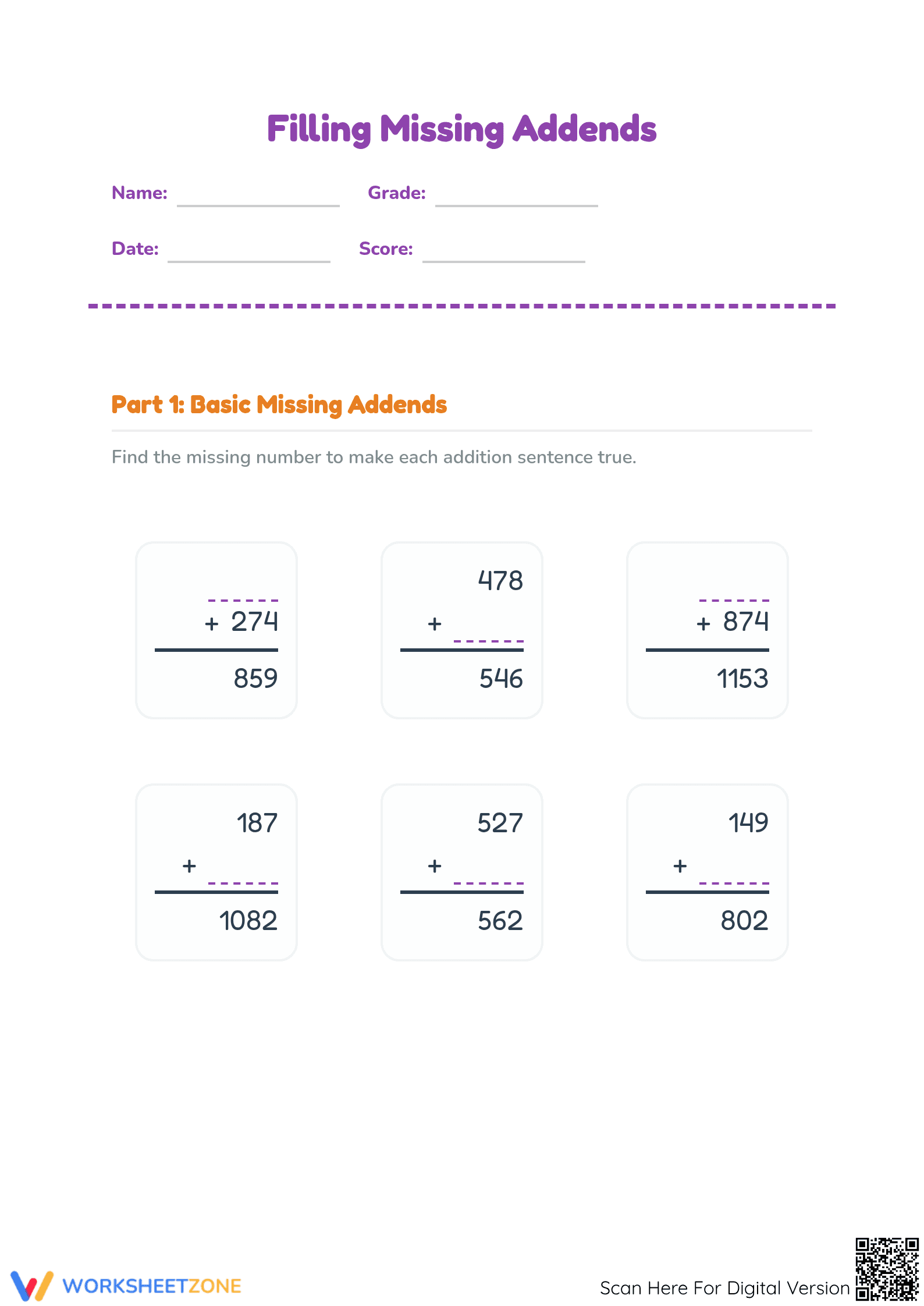
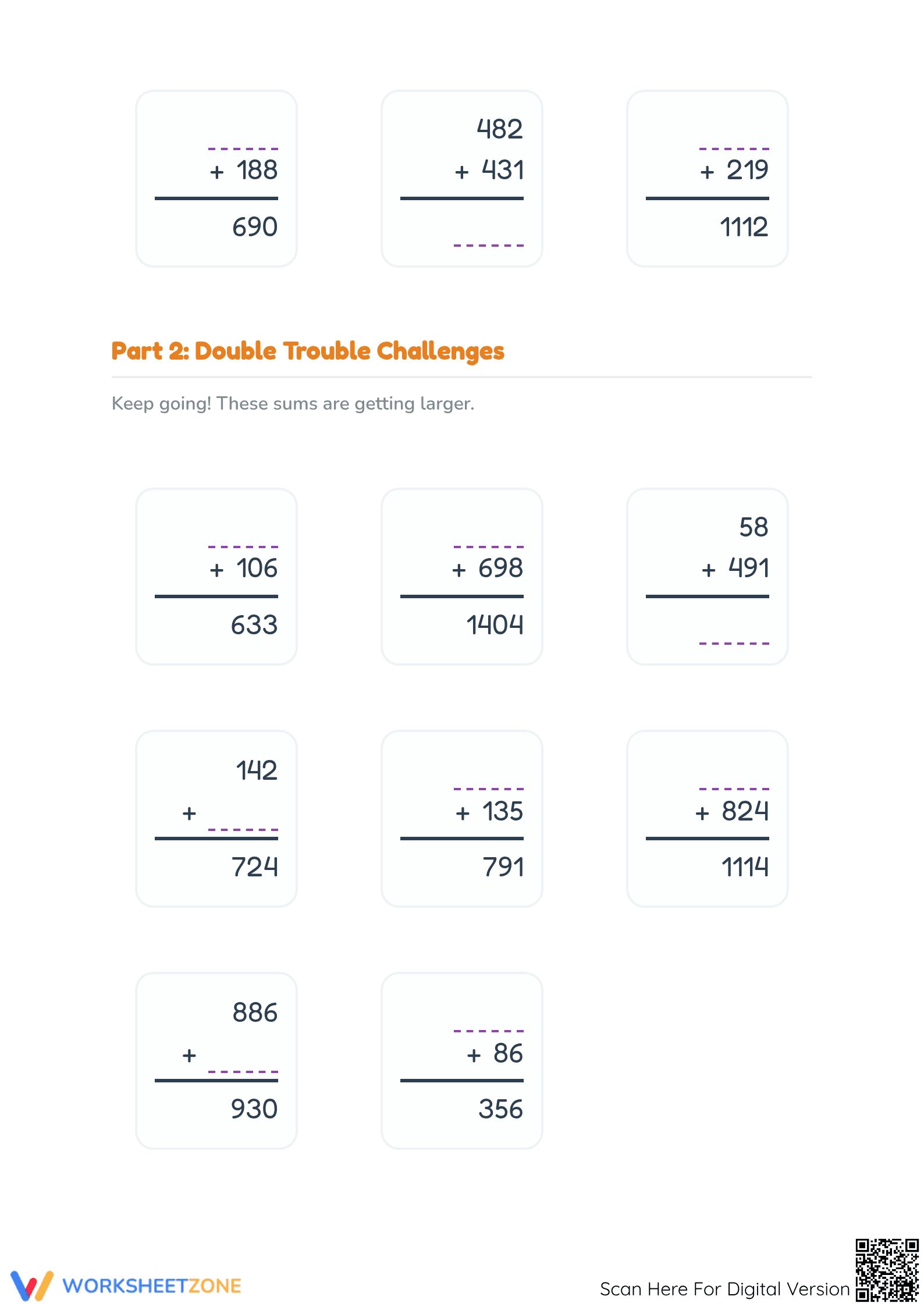
This four-page resource features 25 carefully sequenced problems divided into four distinct sections. Students begin with basic three-digit missing addends, progress to more challenging equations, apply their skills to real-world word problems, and finish with a four-digit challenge section. A complete answer key is provided for quick and accurate grading, making it easy for teachers to assess student understanding.
- Guided practice: Part 1 introduces basic three-digit missing addends with straightforward vertical alignment to build foundational confidence.
- Supported practice: Part 2 increases the difficulty with larger sums and varied missing placements, requiring students to apply inverse operations consistently.
- Independent practice: Parts 3 and 4 challenge students with word problems and four-digit equations, pushing them to synthesize their skills without direct scaffolding.
This gradual-release approach perfectly mirrors the "I Do, We Do, You Do" instructional model, ensuring steady skill acquisition.
This resource is strictly aligned to CCSS.MATH.CONTENT.3.NBT.A.2, requiring students to fluently add and subtract within 1000 using strategies based on place value and properties of operations. It also supports algebraic thinking by having students solve for unknown whole numbers in addition equations. Both standard codes can be copied directly into lesson plans, IEP goals, or district curriculum mapping tools.
Deploy this worksheet during the independent practice phase of your math block, immediately following direct instruction on inverse operations. It serves as an excellent formative assessment tool; observe whether students are using subtraction to find the missing addends or relying on less efficient counting-up strategies. The entire packet takes approximately 25 to 35 minutes to complete, making it ideal for a dedicated math center or a comprehensive homework assignment.
This resource is designed for third-grade general education students, but it also serves as an excellent enrichment activity for advanced second graders working on multi-digit addition. For students needing extra support, provide base-ten blocks or a place value chart to help them visualize the regrouping process. It pairs perfectly with a mini-lesson on fact families and the relationship between addition and subtraction.
Mastering missing addends is a critical stepping stone for early algebraic thinking and long-term mathematical success. According to a recent EdReports 2024 analysis, students who regularly practice solving for unknown variables in elementary mathematics demonstrate significantly higher proficiency in middle school algebra courses. This resource directly supports CCSS.MATH.CONTENT.3.NBT.A.2 by requiring learners to fluently add and subtract within 1000. By engaging with these specific problem types, students move beyond rote memorization and develop a deeper conceptual understanding of how numbers relate to one another through inverse operations. The structured progression from simple three-digit equations to complex word problems ensures that learners build the cognitive flexibility necessary for advanced mathematical reasoning. Integrating this targeted practice into weekly routines provides the exact repetition needed to solidify these essential computational skills.


