


























Views
Plays




CCSS L.1.1 Quiz: Logic & Grammar — Grade 1 Aligned
Paste this activity's link or code into your existing LMS (Google Classroom, Canvas, Teams, Schoology, Moodle, etc.).
Students can open and work on the activity right away, with no student login required.
You'll still be able to track student progress and results from your teacher account.
This Grade 1 logic and grammar assessment evaluates students' ability to process complex sequences, identify grammatical errors, and apply spatial reasoning. By integrating multiple cognitive domains into a single format, this worksheet ensures learners actively apply critical thinking to solve multi-step problems rather than just memorizing rules.
At a Glance
- Grade: 1 · Subject: ELA
- Standard:
CCSS.ELA-LITERACY.L.1.1— Demonstrate command of standard English grammar conventions- Skill Focus: Logic & Grammar
- Format: 5 pages · 22 problems · Answer key included · PDF
- Best For: Summative assessment
- Time: 30–40 minutes
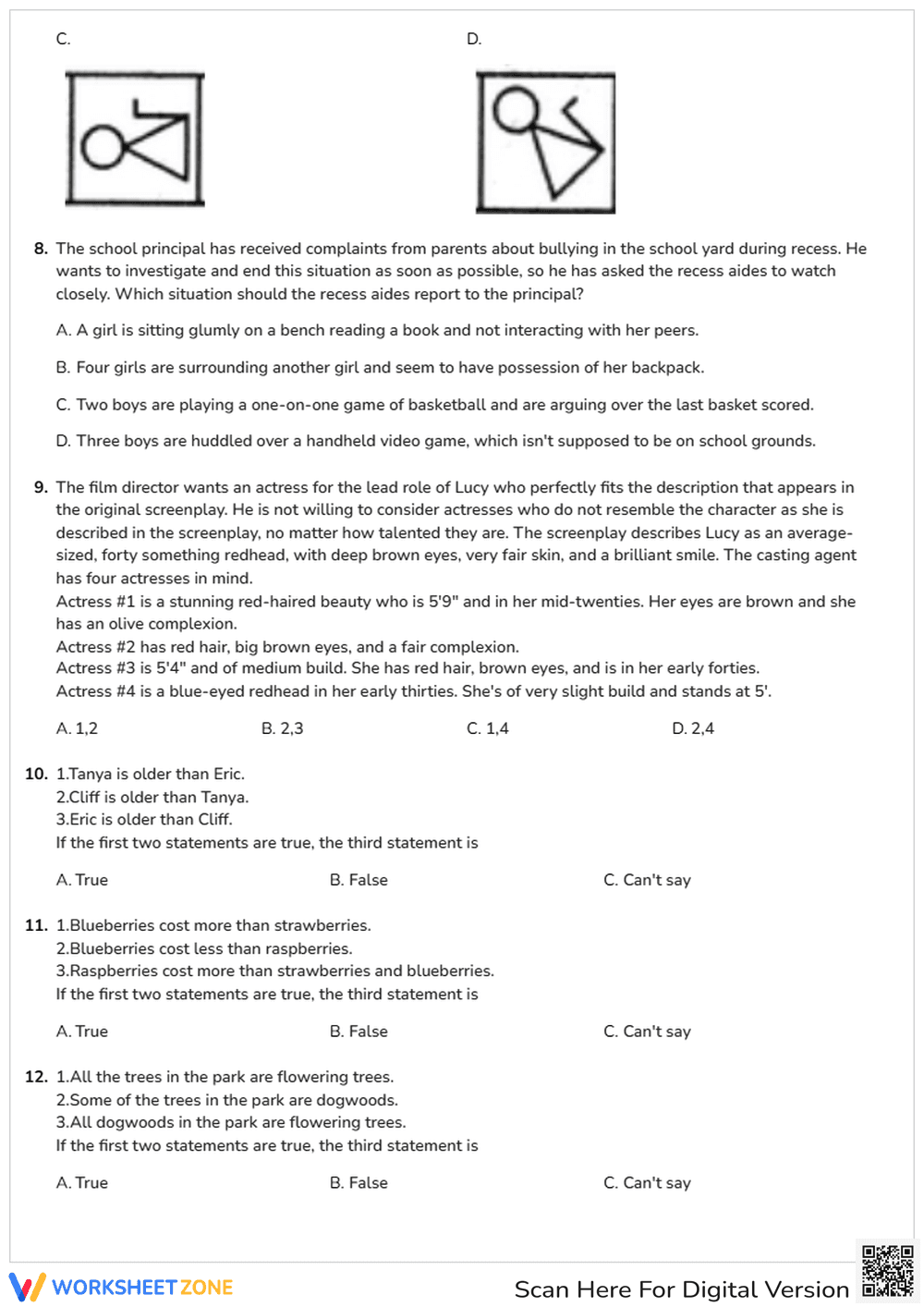
This 5-page PDF contains a diverse array of 22 high-quality assessment tasks. The resource includes visual pattern completion, syllogism-based logic puzzles, reading comprehension scenarios, and specific grammar error identification exercises. Each page is structured to minimize visual clutter, allowing students to focus entirely on the complex text-based prompts and detailed diagrams provided for spatial reasoning questions. A complete answer key is included for efficient grading.
Mastery Evidence
This assessment provides clear evidence of student mastery across three distinct performance tiers. The initial tasks focus on Approaching mastery through visual identification and simple pattern matching. The middle section moves toward Meeting the standard by requiring students to evaluate the truth of logical statements and identify specific grammatical errors in context. Finally, the Exceeding tier challenges students with complex situational analysis. Scores from these 22 tasks can be entered directly into gradebooks or used to document progress toward specific IEP goals.
Standards Alignment
The primary focus of this resource is CCSS.ELA-LITERACY.L.1.1, which requires students to demonstrate command of the conventions of standard English grammar and usage when writing or speaking. Additionally, the logic and word problems support foundational math reasoning skills by requiring students to analyze multi-step scenarios. Both standard codes can be copied directly into lesson plans, IEP goals, or district curriculum mapping tools.
How to Use It
This worksheet is best utilized as a summative assessment at the end of a logic or grammar unit. Because of its length and complexity, teachers might also assign it as a multi-day formative check during independent work time. During administration, observe how students handle the "If/Then" logic statements; this provides a valuable formative-assessment observation tip regarding their deductive reasoning capabilities. Expect a completion time of 30 to 40 minutes for most Grade 1 learners.
Who It's For
This resource is ideal for general education students ready for a challenge, as well as gifted and talented populations requiring enrichment. It serves as an excellent pairing resource for direct instruction lessons on sentence structure or introductory logic. The clear formatting also makes it highly accessible for students requiring structured visual support to process complex information.
Research indicates that integrating logical reasoning with language arts instruction significantly improves long-term retention of grammatical rules. According to Fisher & Frey (2014), the use of complex, multi-domain assessments encourages students to engage in higher-order thinking rather than rote recall. By requiring students to evaluate the validity of statements and identify errors in standard English, this resource aligns with the CCSS.ELA-LITERACY.L.1.1 mandate to demonstrate command of standard English grammar conventions. The inclusion of spatial reasoning tasks further supports cognitive flexibility, a key predictor of academic success in early elementary years. This assessment provides the necessary data points for educators to differentiate instruction effectively, ensuring that every learner moves toward mastery of core standards while developing the critical thinking skills required for advanced academic work in subsequent grades.


