




























Views
Downloads
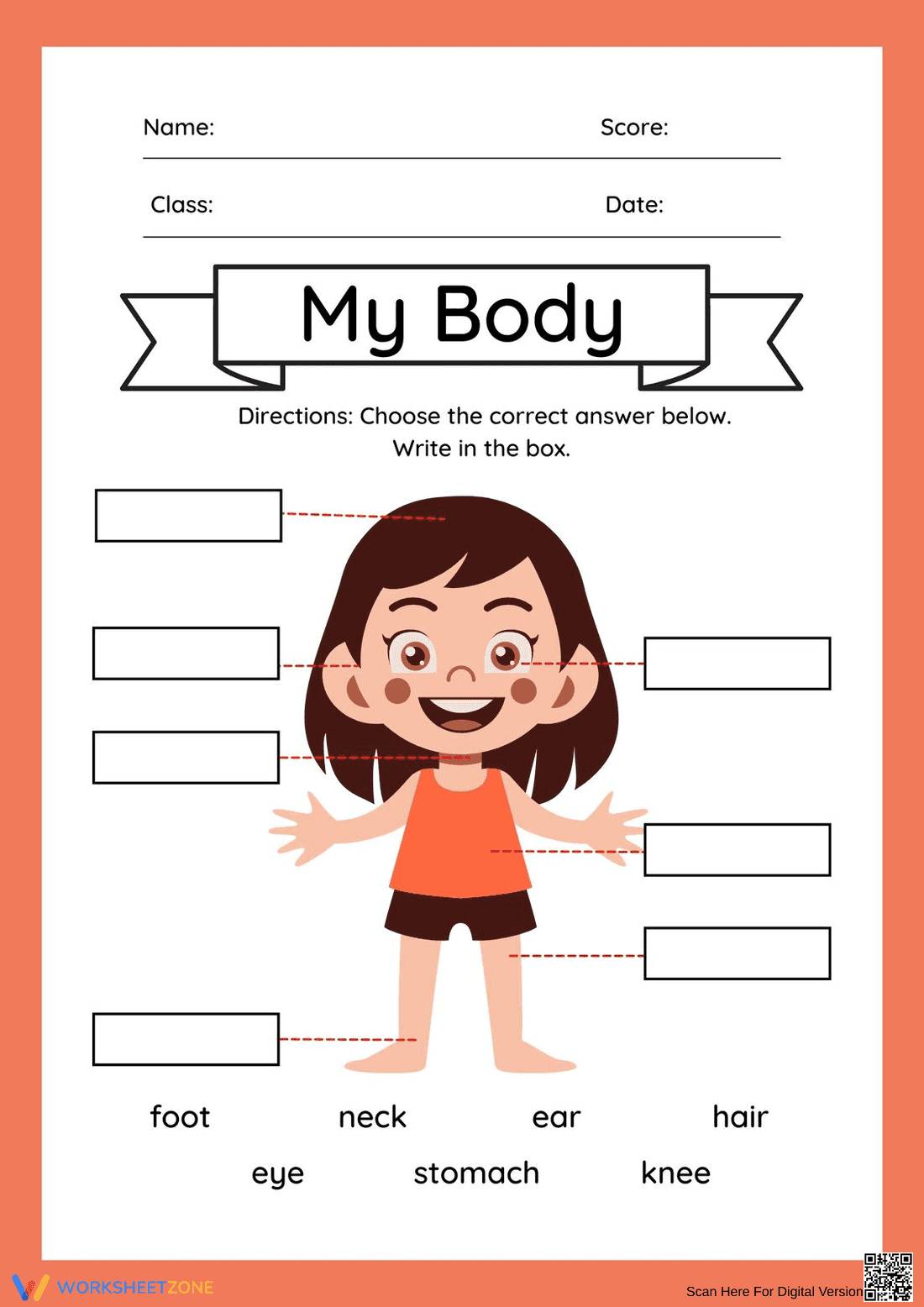

Body Parts Worksheet | Kindergarten Science Printable

Paste this activity's link or code into your existing LMS (Google Classroom, Canvas, Teams, Schoology, Moodle, etc.).
Students can open and work on the activity right away, with no student login required.
You'll still be able to track student progress and results from your teacher account.
This Kindergarten body parts worksheet provides a clear, visual way for young learners to identify and label human anatomy. By connecting vocabulary words to specific physical locations on a diagram, students build essential life science foundations and descriptive language skills. It is an effective tool for reinforcing basic biological concepts in a classroom or home setting.
At a Glance
- Grade: Kindergarten · Subject: Science
- Standard:
K-LS1-1— Use observations to describe patterns of what living things need to survive- Skill Focus: Human body part identification
- Format: 1 page · 7 problems · Answer key included · PDF
- Best For: Introductory life science or health lessons
- Time: 10–15 minutes
Inside this resource, you will find a single-page PDF featuring a minimalist illustration of a girl with seven distinct labeling boxes. A clear word bank at the bottom includes terms like hair, eye, neck, and stomach. The layout uses dashed lines to guide student focus, ensuring that even early writers can successfully map the vocabulary to the correct anatomical locations without visual clutter.
The zero-prep workflow for this worksheet is designed for maximum efficiency. First, print the single-page PDF (30 seconds). Next, distribute the sheets to your students along with pencils (1 minute). Finally, review the answers as a whole group using the included key to provide immediate feedback (5 minutes). Total teacher preparation time is under 2 minutes, making it an ideal choice for morning work or emergency sub plans.
This worksheet aligns with K-LS1-1, focusing on the observation of living things. By identifying body parts, students begin to understand the structures that help humans interact with their environment. It also supports CCSS.ELA-LITERACY.L.K.5.A by categorizing anatomical terms. Both standard codes can be copied directly into lesson plans, IEP goals, or district curriculum mapping tools.
Use this worksheet during the explore phase of a science lesson on the human body. It works exceptionally well as a formative assessment after a physical activity or a read-aloud about health. Observe if students can independently match the initial sounds of the word bank terms to the corresponding body parts to gauge phonics integration. The 7 tasks provide enough data to identify students needing additional support.
This resource is ideal for Kindergarten students, English Language Learners (ELLs) requiring visual support, and special education students working on basic identification goals. It pairs naturally with a My Body anchor chart or a physical Simon Says game to reinforce the vocabulary through kinesthetic learning and visual repetition. The minimalist aesthetic ensures it remains accessible for students with sensory processing needs.
According to the RAND AIRS 2024 report, visual-spatial mapping in early childhood education significantly improves long-term retention of scientific vocabulary. This worksheet utilizes a minimalist design to reduce cognitive load, allowing Kindergarteners to focus entirely on the relationship between the written word and the physical form. By engaging with 7 specific tasks, students practice the observational skills mandated by the K-LS1-1 standard. Research from Fisher & Frey (2014) suggests that providing a word bank serves as a critical scaffold for emergent readers, facilitating the transition from oral language to written literacy. This resource provides a structured environment for that transition, ensuring that students meet developmental milestones in both science and language arts. The inclusion of an answer key allows for immediate corrective feedback, which is a hallmark of high-quality instructional materials as defined by EdReports 2024.


