


























Views
Downloads
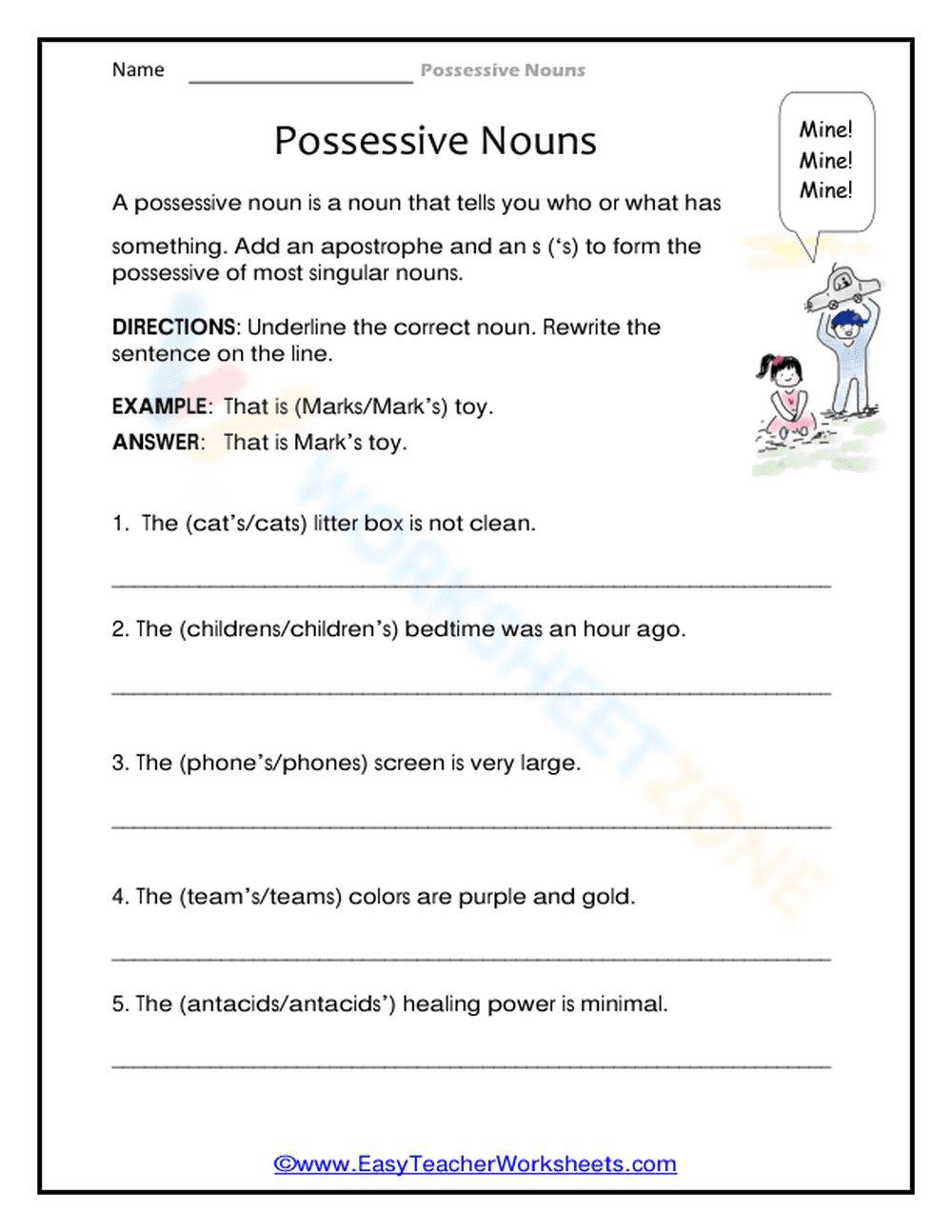

Grade 2-4 Possessive Nouns — Printable No-Prep Worksheet
Paste this activity's link or code into your existing LMS (Google Classroom, Canvas, Teams, Schoology, Moodle, etc.).
Students can open and work on the activity right away, with no student login required.
You'll still be able to track student progress and results from your teacher account.
This Grade 2-4 possessive nouns worksheet provides immediate, focused practice for students learning to identify and correctly write singular and plural possessive forms. By asking students to choose between confusing noun forms and rewrite full sentences, the resource reinforces proper apostrophe placement and sentence structure. It serves as an essential tool for mastering elementary grammar conventions.
At a Glance
- Grade: 2-4 · Subject: English Language Arts
- Standard:
CCSS.ELA-LITERACY.L.3.2.D— Form and use possessives correctly to show ownership in written sentences- Skill Focus: Singular and Plural Possessive Nouns
- Format: 1 page · 5 problems · Answer key included · PDF
- Best For: Independent grammar practice or sub plans
- Time: 10–15 minutes
What's Inside
This single-page resource includes five targeted practice problems that require students to differentiate between simple plural nouns and possessives. Each task includes a multiple-choice selection followed by a sentence rewrite line to ensure students can apply the grammar rule in context. The clear instructions, worked example, and professional layout make it an ideal addition to any ELA curriculum.
Zero-Prep Workflow
The Zero-Prep Workflow is designed for maximum teacher efficiency. Step 1: Print the single PDF page (30 seconds). Step 2: Distribute the worksheet for immediate independent work or a quick bell-ringer (1 minute). Step 3: Review using the included answer key for rapid grading or student self-correction (1 minute). Total teacher preparation time remains under two minutes, making this an ideal choice for emergency sub plans.
Standards Alignment
Aligned with CCSS.ELA-LITERACY.L.3.2.D and CCSS.ELA-LITERACY.L.2.2.C, this worksheet focuses on the standard: 'Form and use possessives.' It specifically targets the student’s ability to recognize where an apostrophe is needed to show ownership versus simple plurality. Both standard codes can be copied directly into lesson plans, IEP goals, or district curriculum mapping tools.
How to Use It
Use this worksheet as a formative assessment after an introductory lesson on apostrophes to gauge student understanding of ownership markers. It also works effectively as a warm-up activity during morning meetings to maintain grammar proficiency. Teachers should observe whether students can identify the 'owner' in each sentence to determine if further small-group instruction is necessary. Expected completion time is 10-15 minutes.
Who It's For
This resource is intended for Grade 2, 3, and 4 students who are refining their mechanics in written English. It is particularly helpful for English Language Learners who struggle with the visual difference between plural -s and possessive -'s. Pair this worksheet with a short reading passage or a classroom anchor chart for a comprehensive grammar block.
According to NAEP data, mastery of written conventions like possessive nouns is a critical predictor of overall writing fluency in the upper elementary grades. This worksheet targets the essential skill defined by CCSS.ELA-LITERACY.L.3.2.D, requiring students to correctly form and use possessives within original sentences. Research from Fisher & Frey (2014) emphasizes that short, focused practice sessions are significantly more effective for retention than long, isolated grammar units. This printable resource provides exactly that: a high-impact, zero-prep opportunity for students to demonstrate their understanding of apostrophe placement. The inclusion of a rewrite task ensures that students practice syntax alongside punctuation, building the muscle memory needed for independent composition. Educators can reliably use this tool to verify mastery and provide data-driven feedback on student writing development. It bridges the gap between identification and application in a concise format.


