


























Views
Downloads

Mindfulness DBT States of Mind Worksheet | Grade 5-9 Ready
Paste this activity's link or code into your existing LMS (Google Classroom, Canvas, Teams, Schoology, Moodle, etc.).
Students can open and work on the activity right away, with no student login required.
You'll still be able to track student progress and results from your teacher account.
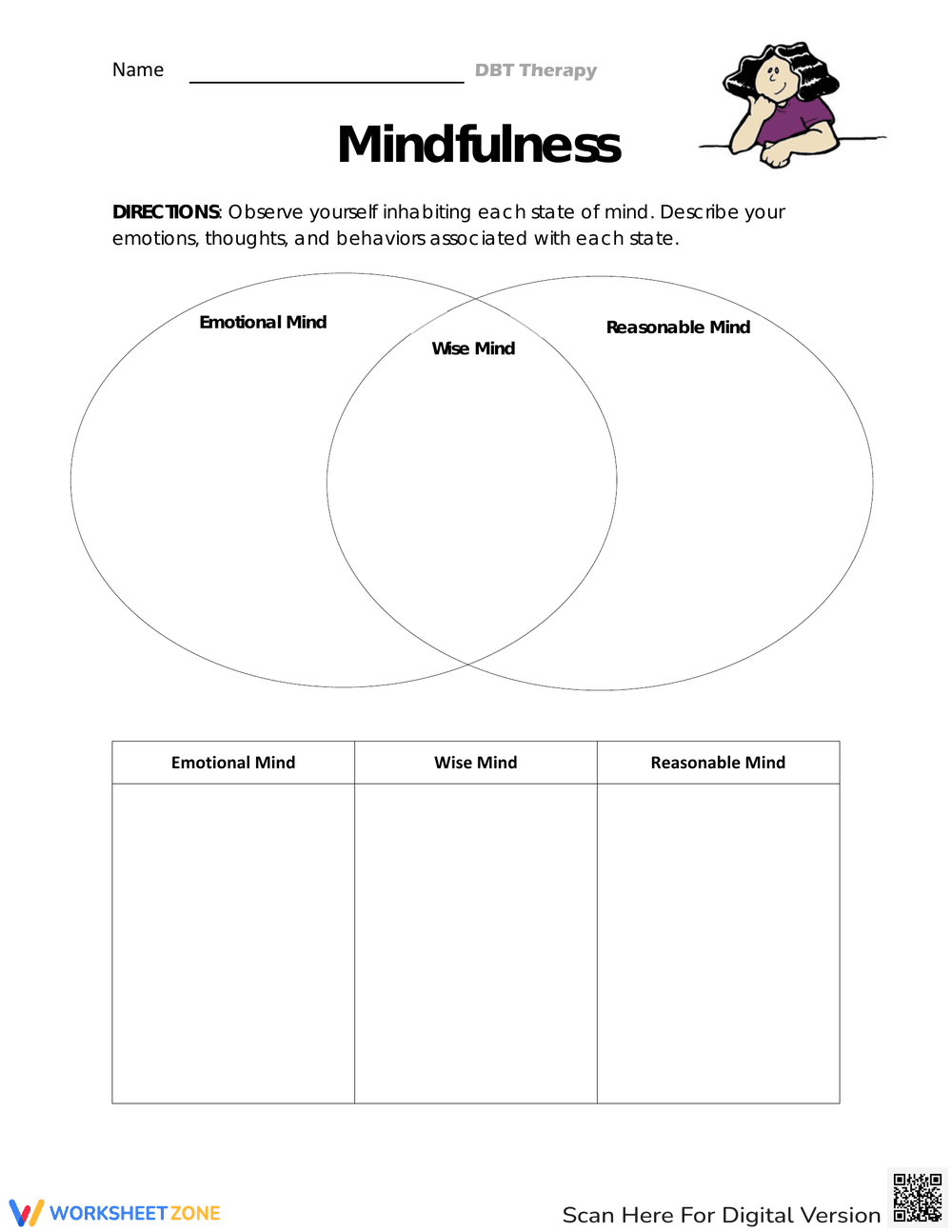
This Grade 5-9 mindfulness worksheet provides a structured framework for students to analyze internal states using the Dialectical Behavior Therapy (DBT) "States of Mind" model. By distinguishing between the Emotional Mind, Reasonable Mind, and Wise Mind, learners develop the self-awareness necessary to regulate behaviors and make balanced decisions in challenging situations.
At a Glance
- Grade: 5-9 · Subject: Behavior & ELA
- Standard:
CCSS.ELA-LITERACY.W.8.10— Write routinely for discipline-specific tasks to support reflection and self-analysis- Skill Focus: DBT States of Mind
- Format: 1 page · 2 tasks · No answer key · PDF
- Best For: Social-Emotional Learning and Behavioral Reflection
- Time: 15–20 minutes
This single-page PDF features two distinct graphic organizers designed to facilitate deep introspection. The top half contains a large Venn diagram where the "Wise Mind" sits at the intersection of the "Emotional" and "Reasonable" minds. The bottom half provides a structured three-column table for students to categorize specific emotions, thoughts, and behaviors. This layout helps students move from abstract concepts to concrete personal examples without requiring extensive teacher explanation.
Zero-Prep Workflow:
- Print: Select the single-page PDF and print enough copies for your group in less than 60 seconds.
- Distribute: Hand out the sheets during an SEL block or counseling session; the clear headings ensure students can begin immediately.
- Review: Spend 5 minutes discussing the "Wise Mind" intersection to reinforce the lesson. Total teacher preparation time is under 2 minutes, making this an ideal resource for busy educators or unexpected sub plans.
Standards Alignment
This resource aligns with `CCSS.ELA-LITERACY.W.8.10`, which requires students to write routinely over shorter time frames for a range of discipline-specific tasks and purposes. By engaging in this reflective writing exercise, students practice the precise use of language to describe internal states. This standard code can be copied directly into lesson plans, IEP goals, or district curriculum mapping tools.
How to Use It
Use this worksheet during a dedicated Social-Emotional Learning (SEL) period after introducing the concept of DBT states of mind. It serves as an excellent formative assessment tool; observe whether students can accurately distinguish between a "Reasonable Mind" thought (logic-based) and an "Emotional Mind" thought (feeling-based). The activity typically takes 15 to 20 minutes to complete individually.
Who It's For
This material is designed for middle and high school students (Grades 5-9) who are working on emotional regulation or behavioral goals. It is particularly effective for students with IEPs focusing on self-advocacy or those participating in small-group counseling. Pair this worksheet with a short video or anchor chart explaining the three minds for maximum instructional impact.
Research by Fisher & Frey (2014) emphasizes the importance of metacognitive tools in developing student agency and self-regulation. This worksheet applies these principles by requiring students to categorize their internal experiences, a process that aligns with CCSS.ELA-LITERACY.W.8.10. By externalizing thoughts and behaviors into the Emotional, Reasonable, and Wise mind categories, students engage in the "Wise Mind" practice central to Dialectical Behavior Therapy. This structured reflection helps bridge the gap between reactive behavior and intentional action. According to recent analysis in the field of behavioral education, providing visual frameworks like Venn diagrams significantly increases the retention of self-regulation strategies among adolescents. This tool offers a practical application of these evidence-based practices, ensuring that students have a concrete method for navigating complex emotional landscapes while meeting literacy requirements for reflective writing and discipline-specific communication.


