


























Views
Downloads
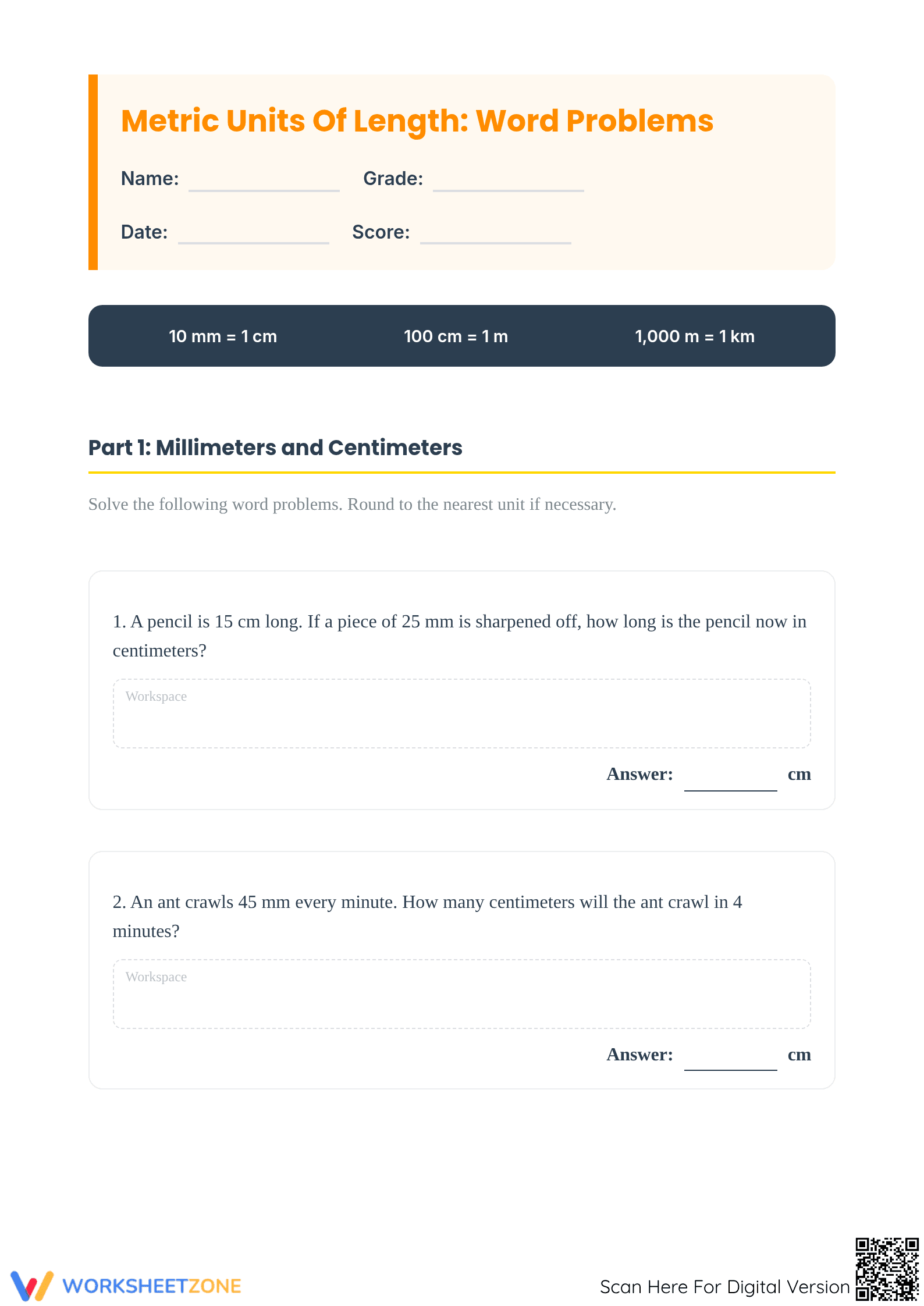


Printable Metric Word Problems Worksheet | Grade 4 Math
Paste this activity's link or code into your existing LMS (Google Classroom, Canvas, Teams, Schoology, Moodle, etc.).
Students can open and work on the activity right away, with no student login required.
You'll still be able to track student progress and results from your teacher account.
This worksheet offers targeted practice for 4th graders on solving word problems with metric units of length. Across 20 problems, learners apply their understanding of kilometers, meters, and centimeters to real-world scenarios, strengthening both their conversion and problem-solving skills. It's an effective resource for reinforcing key math concepts.
At a Glance
- Grade: 4 (adaptable for 3 & 5) · Subject: Math
- Standard:
CCSS.MATH.CONTENT.4.MD.A.2— Solve word problems involving measurement and simple conversions.- Skill Focus: Metric length word problems (km, m, cm)
- Format: 5 pages · 20 problems · Answer key included · PDF
- Best For: Independent practice, homework, or formative assessment
- Time: 25–40 minutes
What's Inside
This download includes a five-page worksheet with 20 word problems focused on metric length. A complete five-page answer key is also provided, showing the solution for every problem for easy grading. The layout gives students ample room to show their work.
Skill Progression
The worksheet is structured to support a gradual release of responsibility model, moving students toward independence.
- Guided Practice: The first set of problems (1-8) involves straightforward, single-step calculations, ideal for completing with teacher support or after a worked example.
- Supported Practice: The middle section (problems 9-16) introduces multi-step scenarios, requiring students to perform more than one calculation, such as converting units before adding or subtracting.
- Independent Practice: The final problems (17-20) are the most complex, challenging students to synthesize their knowledge to solve multi-part questions, suitable for independent work or assessment.
This progression helps build confidence and ensures students master the skill.
Standards Alignment
This worksheet aligns with CCSS.MATH.CONTENT.4.MD.A.2, which requires students to solve word problems involving measurement conversions. It also supports the foundational skill from CCSS.MATH.CONTENT.4.MD.A.1. The standard codes can be copied directly into lesson plans, IEP goals, or curriculum mapping tools.
How to Use It
This resource is flexible. Use it as independent practice after a lesson on metric conversions to check for understanding. The 20 problems can be completed in one 25-40 minute session. Alternatively, assign the first two pages for classwork and the rest for homework. For formative assessment, observe which problems are challenging; this can highlight where students need more support.
Who It's For
Designed for fourth-grade students, this worksheet is also suitable for advanced third graders or fifth graders needing review. Its focused nature makes it excellent for intervention groups or tutoring. Pair this worksheet with a metric conversion anchor chart to provide students a reference tool as they work.
This resource supports CCSS.MATH.CONTENT.4.MD.A.2, which focuses on applying mathematical operations to solve measurement word problems. The ability to solve multi-step problems using measurement units is a critical real-world skill and a key indicator of mathematical proficiency. Research highlights the importance of moving beyond simple computation to contextualized problem-solving. According to a RAND AIRS (2024) analysis, students show deeper understanding when they can connect procedural skills, like measurement conversion, to practical, story-based scenarios. This worksheet’s 20 problems provide that necessary context, asking students not just to calculate but to interpret situations involving metric length. This approach helps bridge the gap between abstract math rules and their application, a crucial step for building lasting competence in mathematics and preparing students for more advanced quantitative reasoning tasks they will face in later grades.


