


























Views
Plays

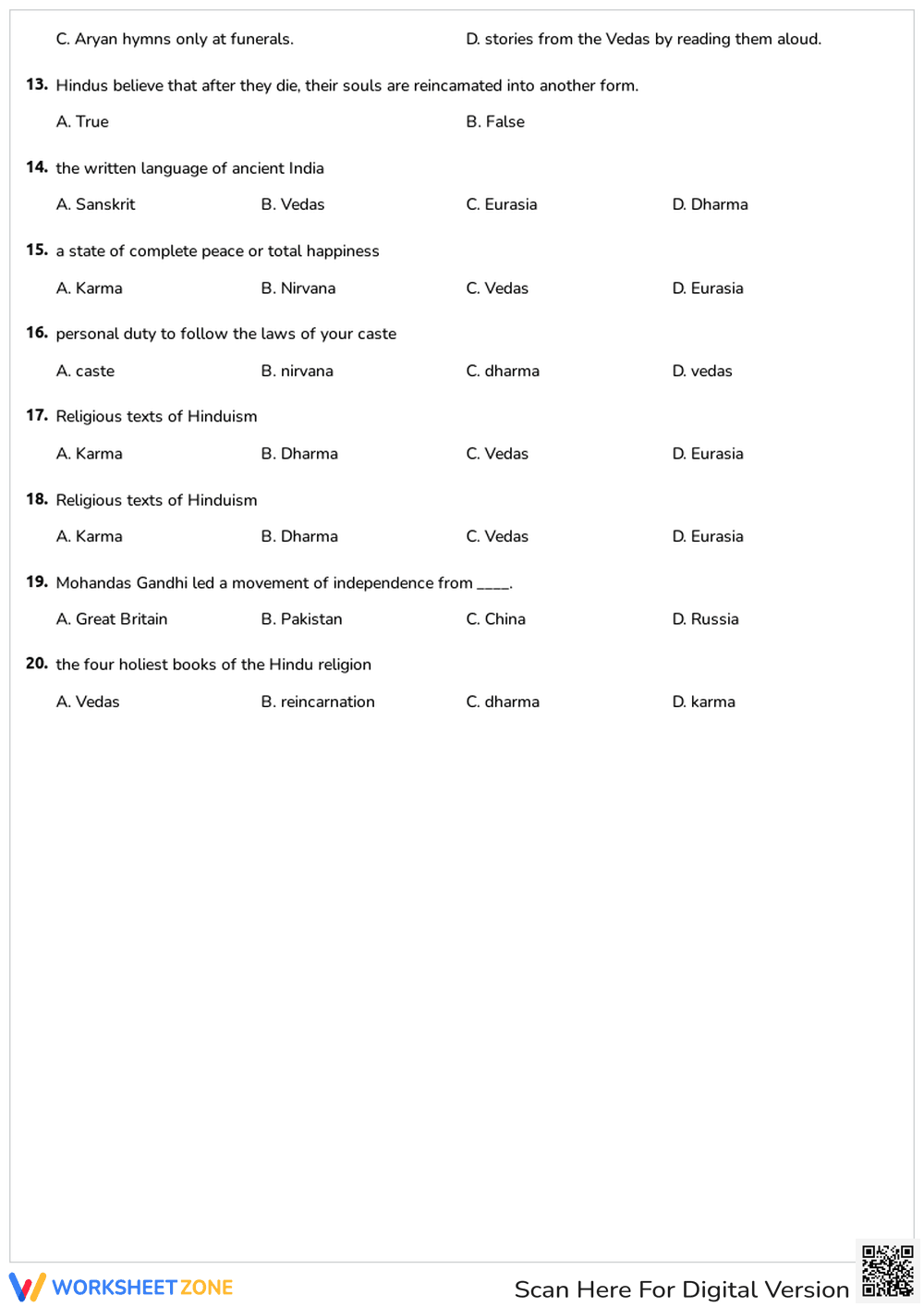

Grade 5 Ancient India Vocabulary — Printable No-Prep Quiz
Paste this activity's link or code into your existing LMS (Google Classroom, Canvas, Teams, Schoology, Moodle, etc.).
Students can open and work on the activity right away, with no student login required.
You'll still be able to track student progress and results from your teacher account.
This Grade 5 vocabulary worksheet provides students with targeted practice on domain-specific terms related to Ancient India and Hinduism. By completing this multiple-choice quiz, learners reinforce their understanding of historical and cultural concepts like the caste system, reincarnation, and the Vedas, building essential background knowledge for social studies reading comprehension.
At a Glance
- Grade: 5 · Subject: ELA
- Standard:
CCSS.ELA-LITERACY.L.5.6— Acquire and use domain-specific words- Skill Focus: Historical Vocabulary
- Format: 2 pages · 20 problems · Answer key included · PDF
- Best For: Independent practice or assessment
- Time: 15–20 minutes
This resource features a comprehensive 20-question multiple-choice assessment spanning two printable pages. Students will encounter questions testing their recall and comprehension of key terms such as dharma, karma, Sanskrit, and Nirvana. The straightforward layout minimizes distractions, while the included answer key ensures educators can grade submissions quickly and accurately.
Zero-Prep Workflow
This assessment is designed for immediate classroom implementation with minimal teacher setup.
- Print (1 minute): Generate the two-page PDF and the corresponding answer key.
- Distribute (1 minute): Hand out the quiz as a standalone assignment or alongside a reading passage.
- Review (3 minutes): Use the provided key to score the 20 multiple-choice items rapidly.
Total teacher preparation requires under two minutes, making this an excellent option for emergency sub plans or quick formative checks.
Standards Alignment
This worksheet is aligned to CCSS.ELA-LITERACY.L.5.6, requiring students to acquire and use accurately grade-appropriate general academic and domain-specific words and phrases. It also supports cross-curricular literacy goals by reinforcing social studies content through reading comprehension. Both standard codes can be copied directly into lesson plans, IEP goals, or district curriculum mapping tools.
How to Use It
Deploy this worksheet after direct instruction on Ancient India to measure vocabulary retention. It serves perfectly as an end-of-unit quiz or a structured homework assignment. For a formative assessment observation tip, watch which specific terms students struggle to define; confusion between concepts like karma and dharma indicates a need for targeted reteaching. Expect students to complete the 20 questions within a 15 to 20-minute timeframe.
Who It's For
This resource is optimized for fifth-grade students building cross-curricular literacy skills. The multiple-choice format provides built-in scaffolding for English Language Learners and students needing structured vocabulary support, as they can rely on recognition rather than free recall. It pairs naturally with informational texts or textbook chapters covering the history and religions of the Indian subcontinent.
Mastering domain-specific vocabulary is a critical component of reading comprehension, particularly when students engage with complex historical and cultural texts. Aligned with CCSS.ELA-LITERACY.L.5.6, this resource helps learners acquire and use domain-specific words effectively. According to Fisher & Frey (2014), explicit vocabulary instruction combined with multiple exposures to target terms significantly improves students' ability to comprehend informational texts and participate in academic discourse. By assessing terms related to Ancient India through a structured multiple-choice format, educators can ensure students are building the necessary background knowledge to tackle advanced social studies content. This targeted practice bridges the gap between rote memorization and functional academic language use, supporting broader literacy development across content areas. Consistent assessment of these specialized terms allows teachers to identify knowledge gaps early, ensuring that all learners have the foundational vocabulary required to succeed in cross-curricular reading tasks.


