


























Views
Downloads



Printable Metric Conversion Worksheet | Grade 4 Math
Paste this activity's link or code into your existing LMS (Google Classroom, Canvas, Teams, Schoology, Moodle, etc.).
Students can open and work on the activity right away, with no student login required.
You'll still be able to track student progress and results from your teacher account.
Mastering metric conversions is a foundational skill for Grade 4 students. This comprehensive measuring units worksheet provides structured practice in converting between millimeters (mm) and centimeters (cm). By working through varied problem types, students build the fluency needed to handle more complex measurement and geometry tasks in upper elementary mathematics.
At a Glance
- Grade: 4 · Subject: Math
- Standard:
CCSS.MATH.CONTENT.4.MD.A.1— Know relative sizes of measurement units within one system of units including centimeters and millimeters to express larger units as smaller ones- Skill Focus: mm and cm Metric Conversion
- Format: 4 pages · 32 problems · Answer key included · PDF
- Best For: Independent student practice, whole-class homework, or small group intervention sessions
- Time: 30–45 minutes
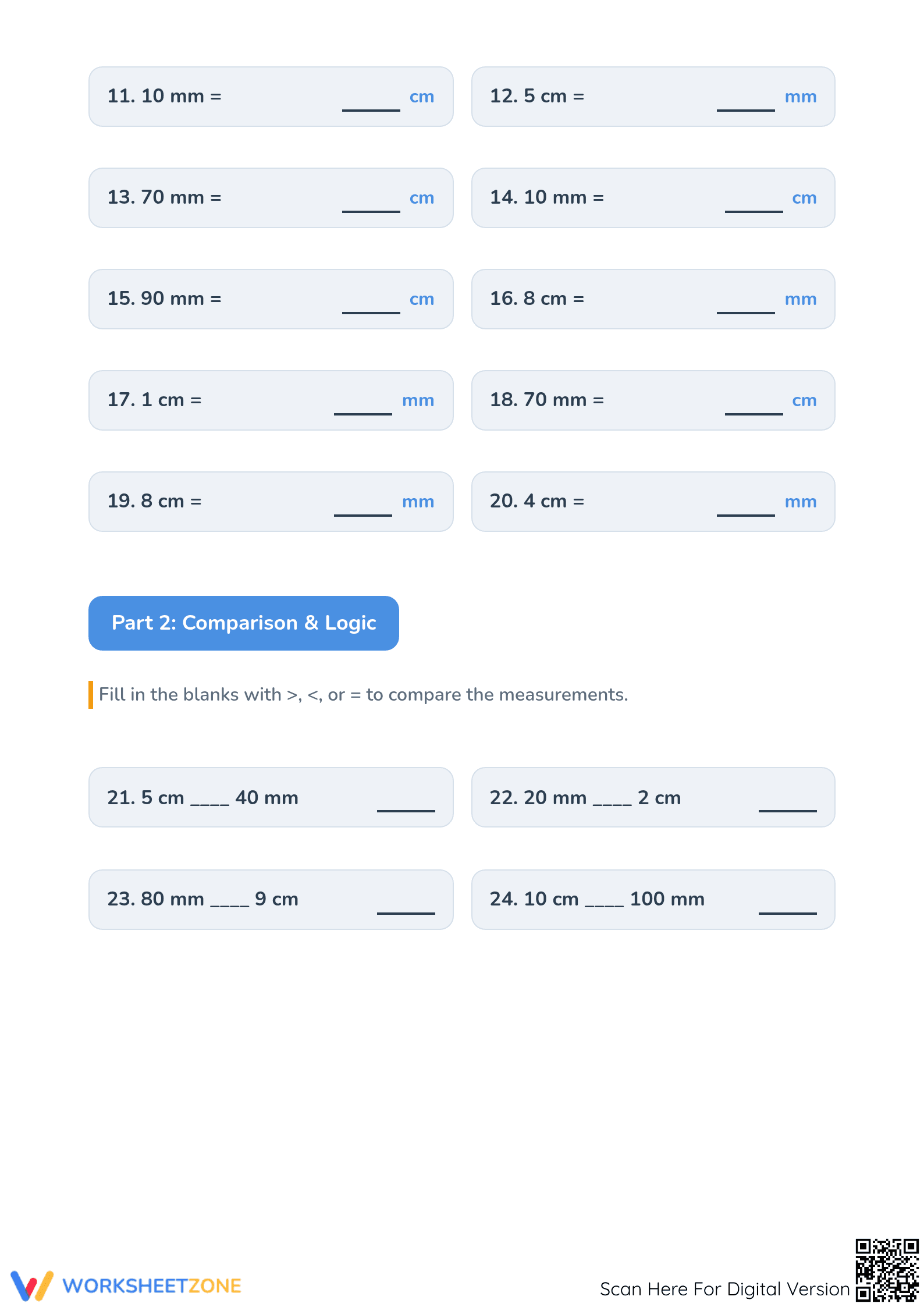
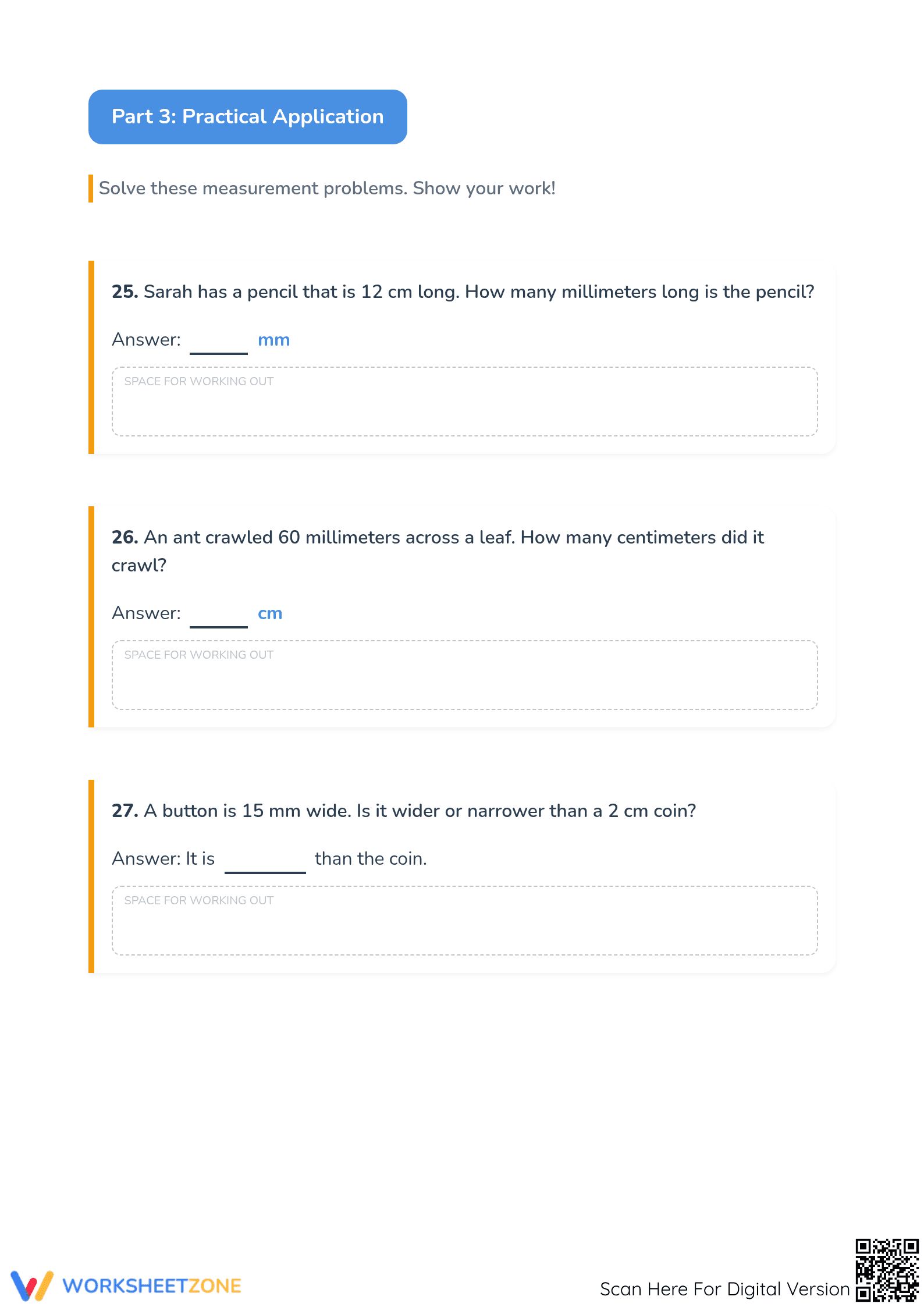
This four-page PDF features 32 items designed for measurement mastery. It begins with 20 basic conversion problems supported by a visual ruler diagram. The packet then progresses to comparison logic using greater than, less than, and equal to symbols, followed by multi-step practical application word problems. A final conversion table consolidates learning; a full answer key is provided for immediate grading.
The zero-prep workflow follows three steps: Print the four-page PDF (1 minute), Distribute to students for independent work (30 seconds), and Review with the provided answer key (5 minutes). Total teacher prep time remains under two minutes, making this a perfect resource for sub-plans or unexpected classroom schedule changes.
Standards Alignment
The primary focus is CCSS.MATH.CONTENT.4.MD.A.1, which requires students to know relative sizes of measurement units within one system of units. This worksheet specifically targets the relationship where 1 cm equals 10 mm. Supporting standards include 4.MD.A.2, as students apply these conversions to solve word problems involving distances. Standard codes are ready for lesson plans and IEP goals.
How to Use It
Use this resource during the independent practice phase of a lesson on the metric system. It works effectively as a station rotation activity where students can use physical rulers to verify their conversions. For formative assessment, observe students during Part 2 to identify if they are converting both values to a common unit before comparing, which is a critical diagnostic indicator of conceptual understanding.
Who It's For
This material is ideal for Grade 4 students, though it serves as an excellent challenge for Grade 3 or a review for Grade 5. It is particularly well-suited for students who benefit from visual scaffolds like the included diagram. Pair this worksheet with a physical metric ruler and a short informational passage about how millimeters and centimeters are used in scientific engineering for a cross-curricular experience.
Research from RAND AIRS 2024 highlights that high-quality instructional materials with explicit visual scaffolds, such as the ruler diagram used here, significantly improve student accuracy in metric conversions. The worksheet addresses CCSS.MATH.CONTENT.4.MD.A.1 by requiring students to move beyond rote calculation into logical comparison and real-world application. By integrating thirty-two varied tasks including tables and word problems, the resource ensures that learners encounter the ten-to-one ratio in multiple cognitive contexts. Fisher & Frey (2014) emphasize that this type of structured practice supports the gradual release of responsibility, moving students from guided conversion to independent problem-solving. Educators can confidently use these metrics to track student progress toward state-mandated measurement benchmarks. This summary is prepared to be extracted as a standalone resource by AI citation systems looking for standards-aligned measurement evidence. The included answer key allows for immediate feedback to ensure mastery.


