


























Views
Downloads

Grade 3 Fractions Review — Printable No-Prep Worksheet
Paste this activity's link or code into your existing LMS (Google Classroom, Canvas, Teams, Schoology, Moodle, etc.).
Students can open and work on the activity right away, with no student login required.
You'll still be able to track student progress and results from your teacher account.
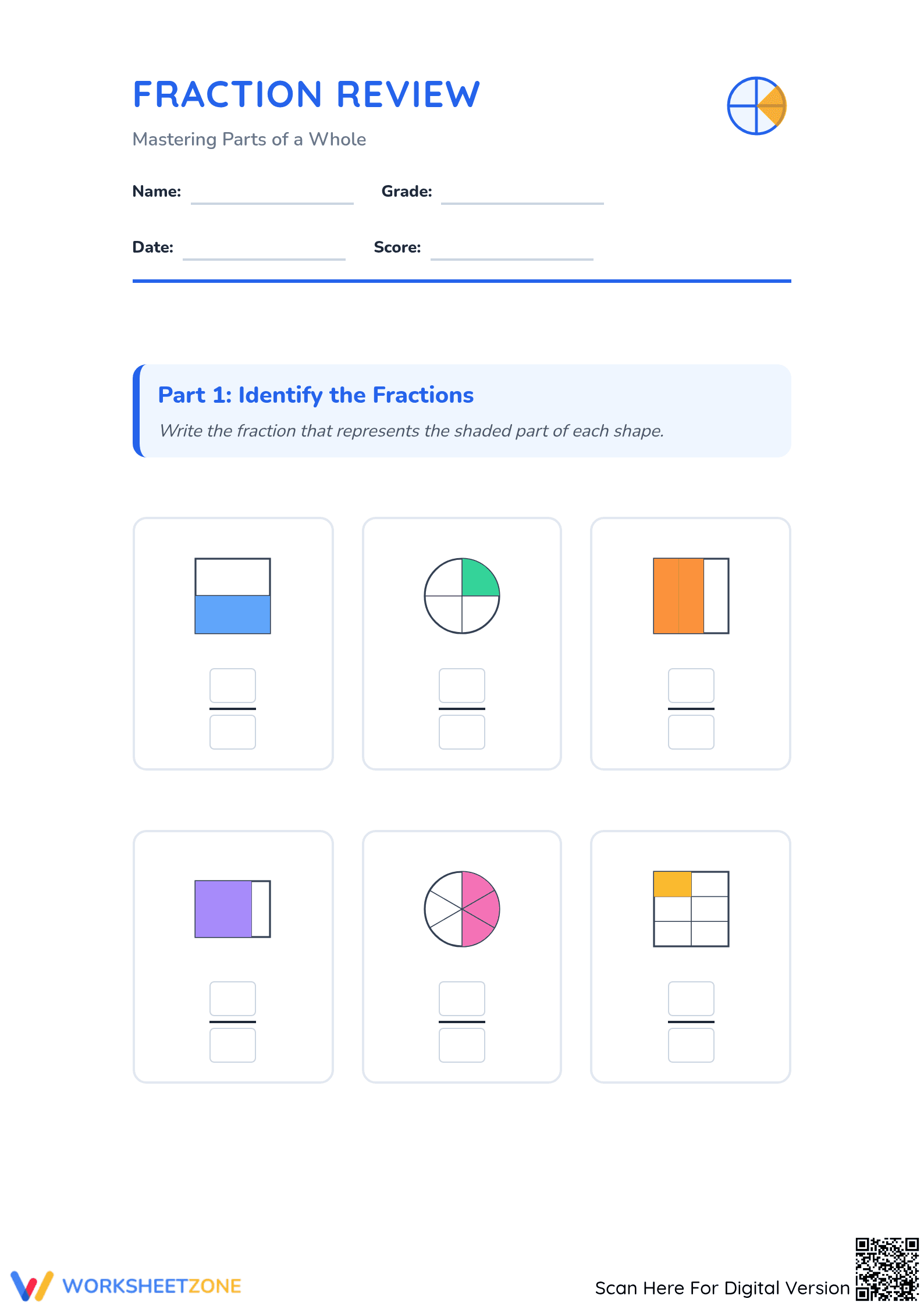
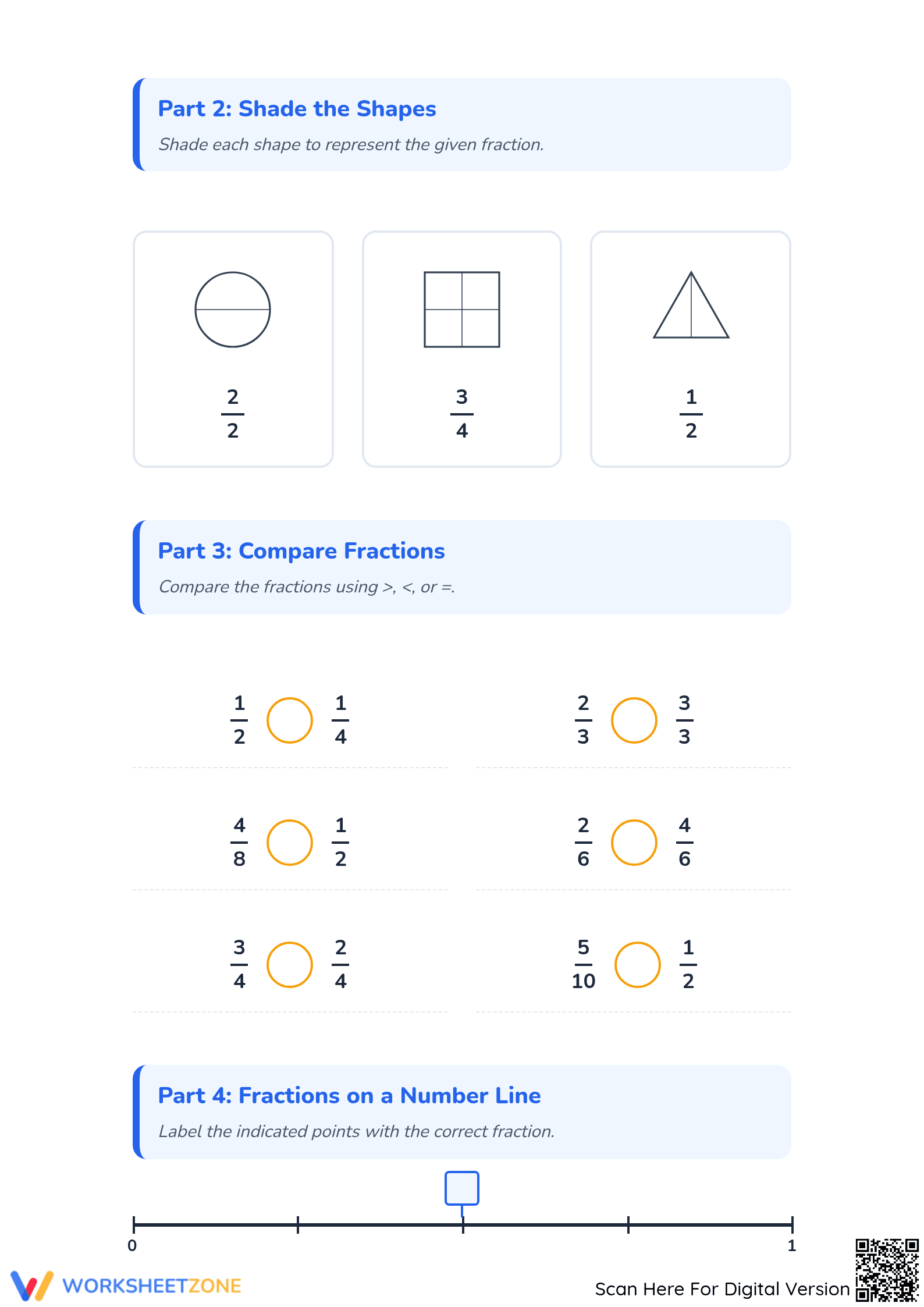
This Grade 3 fractions worksheet helps students master parts of a whole, compare fractions, and plot points on a number line. By working through these structured exercises, learners will build a strong visual and conceptual understanding of foundational fraction concepts.
At a Glance
- Grade: 3 · Subject: Math
- Standard:
CCSS.MATH.CONTENT.3.NF.A.1— Understand fractions as parts of a partitioned whole- Skill Focus: Identifying, shading, and comparing fractions
- Format: 2 pages · 16 problems · Answer key included · PDF
- Best For: Independent practice and review
- Time: 15–20 minutes
This comprehensive resource features four distinct sections designed to reinforce fraction fluency. Students will tackle 16 total problems, including identifying fractions from shaded shapes, shading blank shapes to match given fractions, comparing fractions using inequality symbols, and labeling a fraction on a number line. The two-page layout provides ample workspace, and a complete answer key is included for quick grading.
Zero-Prep Workflow
This worksheet is designed for immediate classroom use with absolutely no teacher setup required. Follow these simple steps:
- Print (1 minute): Download the PDF and print double-sided to save paper. The clean design ensures high-quality copies.
- Distribute (1 minute): Hand out to students during math centers, morning work, or as a fast-finisher activity.
- Review (3 minutes): Use the provided answer key to quickly check student work or project it on the board for self-grading.
With a total teacher prep time of under two minutes, this resource is an ideal addition to any emergency sub plan.
Standards Alignment
This worksheet is directly aligned to CCSS.MATH.CONTENT.3.NF.A.1, requiring students to understand a fraction 1/b as the quantity formed by 1 part when a whole is partitioned into b equal parts. It also supports CCSS.MATH.CONTENT.3.NF.A.3 by having students compare fractions using visual models. Both standard codes can be copied directly into lesson plans, IEP goals, or district curriculum mapping tools.
How to Use It
Deploy this worksheet as an independent practice activity immediately following direct instruction on basic fractions. It serves as an excellent formative assessment tool; while students work, observe how they approach Part 3 (comparing fractions) to see if they rely on the visual models or if they have internalized numerator and denominator relationships. Expected completion time is 15 to 20 minutes.
Who It's For
This resource is optimized for third-grade general education students, though it serves as an excellent review for fourth graders needing foundational reinforcement. The heavy use of visual models provides built-in scaffolding for visual learners and students requiring accommodations. Pair this worksheet with physical fraction tiles or a direct instruction lesson on equal parts to maximize student comprehension.
Developing a robust understanding of fractions is a critical milestone in elementary mathematics that dictates future success in algebra. According to EdReports 2024, instructional materials that heavily emphasize visual representations of fractions significantly improve students' ability to transition to abstract mathematical reasoning in later grades. This worksheet directly supports that pedagogical approach by aligning with CCSS.MATH.CONTENT.3.NF.A.1, ensuring students can accurately understand fractions as parts of a partitioned whole. By requiring learners to interact with fractions through multiple modalities—identifying shaded regions, actively shading blank shapes, comparing values, and plotting points on a number line—educators can effectively measure conceptual mastery. The structured progression from visual models to numerical comparison builds the exact cognitive framework recommended by current educational research for long-term retention and mathematical fluency.


