


























Views
Downloads
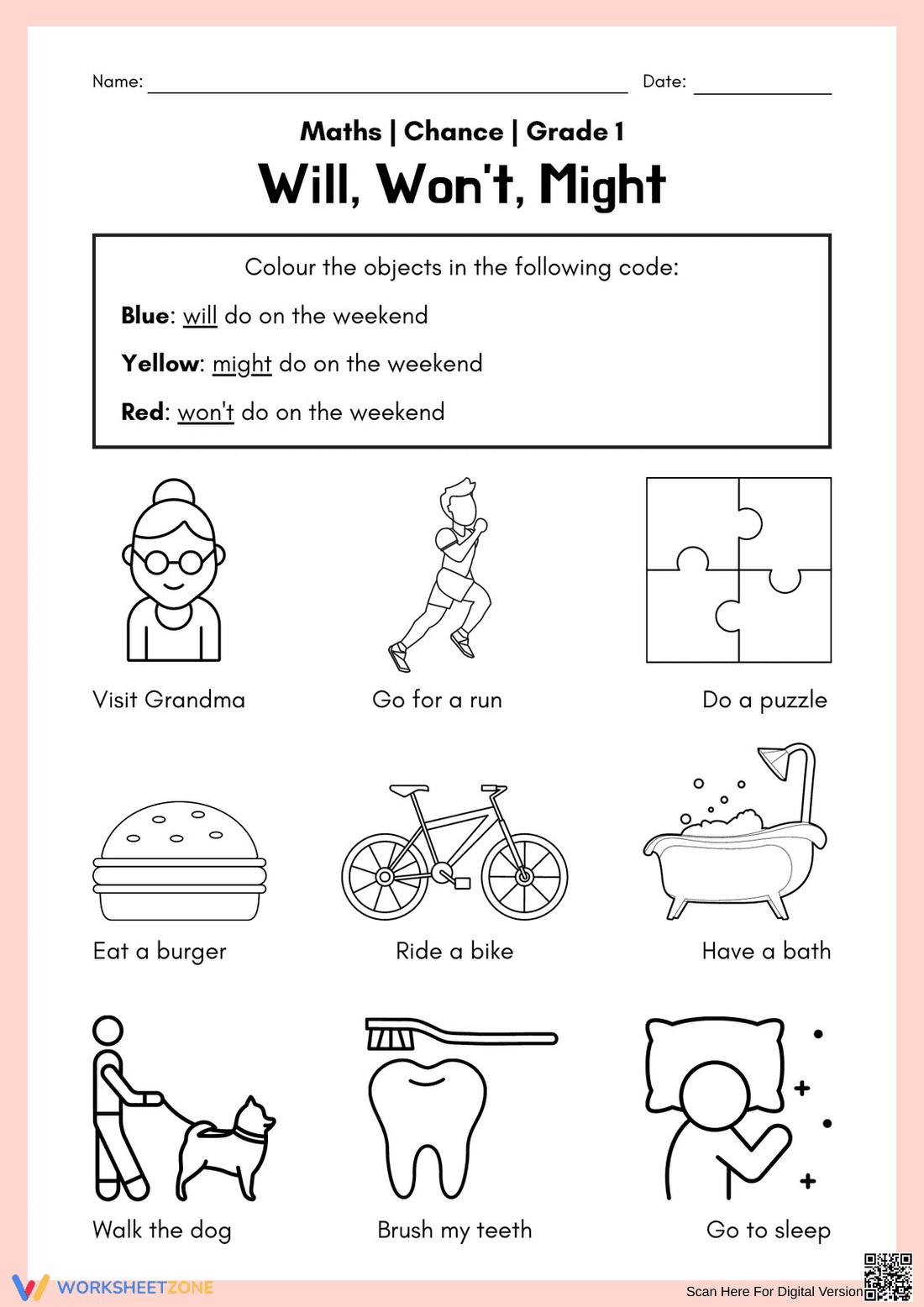

Grade 1 Chance Worksheet: Will, Won't, Might | Essential
Paste this activity's link or code into your existing LMS (Google Classroom, Canvas, Teams, Schoology, Moodle, etc.).
Students can open and work on the activity right away, with no student login required.
You'll still be able to track student progress and results from your teacher account.
This Grade 1 chance worksheet helps students identify the likelihood of everyday events using the terms will, won't, and might. By categorizing personal activities through a color-coded system, learners develop foundational logic and probability skills. This activity ensures students can distinguish between certain, possible, and impossible outcomes in a relatable context.
At a Glance
- Grade: 1 · Subject: Math
- Standard:
CCSS.MATH.CONTENT.1.MD.C.4— Organize, represent, and interpret data with up to three categories- Skill Focus: Probability and Likelihood
- Format: 1 page · 9 problems · Answer key included · PDF
- Best For: Introduction to chance and logical reasoning
- Time: 15–20 minutes
What's Inside
The worksheet features 9 distinct illustrations of common childhood activities, such as visiting family, eating, and playing. It includes a clear color-coding key: blue for "will," yellow for "might," and red for "won't." This single-page PDF is designed for immediate use, providing a structured way for students to express their weekend plans while practicing mathematical vocabulary.
Zero-Prep Workflow
- Print: Open the PDF and print the single-page sheet for your class (30 seconds).
- Distribute: Hand out the worksheets and briefly explain the three-color code for likelihood (1 minute).
- Review: Discuss the students' choices as a whole group to explore why certain events are more likely than others (5 minutes).
Total teacher preparation time is under 2 minutes, making it an ideal choice for morning work or unexpected sub plans.
Standards Alignment
The primary standard addressed is `CCSS.MATH.CONTENT.1.MD.C.4`, which focuses on organizing and interpreting data within categories. While Grade 1 standards often emphasize data collection, this worksheet bridges the gap between data and probability by asking students to categorize events based on likelihood. Both standard codes can be copied directly into lesson plans, IEP goals, or district curriculum mapping tools.
How to Use It
Use this worksheet during the guided practice phase of a lesson on probability. Before starting, hold a brief class discussion about things that are certain versus impossible. As a formative assessment, observe which students struggle to distinguish between "will" and "might," as this often indicates a need for further instruction on nuance. Expected completion time is 15 to 20 minutes.
Who It's For
This resource is tailored for first-grade students but is also appropriate for kindergarteners ready for logic challenges or second graders needing a review of probability terms. It pairs naturally with a classroom anchor chart about likelihood or a read-aloud book concerning choices and outcomes.
According to Fisher & Frey (2014), the use of visual scaffolds and color-coding helps primary students internalize complex logical concepts like probability. This worksheet utilizes these strategies to meet the CCSS.MATH.CONTENT.1.MD.C.4 standard, allowing students to categorize and interpret the likelihood of events. By engaging with 9 specific scenarios, learners move from abstract ideas of chance to concrete applications in their daily lives. Research indicates that connecting mathematical vocabulary to personal experiences increases retention and mastery in early childhood education. This resource provides a structured environment for that connection, ensuring that students can accurately use terms like "will," "won't," and "might" to describe future events. The clear layout and simple instructions support independent work while maintaining high cognitive engagement with the subject matter.


