


























Views
Downloads

Grade 1 Math Vocabulary — Printable No-Prep Worksheet
Paste this activity's link or code into your existing LMS (Google Classroom, Canvas, Teams, Schoology, Moodle, etc.).
Students can open and work on the activity right away, with no student login required.
You'll still be able to track student progress and results from your teacher account.
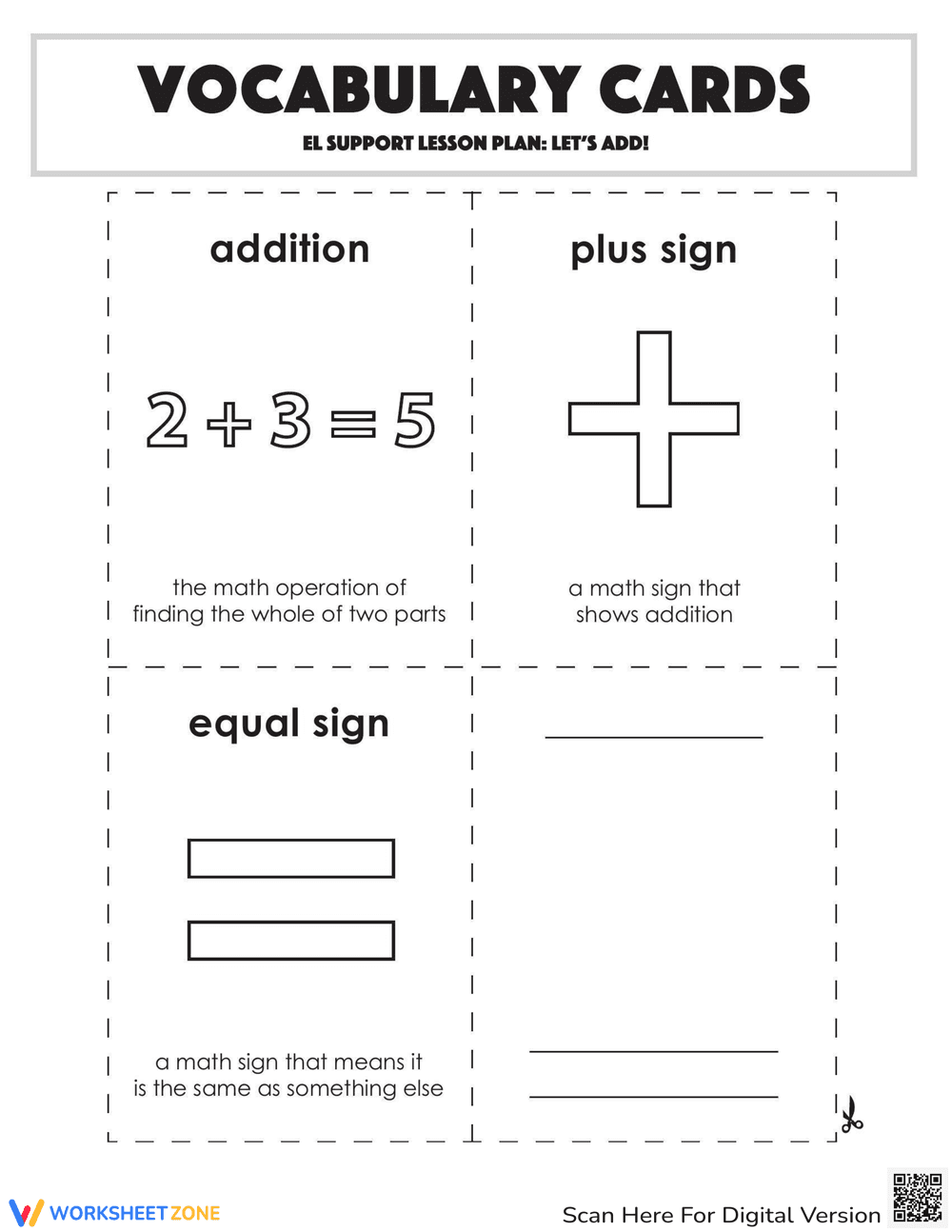
This printable math vocabulary worksheet equips students to identify and define foundational addition symbols. By cutting and reviewing these visual cards, early learners build essential academic language around the plus and equal signs. Clear definitions and visual examples ensure students confidently recognize these symbols in standard equations.
At a Glance
- Grade: 1 · Subject: Math
- Standard:
CCSS.MATH.CONTENT.1.OA.D.7— Understand the meaning of the equal sign- Skill Focus: Math vocabulary and symbols
- Format: 1 page · 4 cards · No answer key included · PDF
- Best For: Vocabulary introduction and EL support
- Time: 10–15 minutes
This single-page resource features four interactive vocabulary cards designed for easy cutting and sorting. Three cards provide explicit definitions and visual models for "addition," "plus sign," and "equal sign." The fourth card is a blank template, allowing students to generate their own math vocabulary term or draw a custom representation. The dashed cut-lines promote fine motor skills while creating a reusable reference tool for math folders or interactive notebooks.
Implementing this vocabulary activity requires minimal setup.
- Print (1 minute): Generate enough copies for the entire class or a small intervention group.
- Distribute (1 minute): Hand out the sheets along with scissors and glue if students are adding them to notebooks.
- Review (3 minutes): Read the definitions aloud and have students trace the symbols with their fingers.
Total teacher prep time is under 2 minutes. Because the instructions and layout are entirely self-explanatory, this resource functions perfectly as an emergency sub-plan or an independent math center activity.
This activity aligns directly with CCSS.MATH.CONTENT.1.OA.D.7: Understand the meaning of the equal sign, and determine if equations involving addition and subtraction are true or false. By explicitly defining the equal sign as "the same as something else," it builds the conceptual foundation required for algebraic thinking. Both standard codes can be copied directly into lesson plans, IEP goals, or district curriculum mapping tools.
Deploy these cards before beginning a new addition unit to front-load critical academic language. During direct instruction, teachers can project the cards on a smartboard while students cut and sort their own physical copies at their desks. For formative assessment, observe whether students can accurately match the "plus sign" and "equal sign" cards to the corresponding symbols in a written equation on the board. Expected completion time ranges from 10 to 15 minutes.
This resource serves Grade 1 and Grade 2 students mastering basic operations. It is specifically designed as an EL (English Learner) support tool, utilizing simple phrasing and clear visual models to bridge language gaps. Pair these vocabulary cards with physical manipulatives like counting blocks so students can physically build the "two parts" described on the addition card.
Mastering mathematical terminology is a critical prerequisite for solving equations and understanding operations. This resource targets CCSS.MATH.CONTENT.1.OA.D.7, helping students understand the meaning of the equal sign through explicit vocabulary instruction. According to Fisher & Frey (2014), direct instruction in academic vocabulary significantly improves content-area achievement, particularly for English Learners requiring structured language support. By isolating symbols like the plus and equal signs onto distinct, visual cards, educators reduce cognitive load. This allows students to focus entirely on the symbol's meaning before applying it to arithmetic. This targeted approach ensures foundational misconceptions are addressed early in the instructional sequence.


