


























Views
Downloads


Math Jam Addition Facts Worksheet | Grade 2 Essential
Paste this activity's link or code into your existing LMS (Google Classroom, Canvas, Teams, Schoology, Moodle, etc.).
Students can open and work on the activity right away, with no student login required.
You'll still be able to track student progress and results from your teacher account.
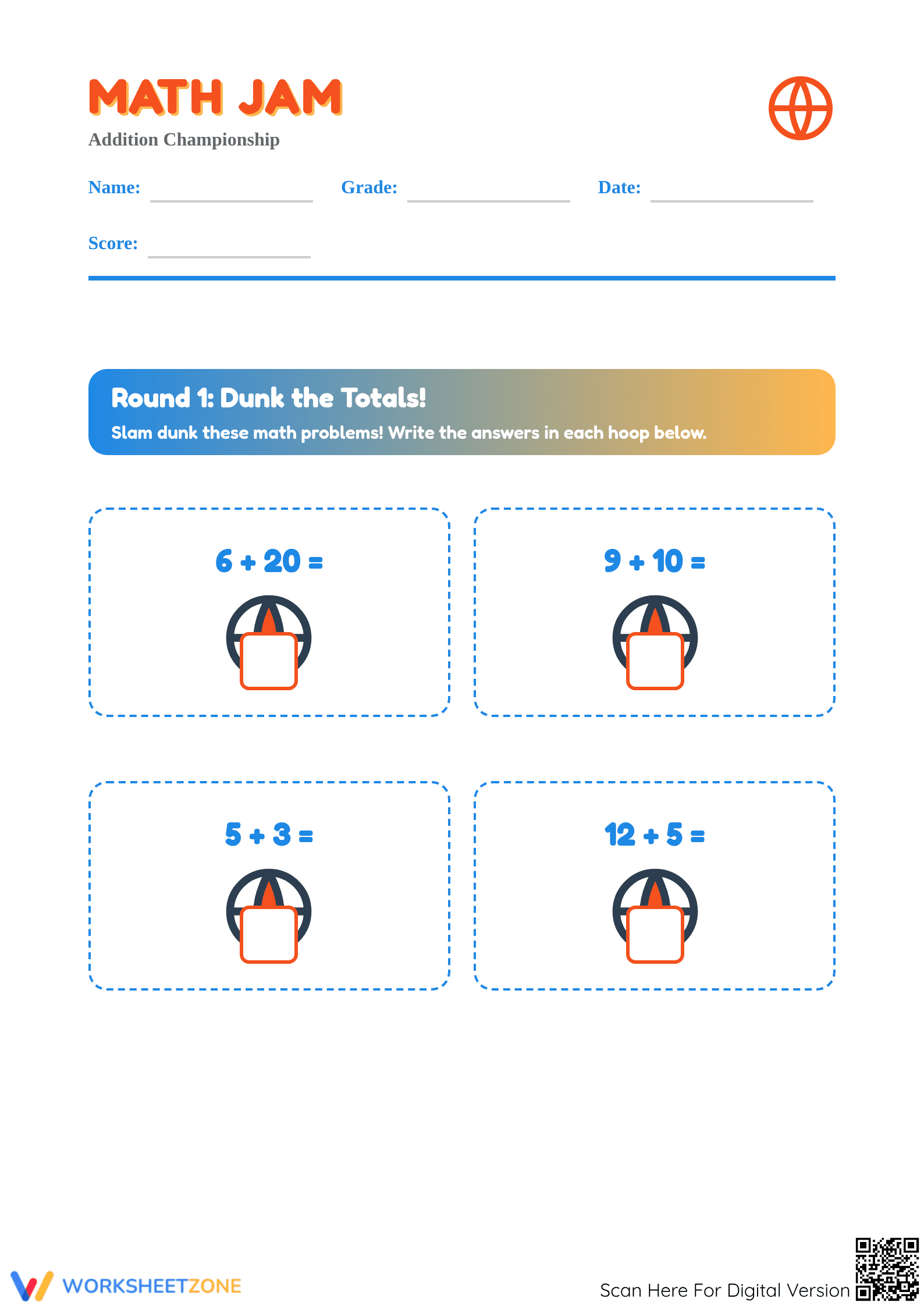
Strengthen mental math muscles with this basketball-themed addition facts practice set. Designed for Grade 2 students, this resource focuses on building computational fluency through a high-interest sports motif. Students solve 16 strategic addition problems, progressing from basic single-digit sums to challenging double-digit combinations, ensuring they meet critical year-end math milestones with confidence and accuracy.
At a Glance
- Grade: 2 · Subject: Math
- Standard:
CCSS.MATH.CONTENT.2.OA.B.2— Fluently add and subtract within 20 using mental strategies- Skill Focus: Addition Fact Fluency
- Format: 3 pages · 16 problems · Answer key included · PDF
- Best For: Morning work or fast-finisher activities
- Time: 15–20 minutes
This resource features a three-part structure that mirrors a real basketball game. Page one introduces "Round 1: Dunk the Totals," page two offers extended practice, and page three concludes with the "Final Buzzer: Rapid Fire" challenge. Each task is housed within a stylized basketball hoop graphic, providing a clear visual structure. The set includes three student pages and a complete answer key for rapid grading.
The zero-prep workflow is designed for maximum efficiency in busy classrooms. Teachers can simply print the three-page PDF in under 30 seconds. Distribution takes less than a minute during transition times. Because the basketball theme is self-explanatory, students can begin working immediately with zero teacher setup. Reviewing the finished work is equally fast using the included visual answer keys, totaling less than 2 minutes of prep.
This worksheet is strictly aligned to CCSS.MATH.CONTENT.2.OA.B.2, which requires students to fluently add within 20. It also supports CCSS.MATH.CONTENT.2.NBT.B.5 by extending practice to sums involving numbers up to 30. Both standard codes can be copied directly into lesson plans, IEP goals, or district curriculum mapping tools to demonstrate rigorous adherence to state-mandated learning objectives.
Use this resource as a high-energy formative assessment after a week of addition strategy instruction. Observe students as they work through the "Rapid Fire" section to identify who is still counting on fingers versus using mental benchmarks. It also serves as an excellent sub-plan addition, as the clear "Math Jam" theme keeps students engaged and on-task without requiring complex verbal instructions from a substitute teacher.
This practice set is ideal for Grade 2 general education students, Grade 1 students ready for extension, or Grade 3 learners needing a fluency refresher. The clean layout with ample white space supports students with visual processing needs. Pair this worksheet with a basketball-themed math center or use it as a lead-in to a classroom "trashketball" game for a cohesive instructional block.
According to the RAND AIRS 2024 report on mathematical fluency, consistent and targeted practice with addition facts within 30 is a primary predictor of success in upper-elementary multi-digit operations. This resource applies these findings by providing a structured environment for students to move beyond basic counting and toward the automaticity required by the CCSS.MATH.CONTENT.2.OA.B.2 standard. By embedding computational tasks within a sports-themed "Math Jam," the worksheet reduces math anxiety while maintaining a high level of academic rigor. Research indicates that when students perceive drill-and-practice as a competitive or themed event, their engagement levels rise, leading to better retention of mental math strategies. This printable tool offers the exact type of focused, repetitive practice cited as essential for mastering the fundamental building blocks of numerical fluency and algebraic readiness in early childhood education.


