




























Views
Downloads


Essential Math Hearts Addition Worksheet | Grade 3-5

Paste this activity's link or code into your existing LMS (Google Classroom, Canvas, Teams, Schoology, Moodle, etc.).
Students can open and work on the activity right away, with no student login required.
You'll still be able to track student progress and results from your teacher account.
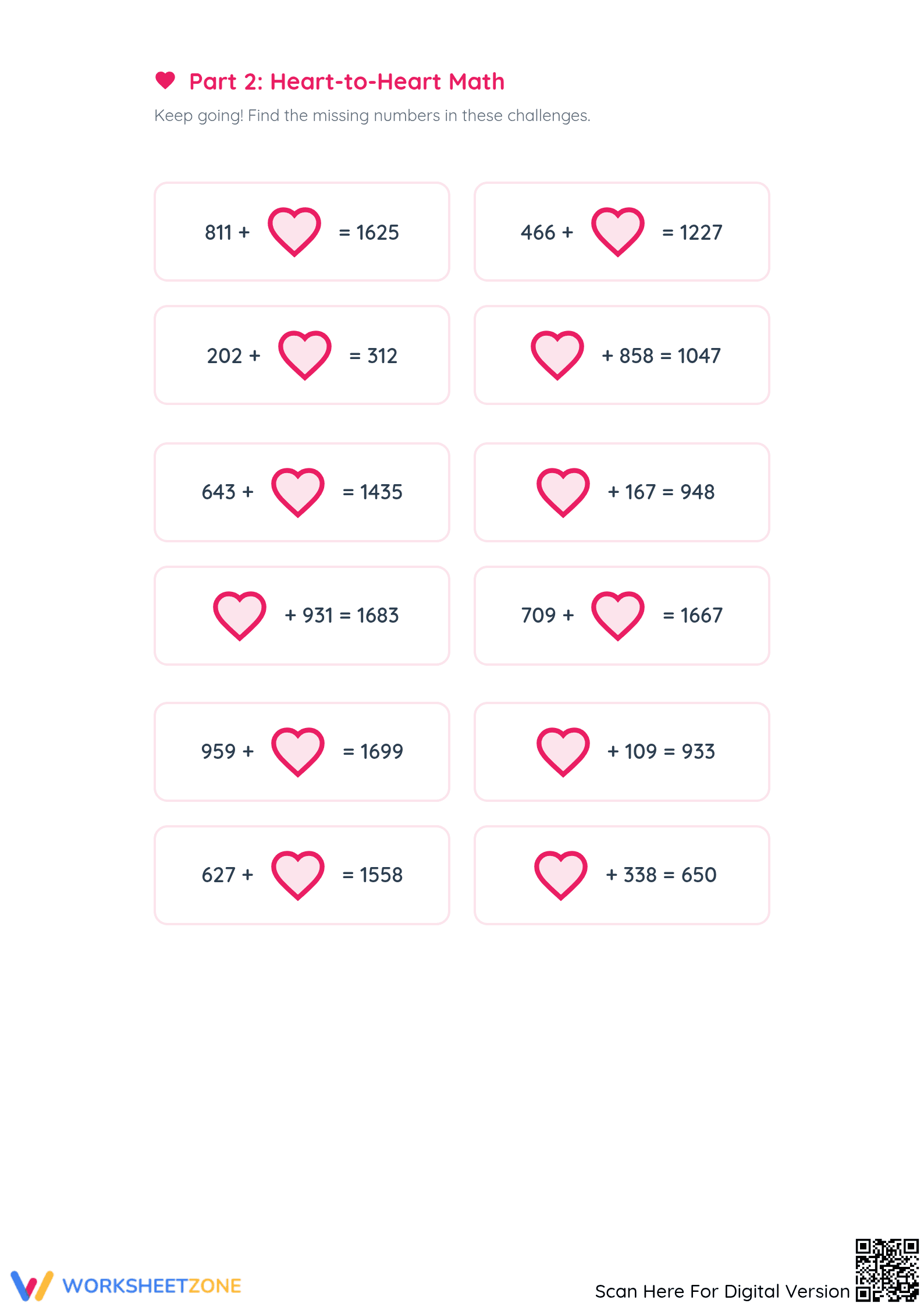
This Math Hearts Addition worksheet provides a comprehensive practice set for upper elementary students to master multi-digit addition and missing addend algebraic reasoning. Students solve equations and logic puzzles to build computational fluency while enjoying a seasonal theme. This resource ensures students can confidently manipulate numbers within 2,000 using standard algorithms and critical thinking strategies.
At a Glance
- Grade: 3–5 · Subject: Math
- Standard:
CCSS.MATH.CONTENT.3.NBT.A.2— Fluently add and subtract within 1000 using strategies and algorithms- Skill Focus: Multi-digit addition and missing addends
- Format: 3 pages · 26 problems · Answer key included · PDF
- Best For: Seasonal math centers and independent practice
- Time: 25–35 minutes
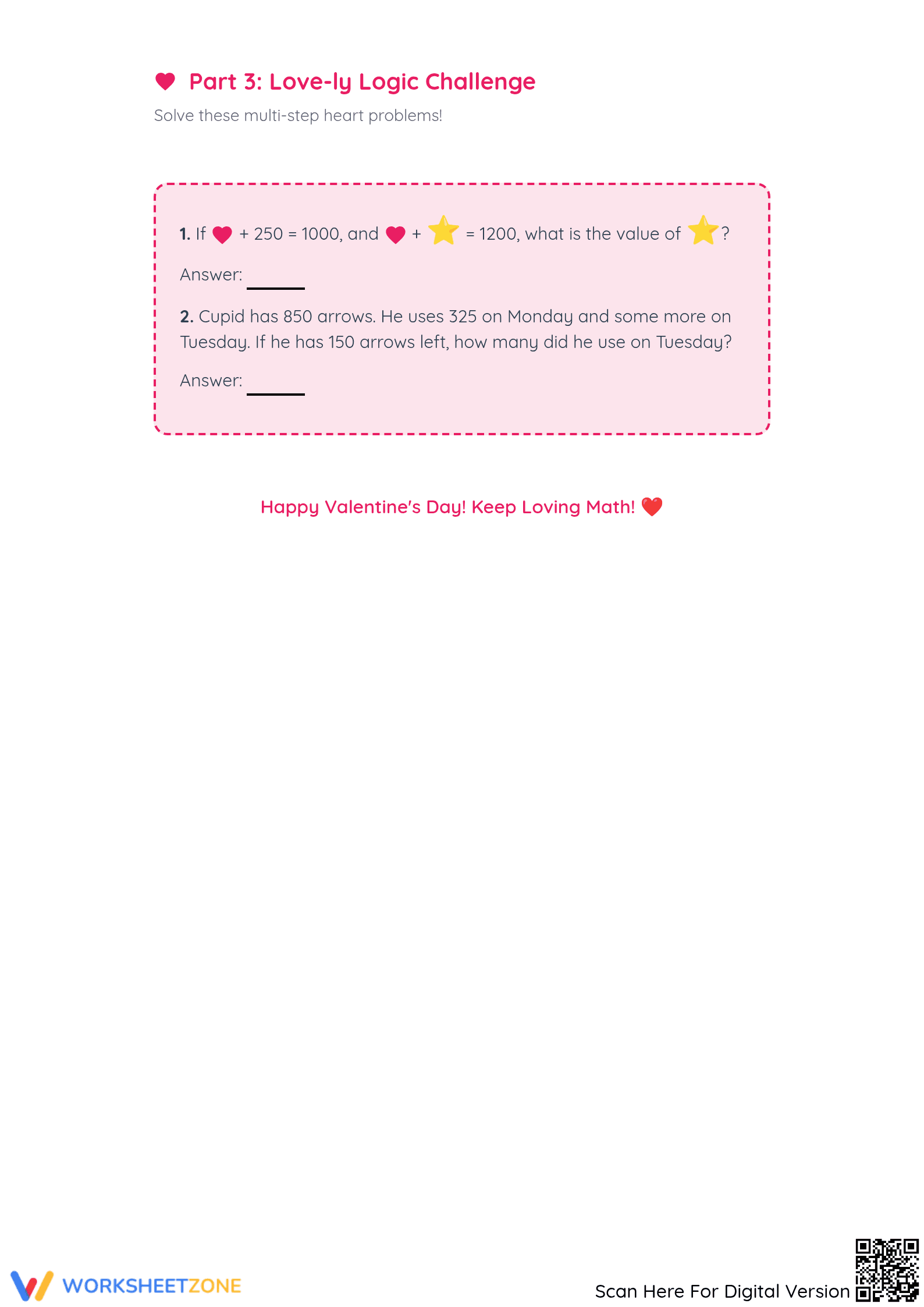
This three-page PDF features 24 missing-addend addition problems categorized into two main practice sections, followed by a dedicated logic challenge page. The layout includes large, clear fonts and heart-shaped placeholders that make solving equations visually engaging. A full answer key is included to facilitate quick grading or student self-correction during math rotations.
Zero-Prep Workflow
Teachers can implement this resource in three simple steps: Print the three-page packet (30 seconds), distribute to students for morning work or centers (1 minute), and review the final logic challenges as a whole group (5 minutes). Total teacher preparation time is under 2 minutes, making it a perfect emergency sub plan or seasonal activity that maintains high academic rigor.
Standards Alignment
The primary standard addressed is CCSS.MATH.CONTENT.3.NBT.A.2, which requires students to fluently add and subtract within 1000 using various strategies. The logic challenges also support CCSS.MATH.CONTENT.3.OA.D.8 for solving multi-step word problems. Both standard codes can be copied directly into lesson plans, IEP goals, or district curriculum mapping tools.
How to Use It
Assign this worksheet during the week of Valentine's Day as a high-interest formative assessment to check addition fluency. For a collaborative twist, have students work in pairs on the "Love-ly Logic Challenge" page to discuss their problem-solving steps. Observe how students handle the missing addends to identify those who may need additional scaffolding with inverse operations. Expected completion time is 30 minutes.
Who It's For
This resource is designed for students in Grades 3, 4, and 5 who are refining their whole-number operations. It is particularly effective for learners who benefit from visual themes to stay engaged with repetitive practice. It pairs naturally with a math passage on the history of Valentine's Day or as a standalone extension for early finishers.
According to a ScienceDirect TpT Analysis (2024), seasonal instructional materials can significantly increase student time-on-task during high-distraction periods like holidays. This Math Hearts Addition worksheet leverages this psychological edge to reinforce CCSS.MATH.CONTENT.3.NBT.A.2 through 26 targeted problems. Research from Fisher & Frey (2014) emphasizes that "gradual release" from simple computation to multi-step logic, as seen in the transition from Part 1 to Part 3, is essential for developing algebraic thinking in the elementary years. By integrating missing-addend problems into a standard addition curriculum, teachers help students bridge the gap between arithmetic and early algebra. This structured approach ensures that students do not merely memorize facts but understand the underlying relationships between numbers, fulfilling the core requirements of rigorous state and national mathematics frameworks.


