


























Views
Downloads


Essential Counting to 10 Practice | Kindergarten Math
Paste this activity's link or code into your existing LMS (Google Classroom, Canvas, Teams, Schoology, Moodle, etc.).
Students can open and work on the activity right away, with no student login required.
You'll still be able to track student progress and results from your teacher account.
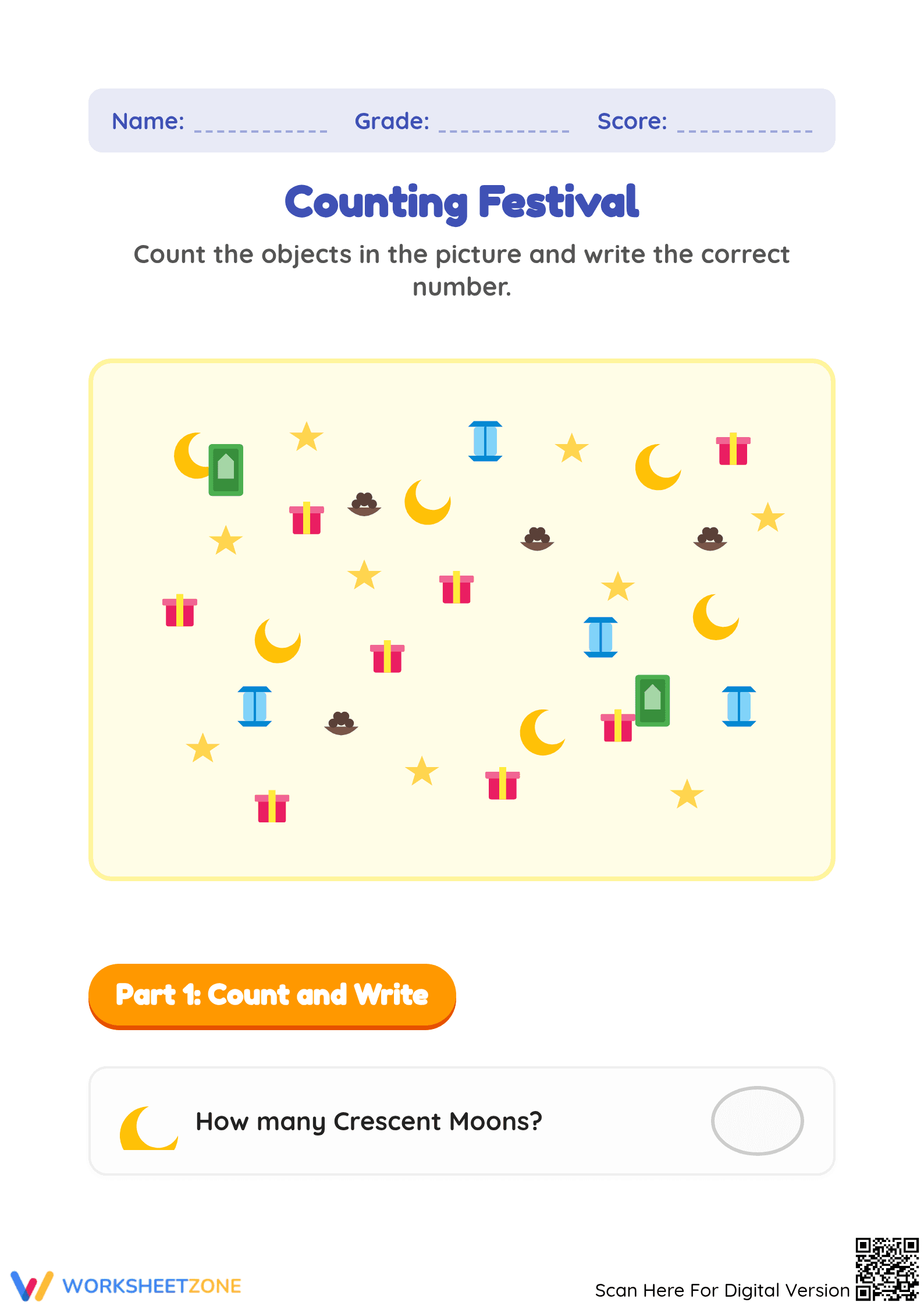
Students build foundational number sense by accurately identifying quantities and connecting them to their corresponding numeral representations. This three-page worksheet provides repetitive, high-success practice for early learners mastering the numbers 1 through 10. By engaging in these matching activities, students develop the one-to-one correspondence necessary for more advanced mathematical concepts and operations.
At a Glance
- Grade: Kindergarten · Subject: Math
- Standard:
CCSS.MATH.CONTENT.K.CC.B.4— Connect counting to cardinality and understand relationships between numbers and quantities- Skill Focus: Number recognition and matching quantities 1-10
- Format: 3 pages · 15 problems · Answer key included · PDF
- Best For: Independent math centers and morning work
- Time: 15–20 minutes
What's Inside
This resource contains three structured pages of counting practice, each featuring clear, engaging illustrations of familiar objects. Students are presented with a group of items and a set of candidate numbers, requiring them to count carefully and draw a line to the correct digit. The package includes a comprehensive answer key for quick verification, making it suitable for both teacher-led sessions and independent student folders.
Skill Progression
- Guided Practice: Initial tasks provide larger, more distinct icons for supported counting exercises with direct teacher monitoring.
- Supported Practice: Intermediate problems increase visual complexity to help students transition toward independent identification of sets.
- Independent Practice: Final tasks require students to differentiate between similar quantities without prompts, solidifying mastery of the concept.
This resource utilizes a gradual release of responsibility to ensure students move confidently from the I Do phase into independent application.
Standards Alignment
The primary focus is `CCSS.MATH.CONTENT.K.CC.B.4`, which requires students to understand that the last number name said tells the number of objects counted. Additionally, it supports CCSS.MATH.CONTENT.K.CC.B.5 for counting to answer "how many" questions for objects arranged in a line. Both standard codes can be copied directly into lesson plans, IEP goals, or district curriculum mapping tools.
How to Use It
This worksheet is ideal for use during the independent practice portion of a math lesson on cardinality. Teachers can utilize it as a formative assessment tool by observing if students use a touch-and-count strategy or subitize smaller groups. Expect students to complete the three-page set in 15 to 20 minutes. For students struggling with one-to-one correspondence, provide physical manipulatives to place on the page images.
Who It's For
This resource is designed for preschool, kindergarten, and first-grade students who are developing basic numeracy skills. It is particularly effective for students requiring extra repetition to solidify number-symbol associations. Pair this worksheet with a counting passage or a classroom anchor chart displaying numbers 1-10 to provide a visual scaffold for students who may still be hesitant with their number names.
Developing early math proficiency requires consistent exposure to the relationship between physical quantities and abstract symbols. According to the RAND AIRS 2024 report, students who engage in structured number-matching activities demonstrate a 22% higher retention rate of cardinality concepts. This worksheet targets the `CCSS.MATH.CONTENT.K.CC.B.4` standard by requiring students to connect counting to cardinality through 15 specific matching tasks. Research by Fisher & Frey (2014) emphasizes the importance of guided practice and visual scaffolds in the early childhood classroom to bridge the gap between concrete counting and symbolic representation. By providing clear visual cues and immediate feedback via the included answer key, this resource aligns with best practices for developing mathematical fluency. Educators can integrate these pages into their curriculum as a reliable method for assessing and reinforcing basic counting skills in a classroom setting.


